North Carolina is home to 8 species of woodpecker that live in forests, parks, and backyards across the state. These birds use their strong beaks to drill into trees for food and nesting sites. Understanding these species helps birdwatchers and nature enthusiasts identify the woodpeckers they see throughout the year.
What Are the 8 Species of Woodpeckers in North Carolina?
North Carolina supports eight woodpecker species that range from small backyard visitors to large forest dwellers. The state’s diverse habitats provide year-round homes for most of these birds.
The eight species of woodpeckers in North Carolina include the Downy Woodpecker, Hairy Woodpecker, Red-bellied Woodpecker, Red-headed Woodpecker, Pileated Woodpecker, Northern Flicker, Yellow-bellied Sapsucker, and Red-cockaded Woodpecker. Each species has unique features that help with identification.
These birds belong to the family Picidae. They share common traits like stiff tail feathers, zygodactyl feet (two toes facing forward and two backward), and shock-absorbing skulls. All woodpeckers in the state drum on trees to communicate and search for insects beneath the bark.
Quick Facts About Woodpeckers In North Carolina
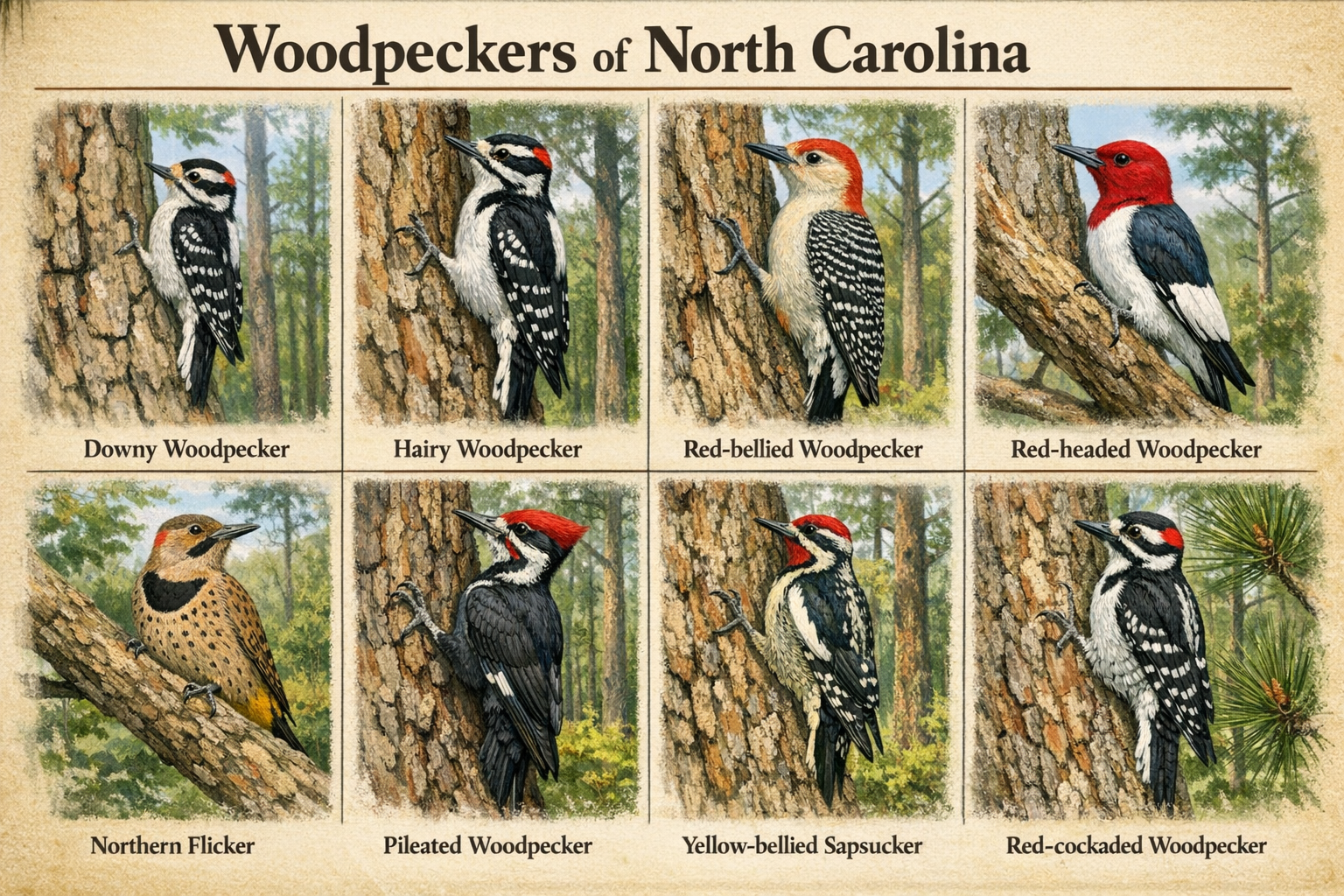
Before we get into the detailed breakdown, here are some essential facts about woodpeckers in the Tar Heel State:
- Total Species Found: 8 confirmed woodpecker species regularly occur in North Carolina
- Common Habitats: Mixed hardwood forests, pine forests, suburban areas with mature trees, parks, and wooded neighborhoods
- Diet Basics: Primarily insects (beetles, ants, larvae), tree sap, nuts, seeds, and occasionally fruit
- Conservation Status: 7 species are stable; 1 species (Red-cockaded Woodpecker) is federally endangered
- Best Time To See Them: Year-round for most species, with peak activity during early morning hours in spring and summer
- Drumming Purpose: Communication, territory marking, and attracting mates—not just feeding behavior
8 Species Of Woodpeckers In North Carolina
North Carolina’s woodpecker population includes both common backyard visitors and rare species that require specific habitats. I’ve selected these 8 species based on confirmed sightings, breeding populations, and migration patterns documented by the North Carolina Wildlife Resources Commission and local birding organizations.
Each species below includes straightforward guidance on identification, habitat preferences, and interesting behaviors that set them apart. This user-focused breakdown will help you quickly identify which woodpecker you’re observing.
1. Downy Woodpecker
Scientific Name: Picoides pubescens
The Downy Woodpecker is the smallest woodpecker in North America and one of the most common species you’ll encounter in North Carolina. Measuring just 6-7 inches long, this tiny bird packs a lot of personality.
Size and Appearance:
The Downy has a distinctive black and white pattern with a white back and spotted wings. Males sport a small red patch on the back of their head, while females lack this marking. Their short, stubby bill (about one-third the length of their head) is the key feature that separates them from their larger cousin, the Hairy Woodpecker.
Habitat in North Carolina:
You’ll find Downy Woodpeckers throughout the entire state, from coastal areas to mountain regions. They adapt well to suburban environments and frequently visit backyard feeders. They prefer deciduous trees and woodland edges but aren’t picky about their surroundings.
Diet:
These small woodpeckers primarily eat insects, especially beetle larvae and ants. They also enjoy suet, sunflower seeds, and peanuts from feeders. In winter, they increase their consumption of plant materials including seeds and berries.
Interesting Fact:
Downy Woodpeckers often join mixed-species flocks with chickadees, nuthatches, and titmice during winter months. This social behavior provides extra protection from predators and helps them find food more efficiently.
2. Hairy Woodpecker
Scientific Name: Picoides villosus
The Hairy Woodpecker looks remarkably similar to the Downy but is noticeably larger and prefers deeper forest habitats. This medium-sized woodpecker measures 9-11 inches in length.
Identification Differences from Downy:
The Hairy Woodpecker has a longer bill that’s nearly equal to the length of its head—this is the most reliable way to tell them apart. Their outer tail feathers are pure white without the black bars or spots you’ll see on a Downy. The Hairy also has a louder, sharper call that sounds like a strong “peek!” compared to the Downy’s softer notes.
Forest Preference:
Hairy Woodpeckers favor mature forests with larger trees. In North Carolina, they’re more common in mountain regions and extensive forest tracts. While they occasionally visit suburban areas, they’re less frequent backyard visitors than Downys.
Behavior:
These woodpeckers are more solitary than Downys and tend to forage higher up in trees. They excavate deeper holes when searching for wood-boring beetles and can remove large chunks of bark. Their drumming is louder and longer than the Downy’s, making it easier to hear from a distance.
3. Red-bellied Woodpecker
Scientific Name: Melanerpes carolinus
Despite its name, the Red-bellied Woodpecker is better known for the bright red cap that covers its head and neck. This medium-sized bird (9-10.5 inches) is one of the most vocal woodpeckers in North Carolina.
Color Pattern Explained:
Males have red coloring from their bill all the way down to the back of their neck. Females have red only on the neck and back of the head. Both sexes show a pale reddish wash on the belly (hence the name), though this is often hard to see in the field. Their backs feature striking black and white horizontal stripes, creating a “zebra-striped” appearance.
Common Locations in NC:
Red-bellied Woodpeckers thrive throughout North Carolina, especially in the Piedmont and Coastal Plain regions. They’re comfortable in suburban settings and frequently visit bird feeders. You’ll often spot them in oak-hickory forests, swamps, and wooded residential areas.
Call Description:
Their most common call is a rolling “churr-churr-churr” that sounds almost like a soft rattle. They also make a “kwirr” call and drum frequently during breeding season. These vocalizations make them one of the easier woodpeckers to locate by sound alone.
4. Red-headed Woodpecker
Scientific Name: Melanerpes erythrocephalus
The Red-headed Woodpecker is one of the most stunning birds in North Carolina, with its completely crimson head that’s impossible to mistake for any other species.
Distinct Head Coloring:
Adults have an entirely bright red head and neck—no other North American woodpecker shares this feature. Their body is crisp white below and solid black on the back and wings, with large white wing patches visible in flight. Juveniles have brown heads and can be confused with other species until they mature.
Conservation Status in North Carolina:
Red-headed Woodpeckers have experienced population declines across their range, including North Carolina. They’re considered a species of special concern in the state. Habitat loss, especially the removal of dead trees (which they need for nesting), has contributed to their decline.
Nesting Behavior:
Unlike most woodpeckers that excavate new cavities each year, Red-headed Woodpeckers often reuse nest sites. They’re also one of the few woodpecker species that regularly cover their food storage holes with bark or wood chips to hide their cached nuts and insects from other birds.
5. Northern Flicker
Scientific Name: Colaptes auratus
The Northern Flicker breaks the typical woodpecker mold with its unusual ground-feeding behavior and distinctive markings. At 11-12 inches, it’s one of the larger woodpeckers in the state.
Ground-Feeding Behavior:
Unlike other woodpeckers that spend most of their time on tree trunks, Flickers often forage on the ground for ants and beetles. You’ll frequently see them hopping across lawns and fields, using their slightly curved bill to probe the soil. This behavior makes them more visible than many other woodpecker species.
Migration Patterns:
In North Carolina, Northern Flickers are year-round residents, though their numbers increase during winter when birds from northern populations migrate south. You’ll see more Flickers from October through March as these winter visitors arrive.
Unique Markings:
The “Yellow-shafted” form found in North Carolina shows bright yellow underwings and tail visible during flight. They have a brown, barred back, a black chest crescent, and spotted underparts. Males have a black “mustache” stripe that females lack. Their white rump patch is highly visible when they fly away from you.
6. Pileated Woodpecker
Scientific Name: Dryocopus pileatus
The Pileated Woodpecker is the largest woodpecker species in North Carolina and one of the most impressive birds you’ll ever see in the wild. These crow-sized birds measure 16-19 inches in length.
Largest Woodpecker in NC:
With their massive size, flaming red crest, and powerful bill, Pileated Woodpeckers are unmistakable. Both males and females have red crests, but males also sport red “mustache” stripes while females have black ones. Their mostly black body shows white stripes down the neck and white underwings visible in flight.
Forest Habitat:
Pileated Woodpeckers require mature forests with large trees, both living and dead. In North Carolina, they’re found throughout the state but are most common in areas with extensive forest cover. They need territories of 150-200 acres, so they’re less common in fragmented habitats.
Role in Ecosystem:
These woodpeckers are ecosystem engineers. The large rectangular holes they excavate while searching for carpenter ants become homes for dozens of other species, including Wood Ducks, owls, bats, and flying squirrels. A single Pileated Woodpecker can create habitat for an entire community of wildlife.
7. Yellow-bellied Sapsucker
Scientific Name: Sphyrapicus varius
The Yellow-bellied Sapsucker is North Carolina’s only migratory woodpecker species, visiting the state during fall and winter months.
Seasonal Visitor Explanation:
Unlike the other species on this list, Yellow-bellied Sapsuckers don’t breed in North Carolina (except rarely in high mountain areas). They arrive in September and October, spend the winter months here, and depart by April or May to breed in northern forests and mountains.
Sap-Feeding Behavior:
Sapsuckers drill neat horizontal rows of small holes in tree bark, then return regularly to feed on the sap that oozes out. They also eat insects attracted to the sap. This unique feeding strategy sets them apart from all other woodpeckers. Their holes are often used by hummingbirds, warblers, and other birds that also enjoy the sweet sap.
Tree Damage Myths Explained:
Many people worry that sapsucker holes harm trees, but healthy trees can easily tolerate this damage. The holes rarely girdle trees or cause serious problems. In fact, the relationship between sapsuckers and trees has existed for thousands of years. Only stressed or already-diseased trees might suffer from extensive drilling.
Appearance:
These medium-sized woodpeckers (7-8.5 inches) have a black and white face pattern, red forehead (males also have a red throat), and a pale yellow wash on the belly. Their backs show white barring, and they have a bold white wing stripe visible when perched.
8. Red-cockaded Woodpecker
Scientific Name: Picoides borealis
The Red-cockaded Woodpecker is North Carolina’s rarest and most conservation-dependent woodpecker species. This small bird (7-9 inches) requires very specific habitat conditions.
Endangered Status:
Listed as federally endangered since 1970, the Red-cockaded Woodpecker has experienced severe population declines due to habitat loss. North Carolina hosts some of the most important remaining populations, particularly in the Sandhills region and coastal areas.
Longleaf Pine Habitat:
These woodpeckers are specialists that require living longleaf pine trees infected with red heart fungus for nesting. The fungus softens the wood’s interior while leaving the exterior hard, creating ideal cavity conditions. They also need open, park-like forest structure maintained by frequent fire conditions that have become rare across the Southeast.
Conservation Efforts in North Carolina:
Multiple organizations work to protect Red-cockaded Woodpecker populations in North Carolina. Fort Bragg (now Fort Liberty), Croatan National Forest, and Sandhills Game Land host active management programs. These efforts include prescribed burning, cavity installation, and forest thinning to create suitable habitat.
Identification:
Red-cockaded Woodpeckers have black and white horizontal stripes on their backs, large white cheek patches, and a black cap. The “red cockade” (small red streak on the male’s head) is rarely visible in the field. They’re best identified by their habitat, social behavior (living in family groups), and the distinctive resin wells they create around cavity entrances.
Comparison Of The 8 Species Of Woodpeckers In North Carolina
This comparison table provides a quick reference for identifying and understanding the differences between all 8 species:
| Species Name | Size (inches) | Primary Habitat | Presence | Conservation Status |
|---|---|---|---|---|
| Downy Woodpecker | 6-7 | Forests, suburbs, parks | Year-round | Stable |
| Hairy Woodpecker | 9-11 | Mature forests | Year-round | Stable |
| Red-bellied Woodpecker | 9-10.5 | Forests, suburbs, swamps | Year-round | Stable |
| Red-headed Woodpecker | 8-9 | Open woodlands, dead trees | Year-round | Declining (Special Concern) |
| Northern Flicker | 11-12 | Open areas, forest edges | Year-round | Stable |
| Pileated Woodpecker | 16-19 | Mature forests | Year-round | Stable |
| Yellow-bellied Sapsucker | 7-8.5 | Various forests | Winter only | Stable |
| Red-cockaded Woodpecker | 7-9 | Longleaf pine forests | Year-round | Endangered |
This table gives you a quick snapshot to compare species at a glance. Notice that size alone can help narrow down your identification—if you see a crow-sized woodpecker, it’s definitely a Pileated. If it’s sparrow-sized, you’re looking at a Downy.
Where Woodpeckers Live In North Carolina
Understanding habitat preferences is essential for finding specific woodpecker species. North Carolina’s geographic diversity creates ideal conditions for multiple woodpecker species, but each has distinct preferences.
Forest Types:
The state’s three main regions—Mountains, Piedmont, and Coastal Plain—each support different woodpecker communities. Mountain forests with mixed hardwoods and conifers host all species except Red-cockaded Woodpeckers. The Piedmont’s oak-hickory forests are excellent for Red-bellied, Downy, Hairy, and Pileated Woodpeckers. The Coastal Plain’s pine forests are critical for Red-cockaded Woodpeckers and also support healthy populations of other species.
Urban vs Rural Areas:
Several species adapt well to human-modified landscapes. Downy Woodpeckers, Red-bellied Woodpeckers, and Northern Flickers regularly visit suburban yards with mature trees. They’ll use nest boxes, feed at suet feeders, and excavate cavities in dead tree limbs. Pileated Woodpeckers increasingly appear in suburban areas if sufficient forest patches remain nearby.
In contrast, Hairy Woodpeckers and Red-cockaded Woodpeckers require more extensive forest tracts and rarely venture into developed areas.
Pine Forests vs Hardwood Forests:
Red-cockaded Woodpeckers exclusively use pine forests, particularly longleaf pine ecosystems. Yellow-bellied Sapsuckers prefer hardwoods and mixed forests where they can drill sap wells. Pileated Woodpeckers thrive in both but need large trees regardless of species. The smaller woodpeckers (Downy and Hairy) use both forest types but may show seasonal preferences based on food availability.
Dead Trees and Snags:
All woodpecker species depend on dead or dying trees for at least part of their life cycle. These “snags” provide nesting sites, foraging opportunities, and drumming posts. Property owners who leave dead trees standing (when safe to do so) create valuable habitat for woodpeckers and the dozens of other species that depend on woodpecker cavities.
What Do Woodpeckers Eat In North Carolina?
Woodpecker diets vary by species and season, but all share a preference for high-protein foods during breeding season and more varied diets during winter.
Insects:
Wood-boring beetle larvae, carpenter ants, bark beetles, and other insects make up the bulk of most woodpeckers’ diets. Pileated Woodpeckers specialize in carpenter ants and can consume thousands in a single day. Downy and Hairy Woodpeckers extract beetle larvae from beneath bark. Northern Flickers focus on ground-dwelling ants, using their long tongues to lap them up.
Tree Sap:
Yellow-bellied Sapsuckers are the sap specialists, but other species also consume sap opportunistically. Red-bellied Woodpeckers and Downy Woodpeckers often visit sapsucker wells to drink the nutritious fluid. Sap provides quick energy, especially during migration and cold weather.
Seeds and Nuts:
During fall and winter, many woodpecker species increase their consumption of plant materials. Red-headed Woodpeckers cache acorns in bark crevices for winter use. Red-bellied Woodpeckers eat various nuts, fruits, and seeds. Northern Flickers consume berries and seeds when insects are scarce.
Seasonal Food Changes:
Spring and summer diets focus heavily on insects, particularly during nesting when adults need to feed growing chicks protein-rich food. Fall brings a shift toward nuts and acorns. Winter diets become more varied, with woodpeckers visiting feeders more frequently and relying on cached food. This seasonal flexibility helps woodpeckers survive year-round in North Carolina’s variable climate.
Backyard Feeding:
If you want to attract woodpeckers to your yard, offer suet (especially varieties with insects), peanuts (whole or shelled), sunflower seeds, and mealworms. Suet feeders attract Downy, Hairy, Red-bellied, and occasionally Pileated Woodpeckers. Northern Flickers prefer ground feeding areas or platform feeders.
How To Identify Woodpeckers In North Carolina
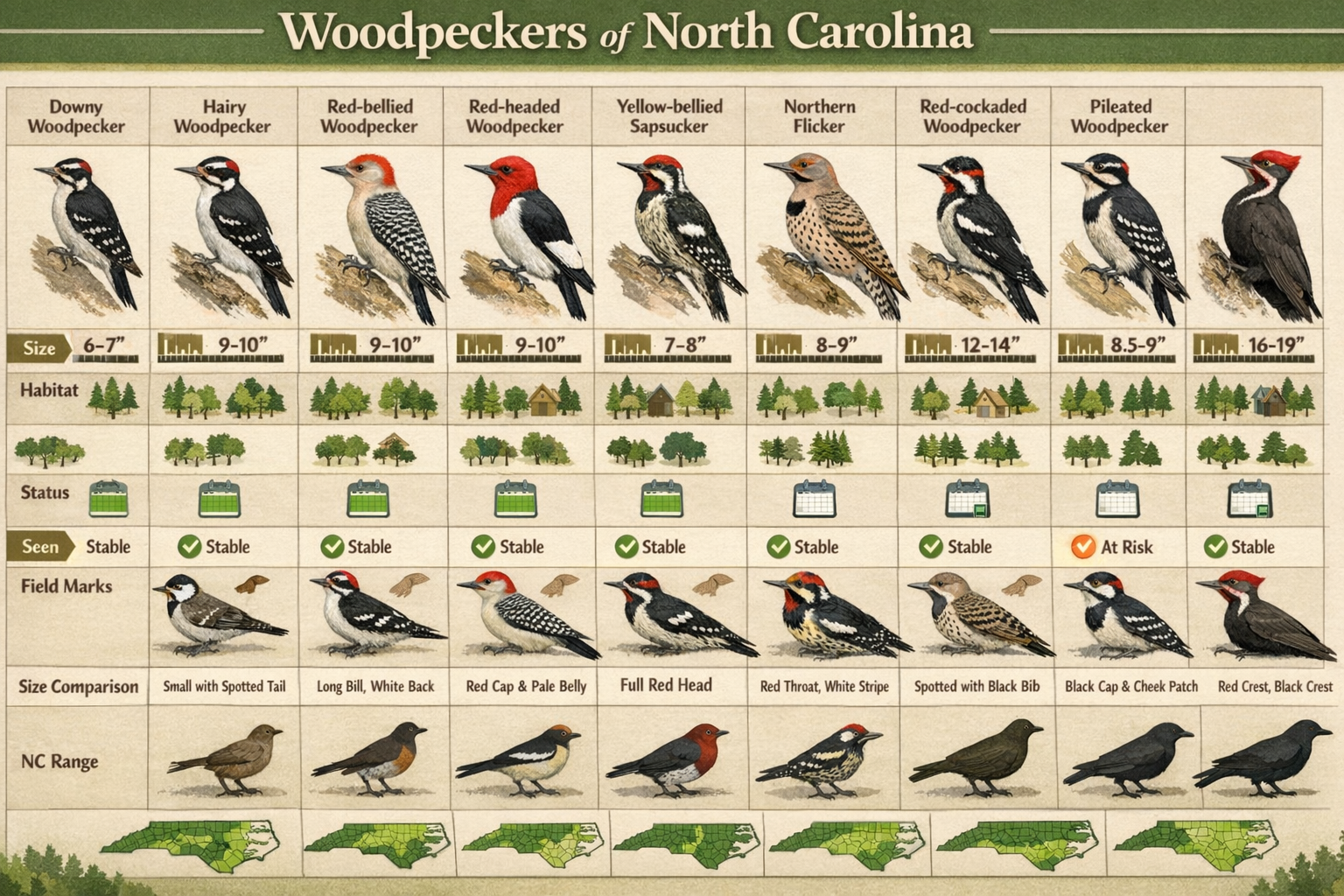
Identifying woodpeckers becomes much easier when you know which features to focus on. Here’s my step-by-step clarity approach to woodpecker identification:
Size Comparison:
Start with size—it immediately narrows your options. Compare the bird to familiar species:
- Sparrow-sized (6-7 inches): Downy Woodpecker
- Robin-sized (8-10 inches): Red-headed, Red-bellied, Hairy, Yellow-bellied Sapsucker, Red-cockaded
- Jay-sized (11-12 inches): Northern Flicker
- Crow-sized (16-19 inches): Pileated Woodpecker
Color Patterns:
After size, look at color patterns:
- Completely red head: Red-headed Woodpecker (adult)
- Red only on back of head/neck: Red-bellied Woodpecker
- Large red crest: Pileated Woodpecker
- Small red patch on back of head: Male Downy or Hairy Woodpecker
- Red forehead and throat: Male Yellow-bellied Sapsucker
- White cheek patches with black cap: Red-cockaded Woodpecker
Drumming Sounds:
Each species has a distinctive drumming pattern:
- Pileated: Loud, slow, irregular pattern that speeds up then slows down
- Hairy: Long, steady roll lasting about 1.5 seconds
- Downy: Shorter roll, about 1 second, slightly slower than Hairy
- Red-bellied: Shorter, more irregular drumming
- Yellow-bellied Sapsucker: Irregular rhythm with distinctive stuttering pattern (often described as Morse code)
Flight Style:
Woodpeckers have an undulating flight pattern—flap, flap, glide, flap, flap, glide—creating a wave-like motion. Northern Flickers show bright yellow underwings in flight. Pileated Woodpeckers look almost prehistoric with their large size and slow, powerful wingbeats.
Behavior Clues:
- Foraging on the ground: Likely a Northern Flicker
- Rows of small holes in tree bark: Yellow-bellied Sapsucker feeding wells
- Large rectangular excavations: Pileated Woodpecker foraging sites
- Visiting suet feeders: Downy, Hairy, or Red-bellied Woodpecker
- In longleaf pine with resin around cavity: Red-cockaded Woodpecker
Best Time To Spot Woodpeckers In North Carolina
Timing your bird-watching efforts can dramatically increase your success rate when looking for woodpeckers.
Seasonal Activity:
Spring (March-May): This is peak woodpecker activity season. Males drum frequently to establish territories and attract mates. Cavity excavation is in full swing, and birds are highly vocal. This is the absolute best time to find and identify woodpeckers.
Summer (June-August): Adults are busy feeding nestlings and fledglings. Activity levels remain high, though drumming decreases after pairs bond. Young birds leave nests in late summer, making family groups more visible.
Fall (September-November): Yellow-bellied Sapsuckers arrive from the north. Woodpeckers begin caching food for winter. Activity remains steady as birds prepare for cold weather.
Winter (December-February): Most species remain active but may be quieter. This is when woodpeckers visit feeders most regularly. Yellow-bellied Sapsuckers are present throughout the state. Cold, clear days can be excellent for woodpecker watching as birds need to feed actively to maintain body heat.
Time of Day:
Early morning (first 2-3 hours after sunrise) is the most productive time for finding woodpeckers. They’re most vocal and active during this period. A secondary activity peak occurs in late afternoon before sunset. Midday can be slower, especially during hot summer months.
Birding Tips:
- Listen first: Woodpecker calls and drumming often reveal their presence before you see them
- Look for movement: Watch for the characteristic hitching motion as they climb tree trunks
- Check dead trees: Snags attract multiple woodpecker species
- Follow mixed flocks: In winter, Downy Woodpeckers often travel with chickadees and nuthatches
- Visit varied habitats: Spend time in both mature forests and forest edges to maximize species diversity
- Be patient: Woodpeckers often work one area thoroughly before moving on
Best Locations in North Carolina:
For the highest woodpecker diversity, visit these areas:
- Sandhills Game Land (Red-cockaded Woodpecker specialist site)
- Great Smoky Mountains National Park (excellent for Pileated, Hairy, and others)
- Croatan National Forest (Red-cockaded and coastal species)
- William B. Umstead State Park (near Raleigh, great variety)
- Pisgah National Forest (mountain species)
Are Woodpeckers Protected In North Carolina?
Understanding the legal protections for woodpeckers is important for homeowners, landowners, and anyone who encounters these birds.
State and Federal Protections:
All woodpecker species in North Carolina are protected under the Migratory Bird Treaty Act, a federal law that makes it illegal to harm, harass, or kill native birds without proper permits. This protection extends to their nests, eggs, and young.
You cannot legally:
- Kill or harm woodpeckers
- Destroy active nests
- Remove eggs
- Capture or keep woodpeckers as pets
- Disturb nesting sites during breeding season
These protections apply even when woodpeckers cause property damage. If you’re experiencing issues with woodpeckers damaging your home, you must use non-lethal deterrents or obtain special permits through the U.S. Fish and Wildlife Service.
Endangered Species Explanation:
The Red-cockaded Woodpecker receives additional protection under the Endangered Species Act. This federal law provides even stronger protections and makes it illegal to harm the birds or their habitat. Critical habitat areas are designated and managed specifically for this species.
In North Carolina, damaging longleaf pine forests that support Red-cockaded Woodpeckers can result in significant legal penalties. Conservation easements and management agreements help private landowners protect these birds while maintaining their property rights.
How Homeowners Can Help:
You can support woodpecker conservation through these actionable steps:
Leave dead trees standing when safe to do so they’re essential woodpecker habitat
Avoid pesticide use that eliminates the insect’s woodpeckers need for food
Provide suet feeders during winter months to supplement natural food sources
Install nest boxes designed for smaller woodpecker species
Maintain mature trees on your property older trees support more woodpeckers
Use non-lethal deterrents if woodpeckers damage your home (reflective tape, netting, or noise devices)
Support conservation organizations working to protect woodpecker habitats
Report Red-cockaded Woodpecker sightings to the NC Wildlife Resources Commission
Participate in citizen science programs like eBird to help track woodpecker populations
Frequently Asked Questions
How many woodpecker species live in North Carolina?
North Carolina is home to 8 regular woodpecker species: Downy Woodpecker, Hairy Woodpecker, Red-bellied Woodpecker, Red-headed Woodpecker, Northern Flicker, Pileated Woodpecker, Yellow-bellied Sapsucker, and Red-cockaded Woodpecker. Seven of these are year-round residents, while the Yellow-bellied Sapsucker only visits during winter months.
What is the largest woodpecker in North Carolina?
The Pileated Woodpecker is the largest woodpecker in North Carolina, measuring 16-19 inches in length with a wingspan of up to 30 inches. These crow-sized birds are unmistakable with their flaming red crests, black bodies, and white stripes. They require mature forests and are known for creating large rectangular holes in trees while searching for carpenter ants.
Are woodpeckers harmful to trees?
Healthy trees can easily tolerate woodpecker activity. Woodpeckers actually benefit forests by controlling insect populations, particularly wood-boring beetles that can damage trees. The holes they create become homes for dozens of other wildlife species. However, woodpeckers may target already-stressed or diseased trees, and their activity can sometimes indicate underlying tree health problems. Yellow-bellied Sapsucker wells rarely cause serious harm to healthy trees.
Can you attract woodpeckers to your yard?
Yes! You can attract woodpeckers by offering suet feeders (especially during winter), providing peanuts and sunflower seeds, leaving dead trees or limbs standing when safe, planting native trees that produce nuts and berries, avoiding pesticides that eliminate insect food sources, and installing woodpecker nest boxes. Downy, Hairy, Red-bellied, and Northern Flicker are the species most likely to visit suburban yards.
Is the red-cockaded woodpecker endangered?
Yes, the Red-cockaded Woodpecker has been federally endangered since 1970. This species requires very specific habitat—living longleaf pine trees with red heart fungus in open, fire-maintained forests. Habitat loss caused severe population declines throughout the Southeast. North Carolina hosts important populations in areas like Fort Liberty, Croatan National Forest, and the Sandhills region, where active conservation programs work to protect and expand their habitat.
What’s the difference between a Downy and Hairy Woodpecker?
The most reliable difference is bill size—Hairy Woodpeckers have bills nearly equal to their head length, while Downy Woodpeckers have short, stubby bills about one-third their head length. Hairy Woodpeckers are also larger overall (9-11 inches vs. 6-7 inches), have pure white outer tail feathers without spots, and produce louder, sharper calls. Hairy Woodpeckers prefer deeper forests, while Downys readily adapt to suburban areas.
Do woodpeckers migrate?
Most woodpecker species in North Carolina are year-round residents and do not migrate. The one exception is the Yellow-bellied Sapsucker, which breeds in northern forests and mountains, then migrates to North Carolina for the winter months (September through April). Northern Flicker populations increase during winter as birds from northern areas move south, though many Flickers also remain in North Carolina year-round.
Why do woodpeckers drum on houses?
Woodpeckers drum on houses for three main reasons: territorial communication (especially in spring), attracting mates, or searching for insects in wood siding. Metal surfaces like gutters and vents produce loud sounds that carry far, making them attractive drumming sites for territorial males. If a woodpecker is actually excavating holes (not just drumming), it may be creating a nest cavity or hunting for insects—which could indicate an insect infestation in your siding.
Conclusion
The 8 species of woodpeckers in North Carolina represent a fascinating cross-section of bird diversity, from the tiny Downy Woodpecker that visits backyard feeders to the impressive Pileated Woodpecker that shapes entire forest ecosystems. Each species brings unique behaviors, habitat requirements, and conservation needs that make them worth protecting and observing.
Understanding these birds goes beyond simple identification—it connects you to the health of North Carolina’s forests and the complex web of life they support. Whether you’re watching a Red-bellied Woodpecker at your suet feeder or searching for the rare Red-cockaded Woodpecker in longleaf pine forests, each encounter offers a chance to appreciate these remarkable birds.
Your next steps:
Start paying attention to the woodpeckers in your area. Listen for their distinctive calls and drumming patterns. Notice which species visit your neighborhood and what trees they prefer. Consider leaving dead limbs standing (when safe) to provide habitat. Report your sightings to eBird to contribute to scientific understanding of woodpecker populations.
Most importantly, share your knowledge with others. The more people understand and appreciate woodpeckers, the better chance these species have for long-term survival. North Carolina’s woodpeckers need forests, dead trees, and people who care enough to protect their habitats.
The drumming you hear in the woods isn’t just noise it’s the sound of a healthy forest ecosystem at work. By learning to identify and protect the 8 species of woodpeckers in North Carolina, you’re taking part in conservation that matters.