The ruby-throated hummingbird is the only hummingbird that breeds regularly across eastern North America. It is tiny, fast, and easy to recognize once you know what to look for. Males are known for the red throat patch that gives the species its name, but females and young birds look quite different. This guide covers how to identify the species, where it lives, how it migrates, what it eats, how it behaves, how it breeds, and how to attract it to your yard.
What does a ruby-throated hummingbird look like?
The adult male has metallic green upperparts, grayish underparts, and a black eye bar. Its most distinctive feature is an iridescent red throat. Depending on the light and the angle you see it from, the throat can look darker or even black. Males have a forked tail. Audubon describes the male’s back as metallic green and its tail as forked and black.
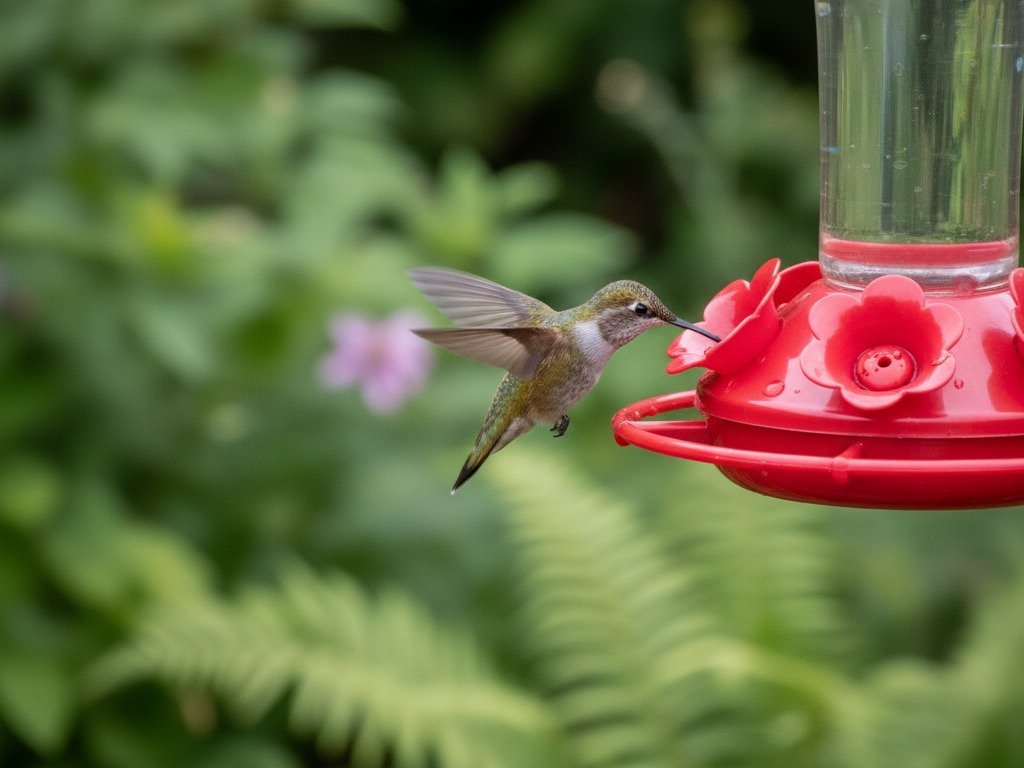
The female looks quite different. She has metallic green upperparts and grayish underparts, but she lacks the red throat. Her throat is whitish with faint green spots. Birdzilla notes that the female’s tail is squared rather than forked, and she is slightly larger than the male. Audubon describes her throat as grayish white and says her outer tail feathers have white tips.
Immature males look more like females at first. Juveniles also resemble females, with green upperparts, whitish underparts, and a pale throat with small green dots. Some young males begin to show a few red spots on the throat as they mature.
Adults measure 2.8 to 3.5 inches (7 to 9 centimeters) long, with a wingspan of 3.1 to 4.3 inches (8 to 11 centimeters). Audubon gives a weight of 0.1 to 0.2 ounces (2 to 6 grams). Birds of the World gives average masses of about 3.0 grams for males and 3.5 grams for females. Birdzilla says the species weighs less than a dime, and it describes the black bill as slender and slightly downcurved.
Because the male and female look different, and because other small hummingbirds can look similar, range is often the best clue. The ruby-throated hummingbird is the only hummingbird that breeds regularly in the east. Audubon describes the species as best identified by range.
Where do they live?
The breeding range extends from southern Canada to the Gulf of Mexico, and from the Atlantic coast west to the Great Plains. In the winter, most birds move to southern Mexico and Central America. Birdzilla also notes that some birds remain at the tip of Florida in winter.
Vassar College’s sensory ecology lab describes the species as preferring woodland habitats, especially mixed, deciduous, and pine forests in summer and tropical forests in winter. The species is flexible, though. It also uses scrub, marshes, open fields, and human-made places such as gardens, orchards, and fencerows.
Birdzilla lists open deciduous and pine forests, open woodlands, forest edges, gardens, meadows, and coastal areas. In summer, the species is often found where flowering plants are plentiful, because nectar is its main food.
How do they migrate?
Ruby-throated hummingbirds make a long trip for such a small bird. Birdzilla says that many birds fly straight across the Gulf of Mexico, a nonstop flight of about 500 miles. Birds of the World describes the Gulf crossing as part of a round trip of more than 1,600 kilometers (about 1,000 miles) during fall and spring migration.
Not every bird makes that crossing. Audubon notes that some birds travel along the Texas coast instead. Either way, the trip depends on fuel. Along the route, birds rely heavily on nectar-rich flowers and backyard feeders to fuel their flights.
Timing follows a seasonal pattern. Birdzilla says males arrive first in spring, usually in March and April, to claim territories before the females appear. In late summer and early fall, adults and their young begin to move south, and most birds have left the United States by October. Vassar notes that the species’ migration patterns track the blooming of its preferred flowers.
What do they eat?
Nectar is the main energy source. Ruby-throated hummingbirds are drawn to red, orange, and pink tubular flowers. Birdzilla lists cardinal flower, honeysuckle, trumpet creeper, bee balm, red buckeye, red morning glory, jewelweed, columbine, and fire pink as examples. They use a long, slender bill and a tongue that extends like a tube to reach nectar deep inside a flower.
Nectar alone does not supply enough protein, so the birds also eat insects and spiders. Vassar lists mosquitoes, flies, bees, spiders, and caterpillars. Birdzilla adds gnats and fruit flies. The birds catch insects in midair, which is called hawking, or pick them from leaves and spider webs, which is called gleaning. Vassar notes that the bird can unhinge its lower jaw to swallow larger prey.
When nectar is scarce, they sometimes feed at sap wells that Yellow-bellied Sapsuckers drill into trees. They also visit feeders that hold sugar water.
How do they behave?
Ruby-throated hummingbirds are territorial throughout the year, especially during the breeding season. Vassar says a bird spaces itself between about 15 and 70 meters from its neighbors, depending on how much food is available. Interactions outside of mating, brooding, and territorial disputes are rare.
When a male defends his territory, he may jab at rivals with his beak, but he usually relies on calls to mark the boundary. Although the species is not a songbird, males give a series of chips at dawn. Birdzilla says both sexes also give a “chee-dit” call. During courtship, the male’s wings make a rapid tik-tik sound.
How do they breed?
Ruby-throated hummingbirds do not form lasting pairs. Vassar notes that both sexes are polygamous from year to year. Males establish territories and perform courtship displays. The male flies back and forth in a broad arc in front of the female, showing his red throat. Audubon describes the display as a wide U-shaped pendulum arc, with a whirring sound on each dive. If the female is interested, she perches, and the male flies side to side in front of her. Birdzilla says that after mating, the male leaves the female to build the nest and raise the young on her own.
The female builds a small cup nest, about two inches across, usually on a downward-sloping branch concealed by leaves above. Birdzilla says nests are usually 10 to 40 feet above the ground, and Audubon gives a typical height of 10 to 20 feet. The nest is made from soft plant material, such as fine grasses and plant fibers, bound together with spider silk so that it stays flexible as the young grow. She lines it with plant down, such as thistle or dandelion. Vassar adds that nests may also contain moss, ferns, and pine resin. Audubon says the outside is camouflaged with lichens and dead leaves.
Females usually lay two white eggs. Birdzilla describes the eggs as tiny, about 0.5 to 0.6 inches long, and says the female incubates them for 10 to 14 days. Audubon gives a range of 12 to 14 days. The female feeds the young by regurgitating a mix of insects and nectar, and Birdzilla says she feeds them one to three times an hour.
Young birds usually leave the nest about 18 to 22 days after hatching, according to Birdzilla and Audubon, which gives 20 to 22 days. Most pairs raise one or two broods each year, and a female may occasionally raise a third.
How long do they live?
Birdzilla reports that the average ruby-throated hummingbird lives 3 to 5 years. It also reports that the oldest known bird lived 9 years and 2 months. Longer lifespans are possible but rare. To compare with other species, see which bird lives the longest.
Some surprising facts
Birdzilla says the species has a high heart rate. A resting bird’s heart beats about 225 times per minute, and this rises to about 1,250 beats per minute in flight. It also says the species has between 900 and 950 feathers, which is among the fewest of any bird species. These figures come from Birdzilla and have not been checked against a second source in this article.
How to attract them to your yard
Plant red, orange, and pink tubular flowers, such as trumpet creeper, bee balm, and cardinal flower. Birdzilla specifically recommends red flowers. Choose plants that bloom at different times so nectar is available from spring through fall. Vassar notes that many of these flowers depend on hummingbirds for pollination. For more planting ideas, see our guide to the best flowers to attract birds.
A feeder can help, especially during migration. To make nectar, dissolve one-quarter cup of white sugar in one cup of boiling water, then let it cool. That makes a 1:4 sugar-to-water ratio. Audubon advises against honey and red food coloring, and it recommends cleaning the feeder often. For a step-by-step approach to yard setup, read How to Attract Hummingbirds to Your Yard.
How do they differ from similar hummingbirds?
Females can be hard to tell apart from other species, especially Black-chinned, Broad-tailed, and Anna’s hummingbirds. Birdzilla says the ranges of the Black-chinned and ruby-throated hummingbirds overlap only in Texas. A male Black-chinned has a black throat with a purple base, which can look dark in poor light. Check the throat color when you can, since a red throat points to the ruby-throated.
When you see a perched female, look at her wings and tail. Birdzilla says that a Black-chinned female’s wings reach or extend past the tail tip, while a ruby-throated female’s wingtips usually do not reach the tail tip.
Are ruby-throated hummingbirds endangered?
No. The species is listed as Least Concern on the IUCN Red List, and Audubon also lists it as Least Concern. Birdzilla notes that the birds were hunted for collection in the 19th century but never fell to very low numbers. Audubon says their population has steadily increased since 1966.
Frequently asked questions
Are ruby-throated hummingbirds the only hummingbird in the east?
They are the only hummingbird that breeds regularly across eastern North America.
When do they arrive in spring?
Birdzilla says males usually arrive first, often in March and April, and females follow. Exact dates vary by region.
Do they eat insects?
Yes. Nectar is their main food, but they also eat small insects and spiders. They catch insects in midair or pick them from leaves, and they sometimes take spiders from webs.
Can I put red dye or honey in a hummingbird feeder?
No. Audubon advises against red food coloring. Its nectar recipe also says not to substitute honey.
How often should I clean a hummingbird feeder?
Audubon recommends cleaning feeders often. It does not give a fixed schedule, so clean yours regularly, especially when the weather is hot.
Where do they spend the winter?
Most ruby-throated hummingbirds winter in southern Mexico and Central America, according to Vassar. Birdzilla also notes that some birds remain at the tip of Florida.
What flowers do they prefer?
Vassar says the species shows a clear preference for red tubular flowers. Birdzilla lists cardinal flower, trumpet creeper, bee balm, and honeysuckle among the flowers they visit.