The king penguin is the second-largest penguin in the world, after the emperor penguin. It lives and breeds on most subantarctic islands, and it has the longest breeding season of any penguin. Its orange ear patches and bright chest make it one of the easiest penguins to recognize. This guide covers how to identify it, how it differs from the emperor penguin, where it lives, what it eats, how it dives, how it breeds, and how it is doing today.
What does a king penguin look like?
Adults have a dark head with bright orange, teardrop-shaped patches on each side. The orange is most intense near the throat, and it fades to pale yellow on the upper chest. The belly is white. The Antarctic and Southern Ocean Coalition (ASOC) describes the back as black, which may have a silvery-blue sheen. Wikipedia describes the back as grizzled sooty gray, which is easy to tell apart from the blackish back of smaller penguins.
Size varies by source. ASOC gives an average height of 33 to 37 inches (85 to 95 centimeters) and an average weight of 21 to 40 pounds (9.3 to 18 kilograms). SeaWorld lists adults at about 94 centimeters (37 inches) tall and 13.5 to 16 kilograms (30 to 35 pounds). Wikipedia gives a range of 70 to 100 centimeters (28 to 39 inches) and says some large individuals reach about 20 kilograms (44 pounds) before molting. Males are slightly larger than females, although the two sexes look alike. For a comparison with other large birds, see what the largest flying bird in the world is.
How do king penguins differ from emperor penguins?
At first glance, the two species look alike. Both have a broad cheek patch and yellow-orange color at the top of the chest. Wikipedia says it is about 25 percent shorter than the emperor penguin and weighs about a third less. Its cheek patch is a solid bright orange, while the emperor’s is yellow and white.
The easiest way to tell them apart is the bill and body shape. They have a longer, straighter bill, larger flippers, and a sleeker body. ASOC adds that they usually have more colorful plumage than emperors. The two species rarely live in the same area, except for occasional wandering birds at sea.
What do king penguin chicks look like?
Chicks change a lot as they grow. Newly hatched chicks weigh less than a pound (about 500 grams) and have little or no down. Over several months they develop a light covering of brown down, which gets longer and slightly paler. After about 40 days, the chick is covered in fluffy, brown down.
Chicks keep their brown plumage until their first molt. Wikipedia says juveniles that have molted resemble adults but are less colorful. According to ASOC, the adult plumage develops over several years, and birds usually have their full adult plumage at about three years old.
Where do they live?
King penguin colonies are found across the subantarctic and the Southern Ocean north of 60 degrees south. The largest populations are on the Crozet Islands, the Kerguelen Islands, and South Georgia. Some colonies hold hundreds of thousands of breeding pairs each summer.
Wikipedia gives approximate breeding counts. The Crozet Islands have around 455,000 pairs, the Prince Edward Islands have 228,000, the Kerguelen Islands have 240,000 to 280,000, and the South Georgia archipelago has more than 100,000. Macquarie Island has about 70,000 pairs. Wikipedia estimates the total population at 2.23 million pairs and says it is increasing.
Historically, they seldom visited Antarctica itself. ASOC says they prefer the temperate conditions around the Antarctic convergence for breeding and feeding. However, ASOC notes that they are starting to move south, with individuals seen on Elephant Island in the South Shetland Islands. Some researchers say climate change is almost certainly the cause.
What do they eat?
They eat small fish, squid, and krill. Wikipedia says fish make up roughly 80 percent of their diet, except in July and August, when fish fall to about 30 percent. Lanternfish are the main fish they catch. ASOC notes that the diet varies with location and season.
Foraging trips vary in distance. ASOC says they can forage up to 1,000 kilometers (about 620 miles) from their colonies. In a study at the Crozet Islands, however, most birds were found within 30 kilometers (19 miles) of the colony. Like most seabirds, they store food and regurgitate it later to feed their chicks.
How deep do they dive?
They are powerful divers. ASOC says they can dive to depths of more than 360 meters (1,180 feet). They can stay underwater for up to 10 minutes, but they usually resurface after about 5 minutes. Wikipedia reports daytime dives of 100 to 300 meters (330 to 980 feet) and shallower night dives of less than 30 meters (98 feet). The deepest dive it reports was 343 meters in the Falkland Islands region, and the longest recorded time underwater was 552 seconds at the Crozet Islands.
Wikipedia also notes that most of their dives follow a flat-bottomed pattern. The bird dives to a set depth and hunts there for a while before returning to the surface. Between dives, they often porpoise, breaking through the surface like dolphins. ASOC says this may help them build speed or confuse predators.
How do they breed?
Their breeding cycle is unusual, even among penguins. ASOC says breeding pairs typically breed twice every three years, and a full cycle takes 13 to 16 months. Breeding can happen at almost any time of year, except during molt. As a result, colonies contain a mix of chicks, immature birds, and adults at many stages of development.
Birds reach sexual maturity at about three years old, but most do not begin breeding until they are five or six. ASOC describes them as serial monogamists. They choose one partner each breeding season and raise their chick together, and they may choose a new partner the following year.
Before mating, adults molt for about 30 days and grow a new waterproof coat. Males court females with trumpeting calls, bowing, and stretching to their full height with their bills raised. Courtship can last up to a month. The female lays a single egg. Both parents take turns foraging and incubating the egg on their feet under a brood pouch. The egg hatches after 50 to 60 days, according to ASOC.
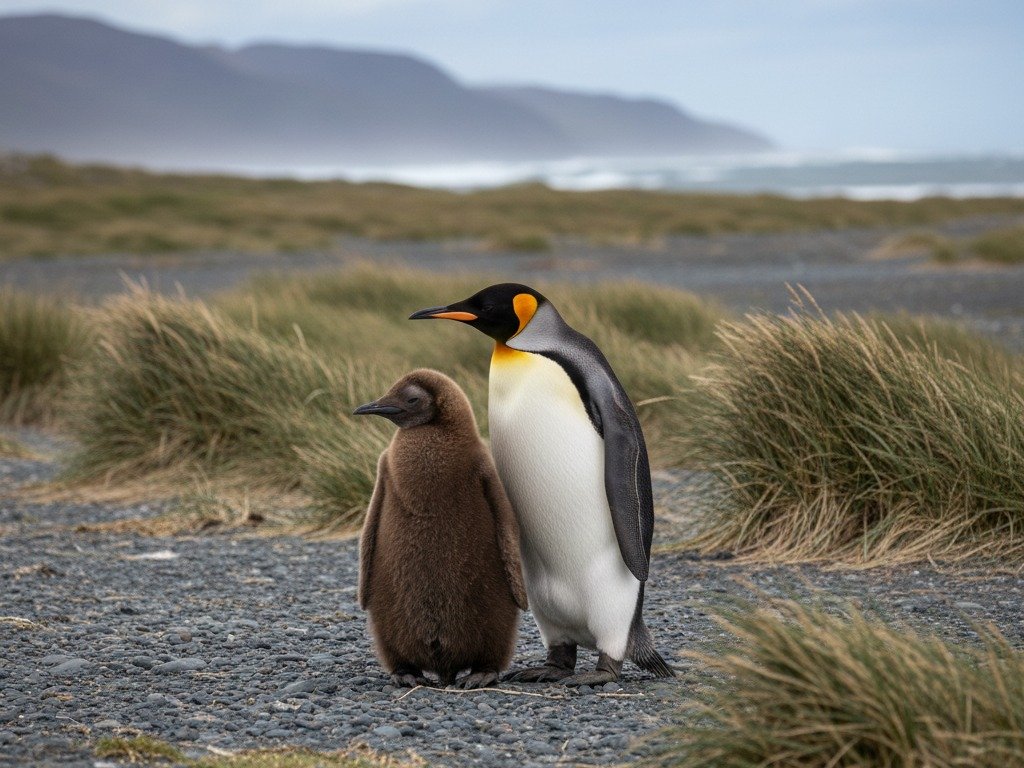
Parents keep taking turns caring for the chick and finding food for it. Around 40 days after hatching, chicks are large enough to survive on their own. They gather in groups called crèches, where they rely on each other for warmth and protection. ASOC says the chicks grow through three stages: a growth spurt, a winter period of fasting and weight loss, and a final growth spurt before they fledge. They become fully independent about 16 months after birth.
What threatens the species?
Skuas, giant petrels, kelp gulls, and snowy sheathbills feed on unguarded eggs and chicks in king penguin colonies. Adults defend their chicks by vocalizing and slapping attackers with their flippers. At sea, leopard seals, fur seals, and killer whales prey on them. Their black and white plumage provides countershading, which helps camouflage them against the sea or sky.
People also threatened the species. Wikipedia says whalers nearly wiped out the population in South Georgia and the Falklands by the early 1920s, and ASOC notes that they were once heavily hunted for meat, oil, blubber, and feathers. Today they are fully protected.
Is the species endangered?
No. The IUCN lists the king penguin as Least Concern, and ASOC describes its population as increasing. ASOC warns that they depend on marine ecosystems that may be at risk from climate change and overfishing. It supports marine protected areas across the Southern Ocean and precautionary management of the Antarctic krill fishery.
Population trends are not uniform everywhere. Wikipedia reports that one of the largest colonies, on Île aux Cochons in the Crozet Islands, fell from about 500,000 breeding pairs in the 1980s to about 60,000 in 2017. Researchers suspect changes in the food supply linked to climate change.
How long do they live?
The lifespan figures differ. ASOC lists an average lifespan in the wild of 26 years. SeaWorld gives a range of 15 to 20 years. Either way, they are long-lived birds with a slow breeding cycle. For a broader look at how long different birds live, see which bird lives the longest.
Frequently asked questions
Is the king penguin the largest penguin?
No. The emperor penguin is the largest. ASOC describes it as the second-largest penguin.
How deep do they dive?
ASOC says they can dive more than 360 meters. Wikipedia reports a record dive of 343 meters in the Falkland Islands region.
Do they live in Antarctica?
They mainly live and breed on subantarctic islands. They have seldom visited the Antarctic continent itself, according to ASOC.
Do they mate for life?
No. ASOC describes them as serial monogamists. They may choose a new partner the following year.