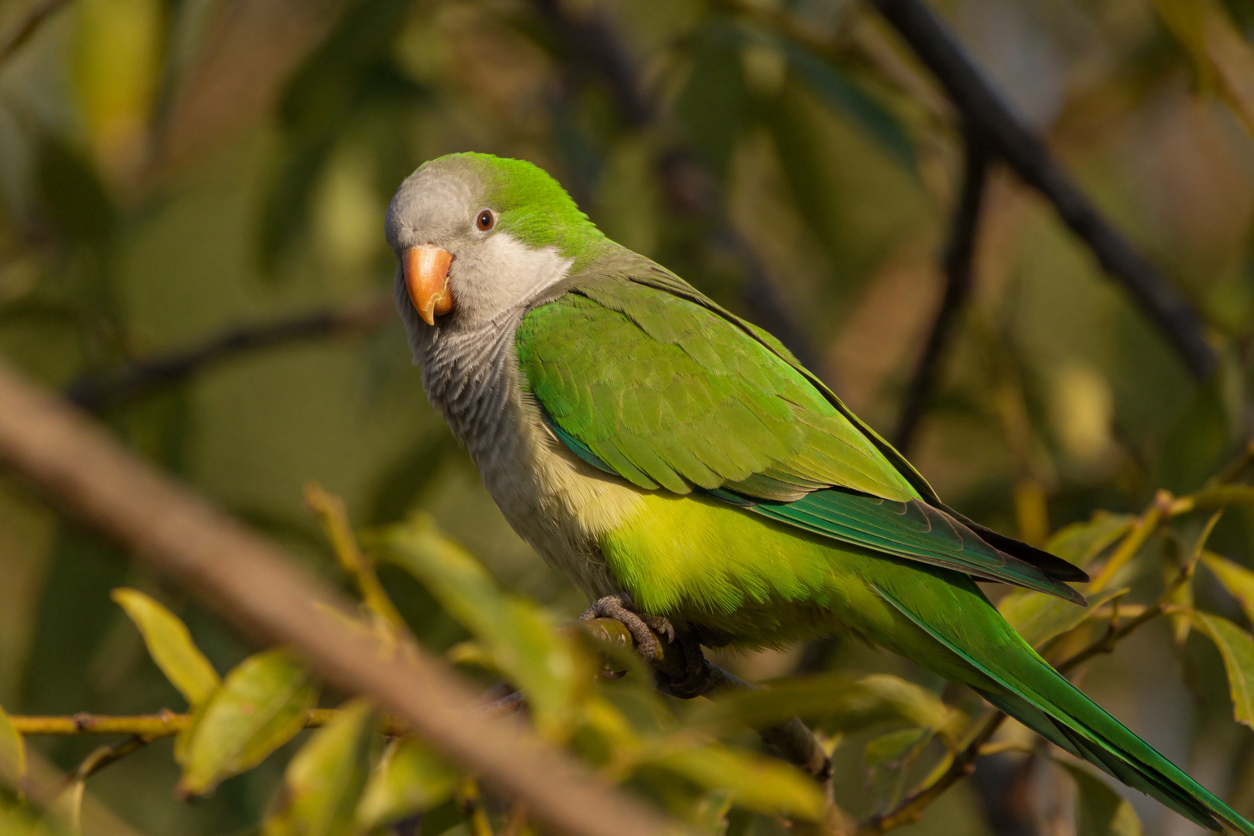
The Monk Parakeet (Myiopsitta monachus), also known as the Quaker Parrot, is a medium-sized, bright green parrot originally from South America that now lives wild in cities across the United States and Europe. It is the only parrot in the world that builds its own stick nest, and it does so on a grand scale, creating huge communal structures that can house dozens of pairs and weigh hundreds of pounds. Whether you spot one at a backyard feeder, see a flock chattering in a city park, or keep one as a pet, the Monk Parakeet is a bird that is hard to miss and impossible to ignore.
Monk Parakeet: Quick Facts
| Feature | Details |
|---|---|
| Scientific Name | Myiopsitta monachus |
| Also Known As | Quaker Parrot, Quaker Parakeet |
| Family | Psittacidae |
| Length | 11 to 12 inches (28 to 30 cm) |
| Wingspan | About 19 inches (48 cm) |
| Weight | 3 to 5 oz (90 to 140 g) |
| Lifespan (Wild) | 6 to 15 years |
| Lifespan (Captive) | 15 to 20 years |
| Native Range | Argentina, Bolivia, Brazil, Paraguay, Uruguay |
| Introduced Range | USA, Spain, UK, Italy, and other countries |
| Diet | Seeds, fruits, grains, flower buds, insects |
| Conservation Status | Least Concern (IUCN) |
What Does a Monk Parakeet Look Like?
The Monk Parakeet is easy to identify once you know its key features. Its body is bright, vivid green on the back, wings, and top of the long, tapering tail. The forehead, cheeks, throat, and upper chest are pale grey, giving a clean, two-tone appearance that makes the bird look as if it is wearing a grey hood. The belly fades to a yellowish-green. When a Monk Parakeet flies, its bright blue outer flight feathers flash vividly against the green, making it unmistakable in the air.
Its beak is pale orange or pinkish-horn colored and strongly hooked, as with most parrots. Its eyes are dark brown surrounded by a bare, pale eye-ring.
Male vs. Female Monk Parakeet
Males and females look identical in plumage. The only way to tell them apart with certainty is through DNA testing or surgical sexing. This is a common challenge for Monk Parakeet owners who want to know their bird’s sex without a vet visit.
Juvenile Monk Parakeets
Young Monk Parakeets look very similar to adults but tend to have a slightly washed-out green color and a less defined grey chest patch. They develop full adult plumage within their first year.
Monk Parakeet Range and Habitat
In the wild, Monk Parakeets are native to the temperate and subtropical grasslands, open woodlands, and scrub forests of South America. Their native range spans central and northern Argentina, parts of Bolivia, southern Brazil, Paraguay, and Uruguay. They thrive in open landscapes with scattered trees and agricultural land.
Outside South America, Monk Parakeets are now established as feral populations in many countries. They were introduced through the pet trade, with birds escaping or being released deliberately starting in the 1960s. Today, feral colonies exist in Spain, Italy, the United Kingdom, Israel, and many other countries.
Monk Parakeets in the United States
The United States hosts some of the largest feral Monk Parakeet populations outside South America. Established colonies exist in:
- Florida: South Florida and the Miami area have some of the largest and most visible colonies
- Texas: Austin, Houston, and San Antonio are known hotspots
- Illinois: Chicago has a well-established feral population that survives harsh Midwestern winters
- New York: Colonies exist in Brooklyn, Queens, and other boroughs
- Connecticut, New Jersey, and other Northeast states: Smaller but established groups
The Monk Parakeet’s Unique Communal Nest
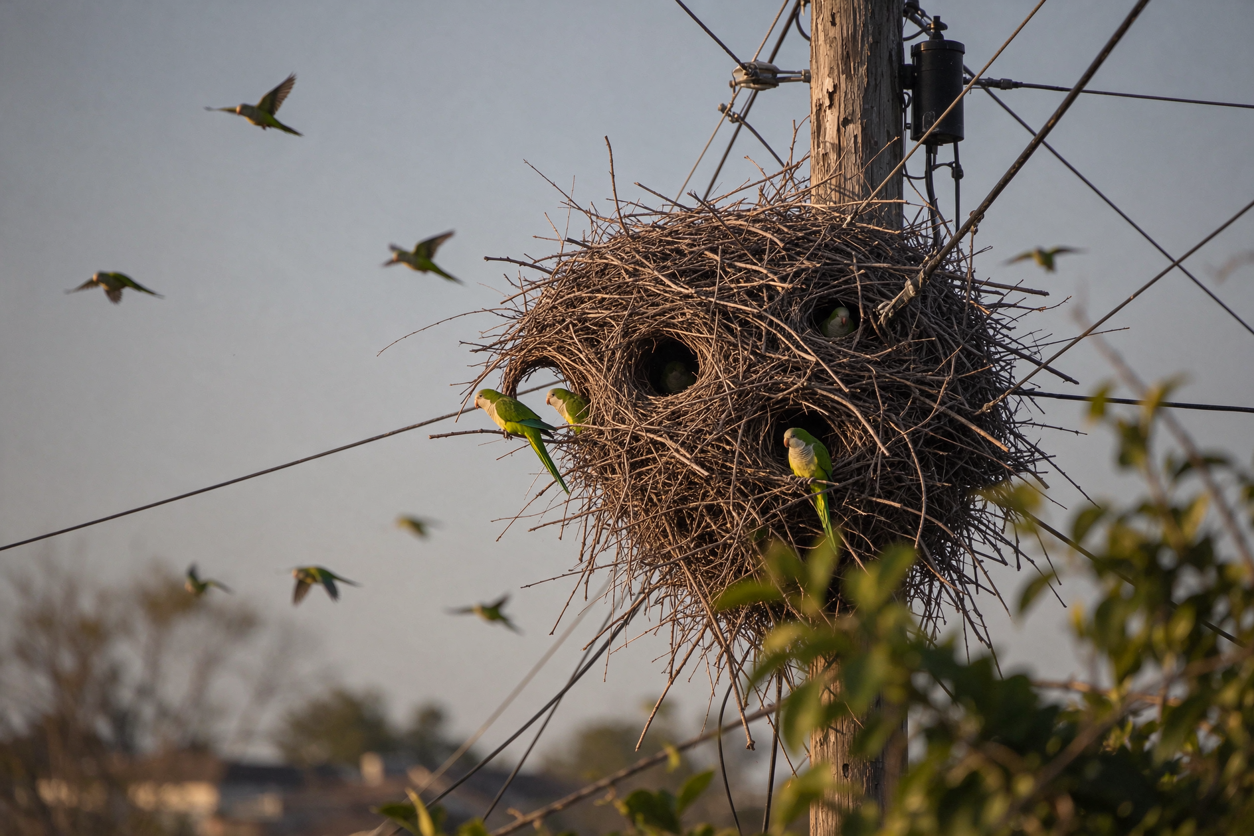
The most remarkable thing about the Monk Parakeet is its nest. It is the only parrot in the world that constructs its own free-standing stick nest rather than using a tree cavity or burrow. These are not simple, small structures. A mature Monk Parakeet colony nest can be several feet wide and several feet tall, weigh hundreds of pounds, and contain separate chambers for dozens of breeding pairs, each with its own private entrance tunnel.
Both males and females gather sticks, often snapping them directly from live tree branches. They weave them together into a dense, interlocking structure that is surprisingly weather-resistant. The inside of each chamber is lined with softer plant material. The nest is used year-round, not just for breeding. The whole colony roosts inside it at night and returns to it after every foraging trip.
Nests on Utility Infrastructure
In urban and suburban areas, Monk Parakeets often choose man-made structures for their nests. Utility poles, cell phone towers, stadium light stands, and electrical substations are all popular choices. This creates a real conflict with utility companies, since the heavy stick nests can cause short circuits, equipment failures, and power outages. Utility companies in Florida and Texas spend significant resources removing Monk Parakeet nests each year.
Monk Parakeet Breeding and Nesting Behavior
Monk Parakeets breed within their communal nests. Each pair occupies a private chamber with its own entrance. The female lays 5 to 12 eggs, though clutches of 5 to 8 are most common. Incubation lasts about 24 days. Both parents help feed the chicks after hatching. Young birds typically fledge at about 6 to 7 weeks old.
Interestingly, juvenile Monk Parakeets from earlier clutches sometimes stay with the colony and help feed younger chicks, a behavior known as cooperative breeding. This social structure strengthens colony bonds and improves the survival rate of young birds.
Breeding Season
- Spring: Main breeding season begins. Pairs begin adding fresh sticks to their nest chambers.
- April to June: Eggs laid and incubated.
- May to July: Chicks hatch and are fed by parents.
- June to August: Juveniles fledge and begin learning to forage.
- Year-round: Nest maintained and occupied by the colony.
What Do Monk Parakeets Eat?
Monk Parakeets are flexible, opportunistic feeders. In their native South American habitat, they eat mainly seeds, grains, plant shoots, fruits, berries, and flower buds. They occasionally catch and eat insects, especially when feeding young chicks that need extra protein.
In urban areas across the United States, they readily adapt to whatever food is available. They visit bird feeders, eat fallen fruit from garden trees, and forage in parks and open grassy areas. Common food sources include:
- Sunflower seeds and millet (at feeders)
- Corn, wheat, and sorghum (in agricultural areas)
- Figs, berries, and other soft fruits
- Flower buds and leaf shoots from trees
- Insects and larvae (less common)
Monk Parakeet as a Pet (Quaker Parrot)
The Monk Parakeet is one of the most popular pet parrots in the world, often sold under the name Quaker Parrot. It is prized for its intelligence, its ability to learn a large vocabulary, and its strong bond with its owner. Quaker Parrots can learn dozens of words and phrases and are often ranked among the top talking parrots after African Greys and Amazon Parrots.
They are energetic, social birds that need daily interaction and mental stimulation. A bored Quaker Parrot can become loud, destructive, or feather-plucking. With proper care, enrichment, and training, they make rewarding, long-lived companions.
Are Monk Parakeets Legal to Own?
Laws vary by state. Monk Parakeets are legal pets in most of the United States, but some states ban or restrict them because of concerns about feral colonies causing agricultural or infrastructure damage. States with restrictions or bans have included California, Georgia, Kansas, Kentucky, Hawaii, New Jersey, Pennsylvania, Tennessee, and Wyoming. Always check your state’s current wildlife regulations before buying a Monk Parakeet.
Monk Parakeet Sounds and Calls
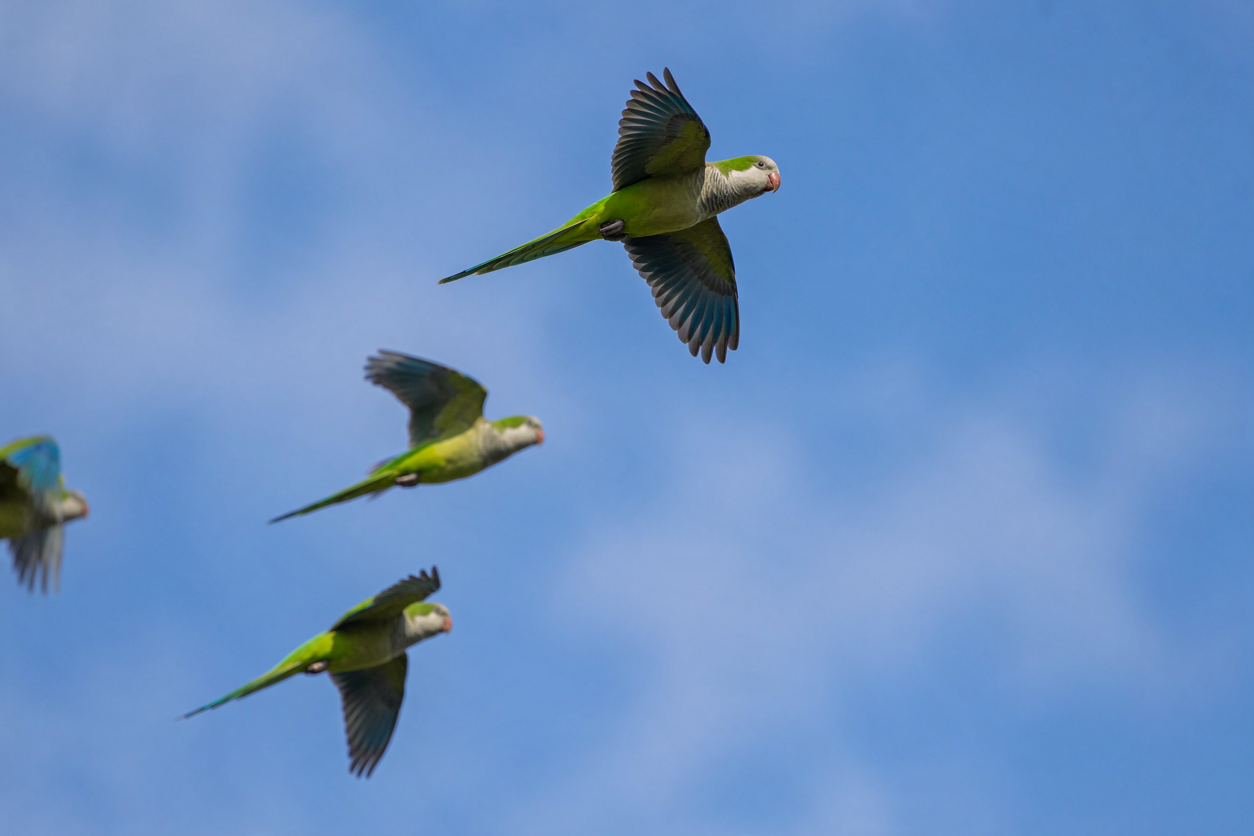
Monk Parakeets are among the noisiest parrots you are likely to encounter. Wild flocks produce a constant mix of harsh, guttural squawks, chatters, and screeches. Their most common contact call is a sharp, repetitive cheeeh-cheeeh or week-week sound that carries a long distance. When alarmed, they produce loud, rapid squawking that alerts the entire flock.
Pet Monk Parakeets develop a broader vocal range. They mimic speech, household sounds, other birds, and even musical tones. Many owners report that their Quaker Parrots learn words quickly and use them in context. They can hold short conversations, greet people by name, and announce their own needs. For verified recordings of Monk Parakeet calls, visit the Cornell Lab of Ornithology’s All About Birds page.
If you enjoy learning bird sounds, see our guide on how to do bird calls for tips on identifying and mimicking different bird species.
Monk Parakeet Conservation Status
The Monk Parakeet is listed as Least Concern by the IUCN Red List. Its global population is large, stable, and in many regions growing, thanks partly to its adaptability and the expansion of feral populations worldwide.
In its native South American range, Monk Parakeet numbers remain healthy despite some localized pressure from trapping for the pet trade and control efforts in agricultural areas. The species is considered a pest in Argentina and other parts of its native range, where large flocks can cause serious damage to grain crops.
In the United States, feral Monk Parakeets face control efforts by some state wildlife agencies and utility companies. Their overall numbers in North America, however, continue to grow in areas where they are established.
Monk Parakeet vs. Similar Species
| Feature | Monk Parakeet | Nanday Parakeet | Green Parakeet |
|---|---|---|---|
| Head color | Pale grey | Black head | All green |
| Chest | Pale grey, scaly | Blue-green | Green or pale yellow |
| Tail | Long, green | Long, blue-black | Long, green |
| Nest type | Stick nest (unique) | Tree cavity | Tree cavity |
| US range | Widespread | Florida mainly | Texas mainly |
Monk Parakeets are most easily confused with other feral green parakeets seen in US cities. The pale grey chest and grey face are the fastest identification clues. No other common feral parakeet in North America has this combination.
Learn more about identifying birds by size with our guide to the world’s largest flying birds, or check the look-alike identification guide for similar birds.
Frequently Asked Questions About the Monk Parakeet
What is a Monk Parakeet?
A Monk Parakeet (Myiopsitta monachus), also called a Quaker Parrot, is a medium-sized bright green parrot native to South America. It is known for its grey face and chest, blue flight feathers, long pointed tail, and noisy, social behavior. It is the only parrot species that builds its own stick nests.
Are Monk Parakeets legal to own in the US?
Ownership laws vary by state. They are legal in most US states but banned or restricted in some, including California, Georgia, Hawaii, New Jersey, and Pennsylvania. Always check your state’s current wildlife regulations first.
Why do Monk Parakeets build stick nests?
Monk Parakeets build free-standing stick nests rather than using tree cavities. This allows them to create large, insulated communal structures that house many breeding pairs and provide warmth in winter, which is one key reason they can survive cold North American climates.
Where do feral Monk Parakeets live in the USA?
Established feral colonies exist in Florida, Texas, Illinois (Chicago), New York, and other Northeastern states. South Florida has some of the largest and most visible populations.
What do Monk Parakeets eat?
They eat seeds, grains, fruits, berries, flower buds, and occasionally insects. In urban areas they visit bird feeders. In their native South American range they can damage crops like corn, sorghum, and sunflowers.
Can Monk Parakeets talk?
Yes. Monk Parakeets are among the most talented talking parrots kept as pets. They can learn a large vocabulary, mimic speech with good clarity, and form strong bonds with owners.
How long do Monk Parakeets live?
In captivity with good care, 15 to 20 years. In the wild, usually 6 to 15 years depending on predation, weather, and food availability.
Conclusion
Few birds have made themselves at home in North American cities as successfully as the Monk Parakeet. It arrived as a pet trade escapee, settled into urban neighborhoods, built enormous communal nests, and kept right on thriving through Chicago winters and Florida heat alike. Whether you admire it as a clever survivor or view it as a noisy neighbor, the Monk Parakeet is one of the most fascinating birds you can find in a North American backyard today.
If you enjoy watching parrots and other exotic birds, explore our complete guide to what parrots can safely eat and learn more about parrot behavior in our guide to why parrots stand on one leg.