The Kentish plover is a small shorebird that breeds on sandy beaches, salt marshes, and the shores of saline lakes. It is easy to overlook at first, because it is pale and blends in with the sand. This guide covers how to identify it, how males and females differ, where it lives, what it eats, how it nests, and how its populations are doing.
What does a Kentish plover look like?
It is a slim, small plover. Hungarian birdwatching guides give its length as 15 to 17 centimeters (about 6 to 7 inches). Wikipedia gives an adult weight of about 40 grams. Birdwatching-bliss describes its legs as fairly long and darkish, and its bill as slim and dark.
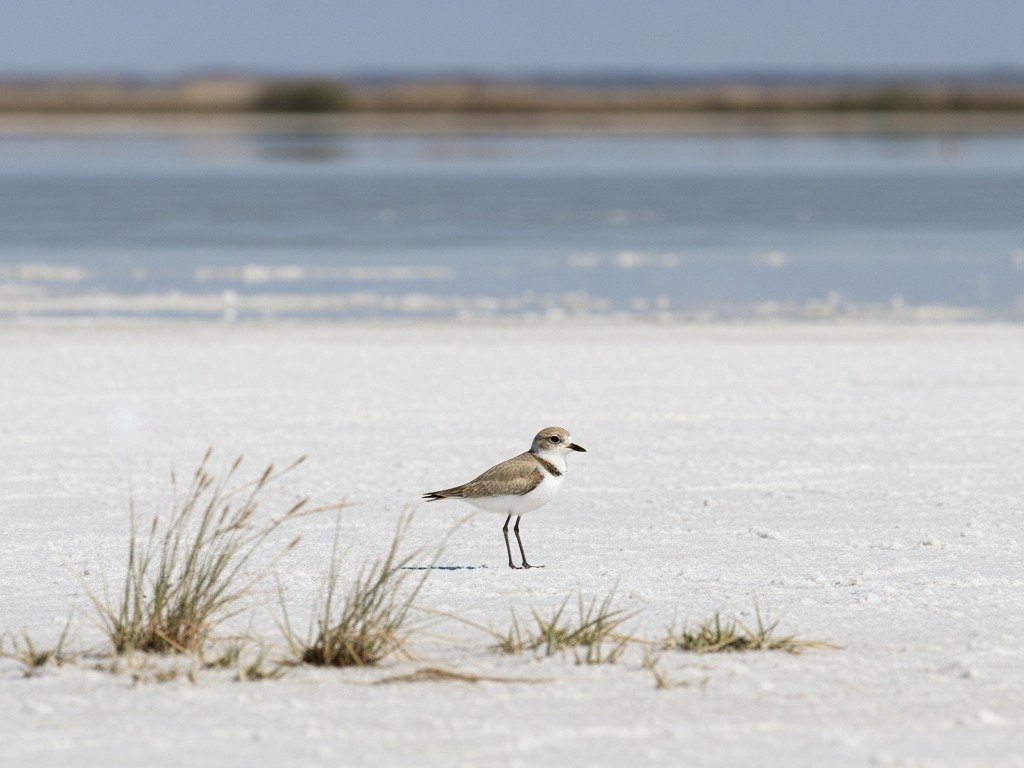
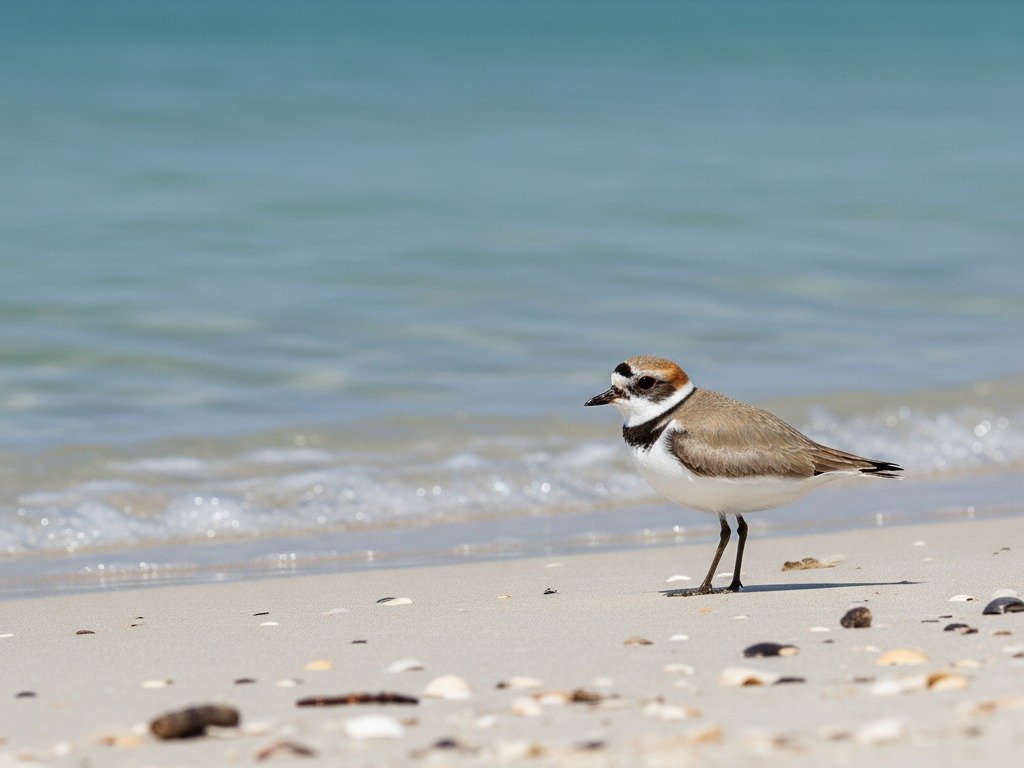
The easiest marks to look for are a white collar on the back of the neck and small dark patches on each side of the breast. The Hungarian guide notes that the species never has a complete breastband in any plumage. In flight, it shows a prominent wing-bar and all-white tail sides.
Breeding males are the most striking. They have a black forehead bar, a black eyestripe from the bill to the ear coverts and sharply defined dark patches at the sides of the breast. Wikipedia describes a rufous nape and crown, although birdwatching-bliss notes that the amount of rufous varies a lot between birds, and some have an entirely chestnut crown. Males also have longer legs and longer flank feathers than females, according to Wikipedia.
Females are paler. The Hungarian guide says their markings on the head and breast are grey brown rather than black, and they have little or no rust on the crown. Winter birds are less boldly marked, so a bird with dull plumage can be hard to place. Wikipedia notes that the difference between the sexes becomes smaller as the breeding season goes on.
How can you tell it apart from similar birds?
It is often confused with other small plovers. The Hungarian guide says it is slightly smaller, longer-legged, and thinner-billed than the ringed plover, and paler overall. Birdwatching-bliss notes that its pattern resembles that of the snowy plover, another small pale plover, so check the breast patches and the neck collar before you decide. For more look-alike comparisons, see 10 Birds That Look Like Robins.
If you are unsure, watch how the bird moves. Birdwatching-bliss says the Kentish plover feeds faster than the ringed and semipalmated plovers. It also tends to gather in small to large flocks of its own species, sometimes mixed with other small waders such as piping plovers.
Where does the Kentish plover live?
Wikipedia says the species breeds on the shores of saline lakes, lagoons, and coasts. It also uses sand dunes, marshes, semi-arid desert, and tundra. The breeding range covers North Africa, Central Asia, and Europe, including small populations in Spain and Austria.
Some populations migrate and often spend the winter in Africa. Others, such as several island populations, do not migrate. Wikipedia notes that the English name comes from the county of Kent, where the bird was once found, but it has not bred in Britain since 1979.
Migration timing varies by region. In Hungary, it arrives in March and leaves in September, although some individuals stay until October. Outside the breeding season, it is mainly a coastal bird, but it also turns up at some brackish or saline lakes.
What does it eat?
Like most plovers, it is mainly an insect eater. Wikipedia says it feeds on a wide range of arthropods and other invertebrates, depending on the environment. It uses a run-and-stop method, dashing across the ground and pausing to pick up prey from the surface. Its diet includes both terrestrial and aquatic invertebrates.
How does it nest?
It is a ground nester. It lays its eggs in a shallow scrape on bare ground or in sparse vegetation. Wikipedia says the male usually prepares the scrape during courtship. Nests are often placed near water, sometimes on a slightly raised spot where the bird can watch for predators.
Nests are lined with whatever is nearby, such as pebbles, small pieces of shell, fish bones, twigs, grass, and other debris. The modal clutch size is three eggs, though some nests begin with one or two. During incubation, the adult leaves the nest for short periods to feed or attend to other needs. Wikipedia notes that the bird adds nest material to cover and insulate the eggs, which also helps camouflage them. Birdwatching-bliss says both males and females take turns incubating. For another guide to telling eggs apart, see Blue Jay Eggs vs Robin Eggs: How to Tell Them Apart.
Wikipedia describes the breeding system as flexible, with monogamous and polygamous pairs found within the same populations. Breeding pairs often return to breed together the following year. Parents have also been observed moving chicks from poor feeding areas to better ones.
What habitat do they need for nesting?
The breeding habitats are most often alkali lake shores, wetlands, salt marshes, and coastlines. A study cited by Wikipedia found that they prefer nesting sites with low elevation, low vegetation, high moisture, and a distance from people and settlements. Birdwatching-bliss adds that the species favors sandy beaches, either on the coast or by brackish or saline inland wetlands.
Is the Kentish plover endangered?
The IUCN lists it as Least Concern, according to Wikipedia. Regional populations can still be in trouble, though. The Hungarian guide reports that the species is a very localized and rare breeder there, and its population has been decreasing for decades.
Frequently asked questions
How big is a Kentish plover?
The Hungarian guide gives a length of 15 to 17 centimeters. Wikipedia gives an adult weight of about 40 grams.
Does it have a breast band?
No. It has small dark patches on each side of the breast. The Hungarian guide says it never has a complete breastband in any plumage.
Where does it spend the winter?
Populations that migrate often winter in Africa. Some island populations do not migrate, according to Wikipedia.