The African jacana (Actophilornis africanus) is a waterbird found across sub-Saharan Africa, famous for its ability to walk across floating lily pads on enormous, spider-like toes. Known as the “lily trotter” and the “Jesus bird,” the African jacana is one of the most unusual birds on the continent, not just for the way it moves, but for its extraordinary family life.
This guide covers everything you need to know about the African jacana: how to identify it, where it lives, what it eats, and the remarkable role reversal that makes it one of the most studied birds in Africa.
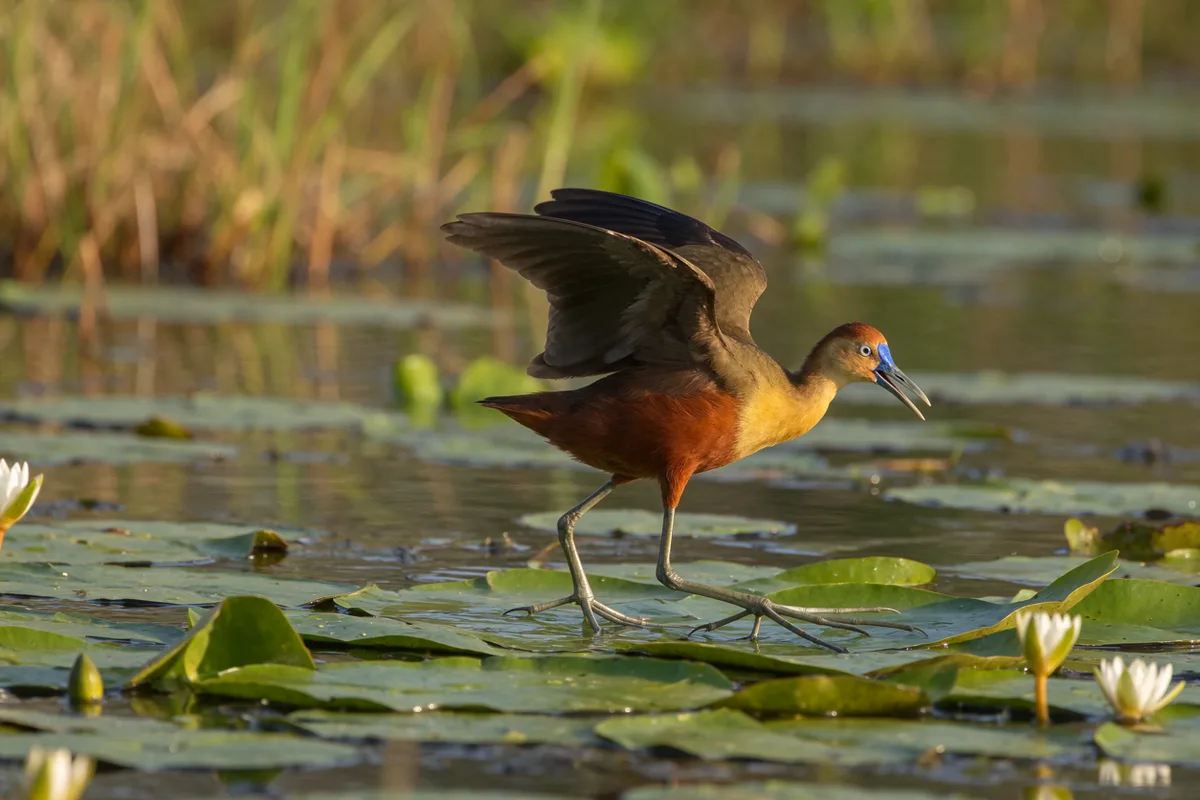
African Jacana Identification
The African jacana is a medium-sized bird, measuring about 23 to 31 cm (9 to 12 inches) in length. Females are noticeably larger than males, which is unusual in the bird world and directly tied to its unique breeding behavior.
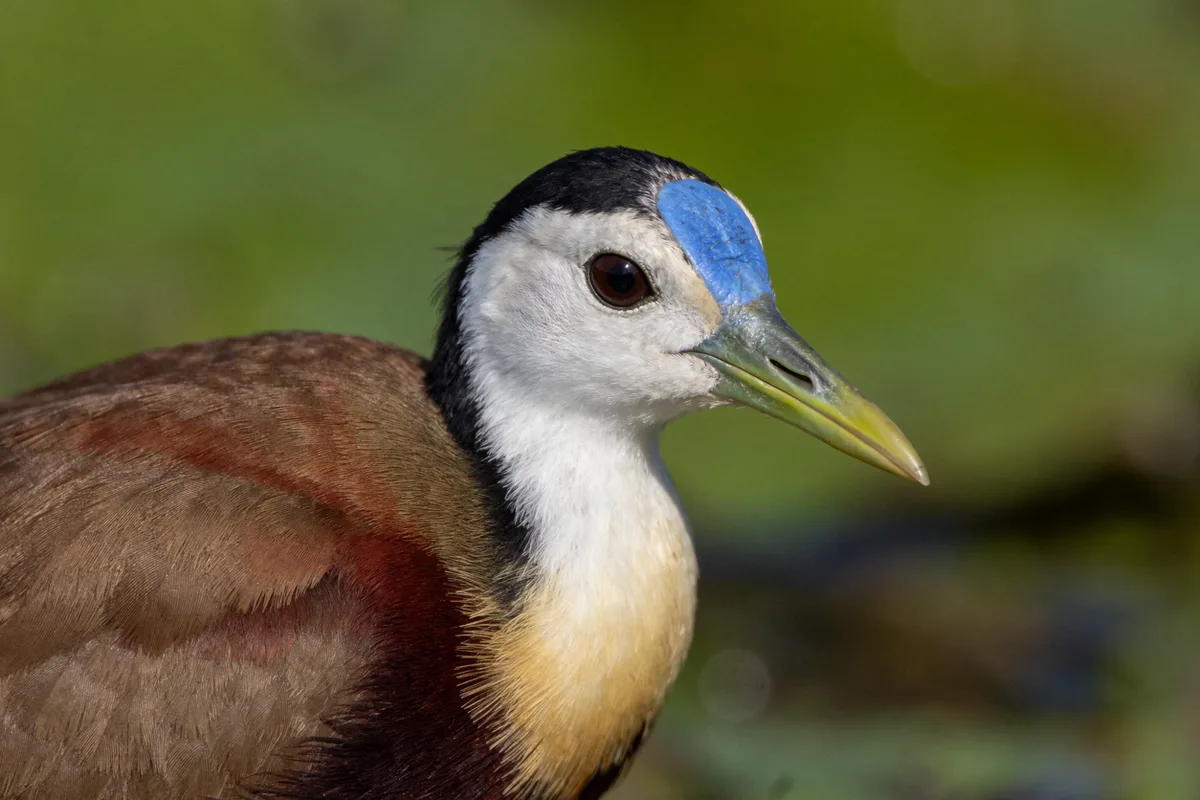
Adults have rich chestnut-brown upperparts and wings, often with a slight greenish sheen in good light. The head is boldly patterned: a black crown and eye stripe contrast with a white throat and foreneck, which fades into a golden-yellow breast. The belly is chestnut.
The most striking feature on the face is the bright blue frontal shield on the forehead, which extends into a bluish-grey bill. This blue shield is one of the easiest field marks to pick out when the bird is walking among green vegetation.
The Famous Toes: Why the African Jacana Can Walk on Water
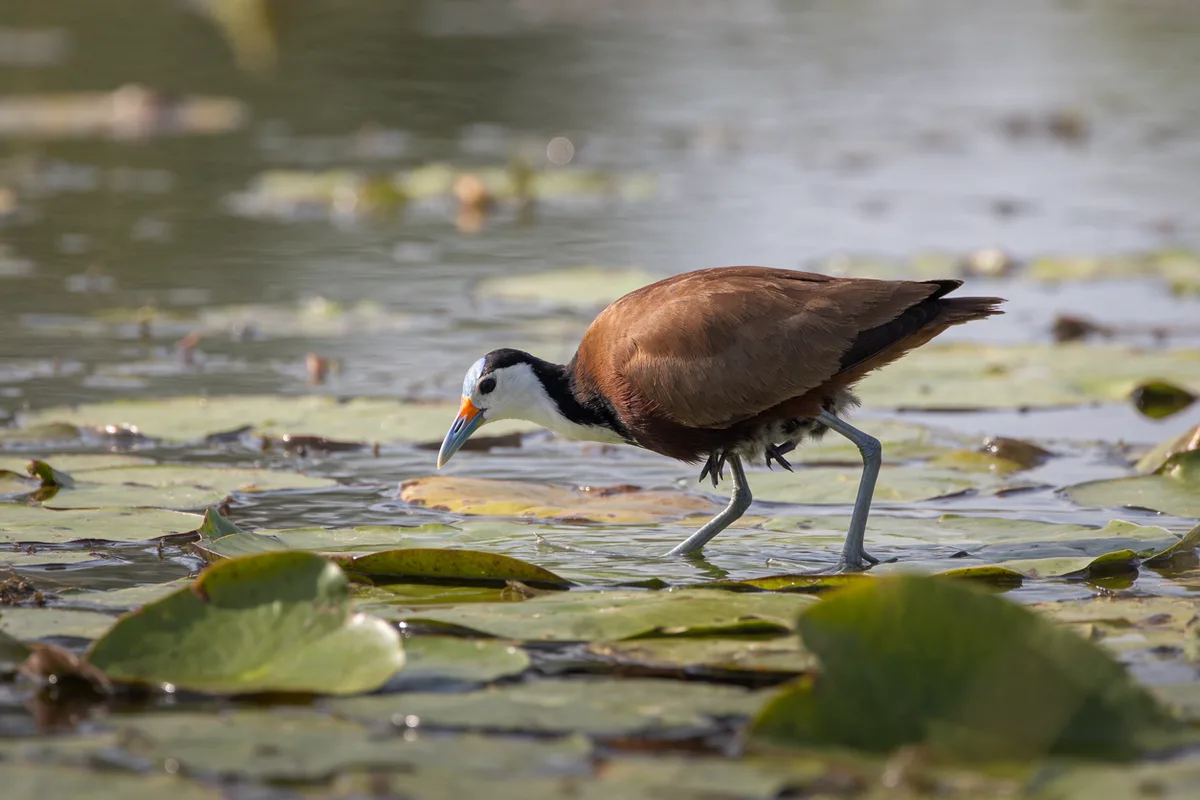
The African jacana’s toes are extraordinary. Each foot has four extremely long, thin toes with long, straight claws. The rear toe alone can be longer than the bird’s entire body. When the jacana spreads its toes wide, they cover a large surface area, spreading the bird’s weight so evenly across floating vegetation that it barely sinks at all.
This is the same principle as snowshoes. The weight is not less, but it is spread over a bigger area, so each point on the surface carries only a tiny fraction of the total load. A lily pad that would buckle under a human finger can easily support a jacana stepping lightly across it.
This adaptation makes the African jacana completely at home in its habitat. It can walk, run, and forage on floating vegetation that most other birds cannot even stand on.
Habitat and Range
The African jacana lives across sub-Saharan Africa, from Senegal and Ethiopia in the north, down through East Africa and into South Africa. It is found wherever there are shallow, slow-moving bodies of fresh water with plenty of floating vegetation.
Its preferred habitat includes:
- Floodplains and seasonal wetlands
- Shallow lakes and lagoon margins
- Slow-moving rivers with reed beds
- Marshes and swamps with water lilies
- Papyrus-lined channels
Water lilies are especially important. The African jacana nests on floating lily pads, feeds from them, and uses them as shelter. In areas where water lily coverage is dense and stable, jacana populations tend to be high.
What Does the African Jacana Eat?
The African jacana is mainly insectivorous. It forages by walking slowly across lily pads and floating weeds, flipping over leaves and probing into crevices with its bill. Its long toes let it reach plants that other waterbirds cannot access.
Its diet includes:
- Aquatic insects and larvae
- Small crustaceans
- Mollusks and snails
- Worms and small invertebrates
- Occasional small fish
- Seeds and plant material (less common)
The bird’s foraging style is deliberate and methodical. It moves across a mat of floating vegetation in a slow, calculated walk, stopping frequently to tip leaves or probe beneath them.
The African Jacana’s Remarkable Mating System
The African jacana has one of the most unusual family structures of any bird in the world. It is polyandrous, meaning one female mates with multiple males. This is a complete reversal of the breeding system seen in most bird species.
How It Works
A female African jacana holds a large territory that overlaps with the smaller territories of several males, typically two to four. She mates with each male in turn. After laying a clutch of four eggs in a simple nest built on a floating platform of vegetation, her role in raising that family is finished. She moves on to mate with the next male on her territory.
The male does everything else. He incubates the eggs alone for about 25 to 28 days. After hatching, he protects the chicks, broods them to keep them warm, and leads them to feeding areas. The female defends the whole territory from rivals but takes no part in day-to-day chick care.
The Most Famous Behavior: Carrying Chicks Under the Wings
When danger approaches, such as a fish eagle, monitor lizard, or large heron, he tucks his chicks under his wings and walks or runs away.
The chicks hide so completely beneath his folded wings that only their dangling legs are visible. To a casual observer, the bird appears to have four or more legs. This behavior is called “wing-carrying” and is the main reason the African jacana is sometimes called the “spider bird.”
Chicks That Can Dive
African jacana chicks have another remarkable survival trick. When a predator is too close to run from, the chicks can drop into the water, swim to a submerged plant stem, and hold on while keeping just their beak above the surface to breathe. They can stay submerged like this for several minutes until the threat passes.
Conservation Status
The African jacana is listed as Least Concern by the IUCN Red List. It is widespread across sub-Saharan Africa and locally common in suitable habitat.
The main threats are wetland drainage, water pollution from agricultural runoff, and reduction of water lily coverage. Organizations such as Wetlands International work to preserve the freshwater habitats these birds depend on.
African Jacana Quick Facts
| Feature | Detail |
|---|---|
| Scientific name | Actophilornis africanus |
| Length | 23 to 31 cm (9 to 12 inches) |
| Nicknames | Lily trotter, Jesus bird, spider bird |
| Range | Sub-Saharan Africa |
| Habitat | Freshwater wetlands with floating vegetation |
| Diet | Insects, crustaceans, mollusks, small fish |
| Mating system | Polyandrous (one female, multiple males) |
| Incubation | 25 to 28 days (male only) |
| Clutch size | 4 eggs |
| Conservation status | Least Concern (IUCN) |
If you enjoy learning about unusual waterbirds, our guide on birds that lay green eggs covers more species with surprising traits. For more African and tropical bird profiles, see our birds of Southeast Asia guide.
Frequently Asked Questions
What is the African jacana known for?
The African jacana is best known for two things: its ability to walk across floating lily pads on enormous, spread-out toes, and its reversed breeding system where females mate with multiple males and fathers raise all the chicks alone. It is also known for carrying chicks hidden under its wings when threatened.
Why is the African jacana called the lily trotter?
The African jacana is called the lily trotter because it trots lightly across floating water lily pads. Its very long toes spread its weight so evenly that it can walk across surfaces too fragile to support most other birds.
Why is the African jacana called the Jesus bird?
It is called the Jesus bird because it appears to walk on water. From a distance, its long toes and the floating vegetation it walks on are hard to see, so the bird looks like it is walking across the open water surface.
Do male or female African jacanas raise the chicks?
Male African jacanas do all the chick-rearing. The female lays the eggs and moves on to mate with other males. The male incubates the eggs alone for 25 to 28 days and raises the chicks until they are independent.
How does the African jacana carry its chicks?
When danger approaches, the male African jacana tucks his chicks under his wings. The chicks hide beneath his folded wings with only their legs dangling. The male can walk, run, or swim to safety while carrying up to four chicks at once.
Where does the African jacana live?
The African jacana lives across sub-Saharan Africa in freshwater wetlands with floating vegetation, particularly water lilies. It is found from Senegal and Ethiopia in the north to South Africa in the south.