Birds in Southeast Asia represent one of the planet’s greatest concentrations of avian biodiversity, boasting more than 1,300 documented species across tropical rainforests, mist-shrouded montane ridges, coastal mangroves, and sprawling freshwater wetlands. Positioned at the biological crossroads of the Indomalaya biogeographic realm, Southeast Asia spans 11 countries including Thailand, Malaysia, Indonesia, the Philippines, Vietnam, Cambodia, Laos, Myanmar, Singapore, Brunei, and Timor-Leste each offering breathtaking endemic species found nowhere else on Earth.
From the reverberating wingbeats of giant canopy hornbills to the jewel-like brilliance of forest floor pittas and hyperactive sunbirds, Southeast Asia is a dream destination for ornithologists, wildlife photographers, and traveling nature lovers. Whether you are exploring our regional field notes on common birds in Thailand or planning your first birding expedition into the ancient dipterocarp jungles of Borneo, this comprehensive guide explores the region’s most iconic bird families, key field identification marks, ecological zones, and premier birdwatching destinations.
Field Comparison: Iconic Birds in Southeast Asia at a Glance
Below is a quick reference table comparing several of Southeast Asia’s most celebrated flagship species across different ecological strata:
| Species | Family | Forest Stratum / Zone | Key Identification Feature | IUCN Red List Status |
|---|---|---|---|---|
| Great Hornbill (Buceros bicornis) | Bucerotidae | Rainforest Canopy | Massive curved yellow-black casque, white wing bars | Vulnerable |
| Blue-winged Pitta (Pitta moluccensis) | Pittidae | Forest Floor / Understory | Electric blue wing covert patch, bright scarlet belly vent | Least Concern |
| Long-tailed Broadbill (Psarisomus dalhousiae) | Eurylaimidae | Sub-montane Mid-canopy | Black helmeted cap, sky-blue crown, long slender tail | Least Concern |
| Stork-billed Kingfisher (Pelargopsis capensis) | Alcedinidae | Jungle Rivers & Mangroves | Enormous dagger-like red bill, buff underparts, blue back | Least Concern |
| Crimson Sunbird (Aethopyga siparaja) | Nectariniidae | Gardens & Forest Edge | Brilliant crimson mantle, metallic purple crown mustache | Least Concern |
| Philippine Eagle (Pithecophaga jefferyi) | Accipitridae | Primary Montane Forest | Massive shaggy mane crest, blue-grey eyes, immense talons | Critically Endangered |
| Rhinoceros Hornbill (Buceros rhinoceros) | Bucerotidae | Lowland Dipterocarp Forest | Spectacular upward-curving red and orange horn casque | Vulnerable |
1. Canopy Titans: The Hornbills of Southeast Asia (Bucerotidae)
Hornbills are arguably the most charismatic forest guardians of Southeast Asia. Out of the world’s 55 hornbill species, more than 30 inhabit Southeast Asia, acting as essential “farmers of the forest” by dispersing large fruit seeds across vast rainforest expanses.
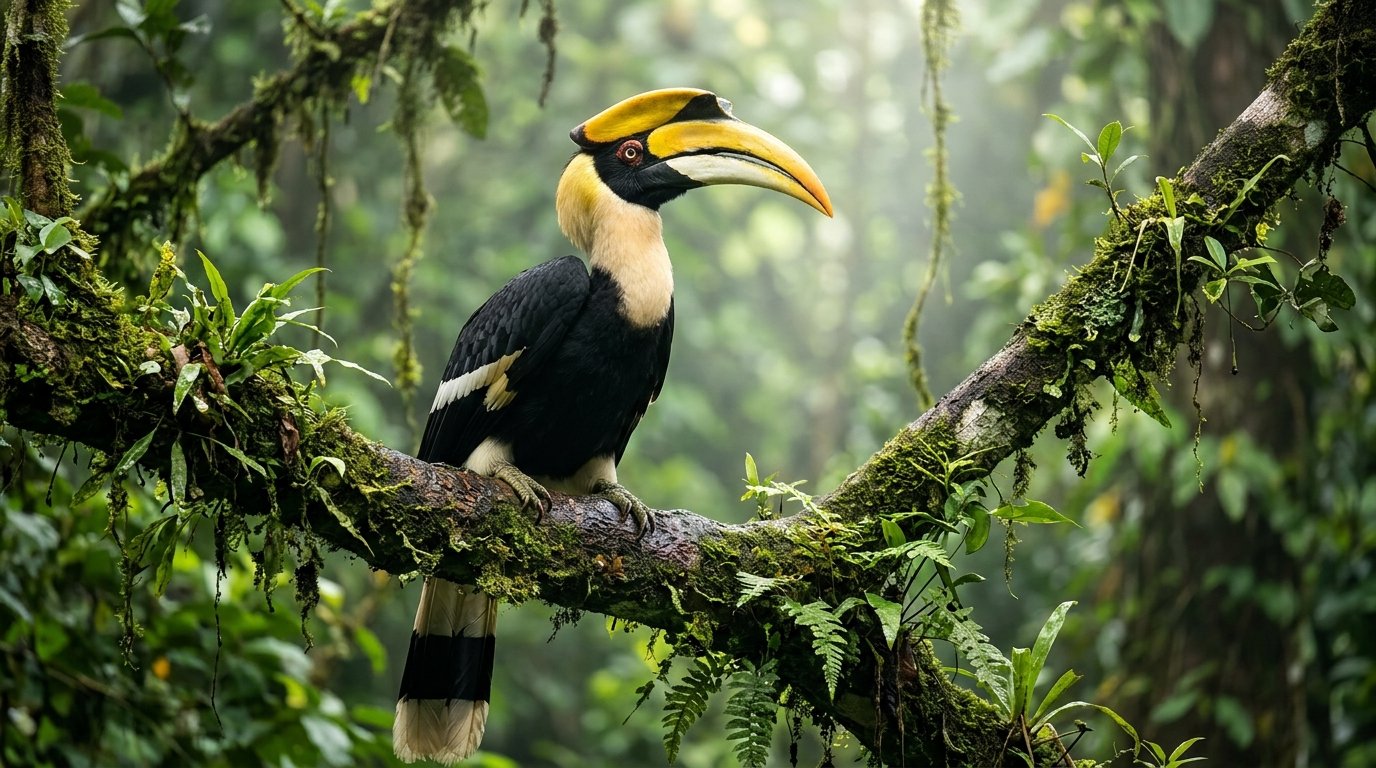
The Great Hornbill (Buceros bicornis)
Reaching an impressive wingspan of 1.5 meters (5 feet), the Great Hornbill is an awe-inspiring presence in mature evergreen canopies from Myanmar down through Peninsular Malaysia and Sumatra. When it flies overhead, the lack of underwing coverts produces a rhythmic, chugging sound akin to a steam locomotive.
- Distinguishing Field Marks: An immense curved bill topped with a hollow, double-pointed yellow and black casque. Males have blood-red irises and black on the front of the casque, while females possess creamy-white eyes and lack black facial markings.
- Fascinating Nesting Ritual: The female seals herself inside a natural tree hollow using a mixture of mud, fruit pulp, and droppings, leaving only a tiny vertical slit. The male diligently feeds her and their growing chicks through this opening for up to four months until the young are ready to fledge.
The Rhinoceros & Helmeted Hornbills
In the dense dipterocarp forests of Borneo and the Malay Peninsula, two other hornbills stand out:
- Rhinoceros Hornbill (Buceros rhinoceros): State bird of Sarawak (Malaysia), easily recognized by its flamboyant, upward-swept scarlet and golden-orange casque that resembles a rhino’s horn.
- Helmeted Hornbill (Rhinoplax vigil): Tragically targeted for its solid keratin casque (known as “red ivory”), this critically endangered giant possesses a chilling vocalization: an accelerating series of hollow hoots culminating in wild, maniacal cackles that echo for miles across the jungle.
2. Jewels of the Forest Floor: Pittas (Pittidae)
If hornbills command the skies, pittas rule the shadows of the forest floor. These plump, virtually tailless terrestrial birds bounce quietly across damp leaf litter, hunting earthworms, beetles, and snails.
Blue-winged Pitta (Pitta moluccensis)
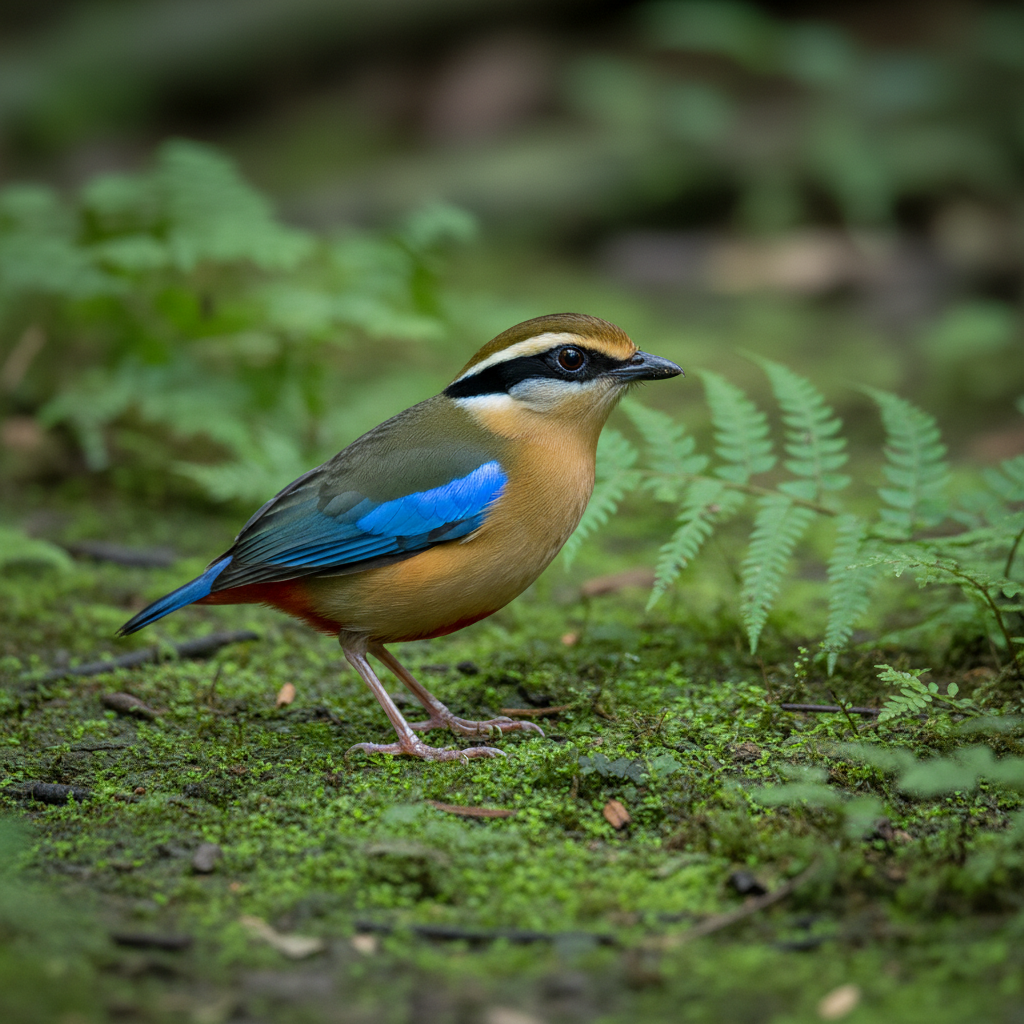
One of the most widespread migratory pittas in mainland Southeast Asia, the Blue-winged Pitta breeds in the lowland deciduous and bamboo forests of Indochina and winters south in the Malay Peninsula and Sumatra.
- Visual Identification: A rich buff breast and belly, marked with an eye-popping scarlet patch between the legs and undertail. Its upperparts display an intense sky-blue wing panel that contrasts with dark olive-green scapulars and a velvety black eyestripe.
- Voice: A clear, two-note whistle, rendered as “tae-laew… tae-laew!” (which translates in Thai to “already dead!”), echoing through the understory just before rain.
Malayan Banded & Garnet Pittas
In the pristine primary rainforests of the Sundaic region, birders search for extreme visual marvels like the Malayan Banded Pitta (Hydrornis irena), with its luminous orange-yellow eyebrow plume and finely barred electric blue breast, and the Garnet Pitta (Erythropitta granatina), whose crimson crown and iridescent sapphire eyebrows glow even in dim understory light.
3. Canopy Dwellers: Broadbills & Trogons (Eurylaimidae & Trogonidae)
Long-tailed Broadbill (Psarisomus dalhousiae)
Broadbills are endemic to the Old World tropics and reach their peak evolutionary diversity in Southeast Asia. Characterized by broad, flat beaks and vibrant plumage, they often travel in chattering family parties through the forest mid-canopy.
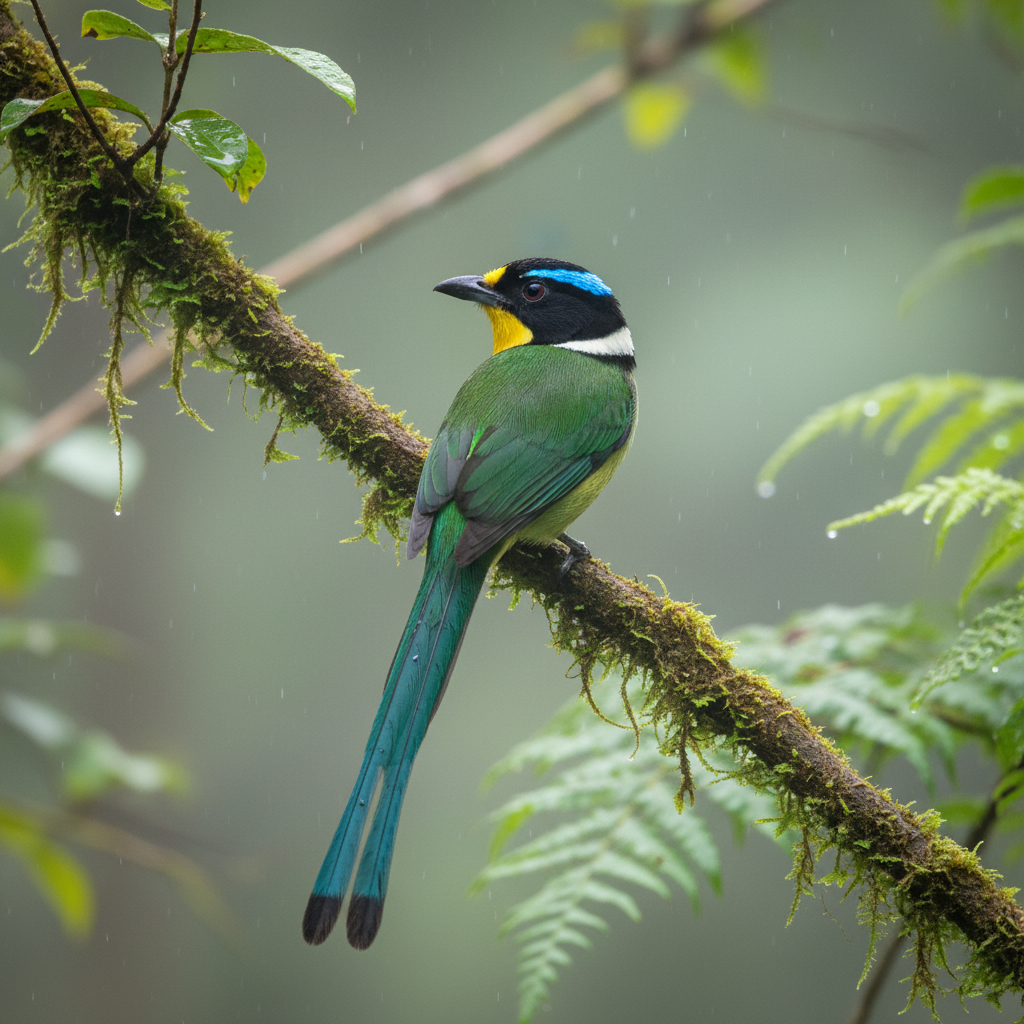
- Plumage Highlights: The Long-tailed Broadbill looks like a creature from a fantasy painting. It boasts a grass-green body, bright yellow face, electric sky-blue crown patch, a velvety black cap resembling an aviator’s helmet, and a long, graduated cyan tail.
- Architectural Nests: Broadbills build enormous, pear-shaped hanging nests woven from vines, moss, and leaves, suspended precariously over forest streams to deter climbing snakes and tree monitors.
Forest Trogons
Southeast Asia’s trogons (such as the Red-naped Trogon and Orange-breasted Trogon) sit motionless on shaded branches for hours. With square-cut tails, soft downy feathers, and luminous pink, yellow, or crimson bellies, they dart out suddenly to pluck caterpillars from under leaves before returning to the exact same perch.
4. Waterway Predators: Kingfishers (Alcedinidae)
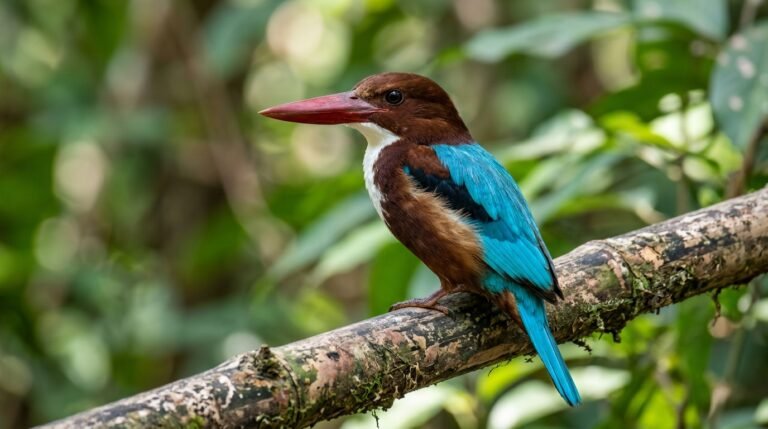
With an abundance of mangrove estuaries, tropical rivers, and freshwater lakes, Southeast Asia hosts over 20 distinct kingfisher species. While some hunt in open country like the ubiquitous White-throated Kingfisher, others are specialized riverine hunters.

Stork-billed Kingfisher (Pelargopsis capensis)
Measuring up to 35 cm (14 inches) in length, the Stork-billed Kingfisher is a heavyweight among kingfishers. Its enormous bill is practically half the length of its body, enabling it to catch not just fish, but large freshwater crabs, frogs, and even small water snakes.
- Field Marks: A soft brownish-grey cap, warm ochre-buff neck and belly, deep turquoise-blue wings and tail, and a massive blood-red dagger bill.
- Territorial Call: A loud, rolling cackle—“peer-peer-purr”—delivered while pumping its head and wings up and down from an overhanging branch along jungle riverbanks.
5. Forest Nectar Specialists: Sunbirds (Nectariniidae)
Often referred to as the Old World ecological equivalents of the Americas’ hummingbirds, sunbirds play a crucial pollination role across Southeast Asian ecosystems.

Crimson Sunbird (Aethopyga siparaja)
Declared the national bird of Singapore in 2015, the Crimson Sunbird is a tiny jewel measuring just 10 cm in length. In bright tropical sunshine, the male’s glowing scarlet breast, metallic purple forehead, and deep olive belly create an unforgettable sight as it hovers before red hibiscus flowers and wild ginger blossoms.
6. Apex Predators: Forest Eagles and Raptors
Southeast Asia’s skies and forest canopies are patrolled by formidable raptors adapted for dense jungle hunting. If you’ve explored what predatory raptors eat and the anatomy of giant flying birds, these apex predators will captivate you:
- Philippine Eagle (Pithecophaga jefferyi): One of the largest and most powerful eagles in the world, with a shaggy lion-like crest, piercing grey-blue eyes, and massive curved talons. Endemic to the lush montane rainforests of Luzon, Samar, Leyte, and Mindanao, it is critically endangered, with fewer than 400 pairs remaining.
- Crested Serpent Eagle (Spilornis cheela): A common sight soaring high over forest edges across Southeast Asia, emitting a distinct high-pitched whistling cry. As its name suggests, it specializes in hunting snakes, monitors, and arboreal lizards.
- Brahminy Kite (Haliastur indus): A striking coastal and wetland raptor with a snow-white head and chest contrasting with rich chestnut-brown wings. Often seen patrolling coastlines and harbors.
Biogeography & The Wallace Line: Why Southeast Asia’s Birds Are So Diverse
Southeast Asia’s staggering bird diversity is shaped by profound geological and evolutionary boundaries:
- Sundaland (Mainland, Sumatra, Borneo, Java): Connected during Ice Age glaciations when sea levels dropped, creating shared lineages of hornbills, broadbills, and babblers.
- Wallacea (Sulawesi, Moluccas, Lesser Sundas): Named after naturalist Alfred Russel Wallace, the famous Wallace Line separates Asian fauna from Australasian fauna. Cross east of Bali and Borneo into Sulawesi, and Asian barbets and broadbills abruptly disappear, replaced by Australian cockatoos, mound-builders (Megapodes), and honeyeaters!
- The Philippine Archipelago: Isolated oceanic islands that never connected to the Asian mainland, resulting in extraordinary island endemism—over 250 bird species found exclusively in the Philippines.
Top 6 Birdwatching Destinations in Southeast Asia
Planning an unforgettable birding itinerary? These world-renowned protected areas offer the highest species counts and best viewing opportunities:
- Danum Valley Conservation Area (Sabah, Borneo): One of the world’s oldest pristine lowland rainforests, home to all 8 Bornean hornbill species, Bornean Bristlehead, and Pittas.
- Khao Yai National Park (Thailand): UNESCO World Heritage site just 2.5 hours from Bangkok, famed for Great Hornbills, Silver Pheasants, Coral-billed Ground-Cuckoos, and trogons.
- Taman Negara National Park (Peninsular Malaysia): A 130-million-year-old jungle sanctuary with over 350 bird species, including the Malayan Peacock-Pheasant and Garnet Pitta.
- Doi Inthanon National Park (Northern Thailand): Thailand’s tallest peak, offering misty Himalayan montane specialties like the Green-tailed Sunbird and Ashy Wood-Pigeon.
- Palawan Island (Philippines): An endemic wonderland home to the Palawan Peacock-Pheasant, Palawan Hornbill, and Red-vented Cockatoo.
- Lore Lindu National Park (Sulawesi, Indonesia): The premier site to observe Wallacean endemics, including the legendary Maleo, Knobbed Hornbill, and purple-bearded bee-eater.
Frequently Asked Questions About Birds in Southeast Asia
How many bird species live in Southeast Asia?
More than 1,300 bird species have been recorded in Southeast Asia, with hundreds of endemics restricted to specific islands like Borneo, Sumatra, Sulawesi, and the Philippines.
What is the best time of year to go birding in Southeast Asia?
The best season runs from November through April. During these months, the weather is generally drier, and resident birds are joined by millions of winter migrants fleeing cold northern climates in Siberia and Northern China along the East Asian–Australasian Flyway.
What is Southeast Asia’s rarest or most endangered bird?
Several species face critical peril, notably the Philippine Eagle (fewer than 400 pairs remaining), the Helmeted Hornbill (poached for its solid keratin casque), the Bali Myna, and the Gurney’s Pitta, all threatened primarily by deforestation and the illegal caged bird trade.
Why do Asian forest birds have such loud morning calls?
In dense tropical rainforest canopies, thick foliage prevents visual communication. Species like hornbills, barbets, and laughingthrushes evolved powerful, low-frequency acoustic vocalizations to establish territories and keep contact with mates over distances exceeding several kilometers. Read our guide on why birds sing in the morning to understand avian dawn acoustics.