The yellow legged gull (Larus michahellis) is a large seagull identified by its bright lemon-yellow legs, yellow bill with a red spot, and pale-yellow eyes framed by a vivid red-orange orbital ring. It is one of Europe’s most widespread coastal birds, native to the Mediterranean Sea and expanding steadily northward into western and central Europe.
This guide covers how to identify the yellow-legged gull at every age, where it lives, what it eats, and how to tell it apart from similar species like the Herring Gull and Lesser Black-backed Gull.
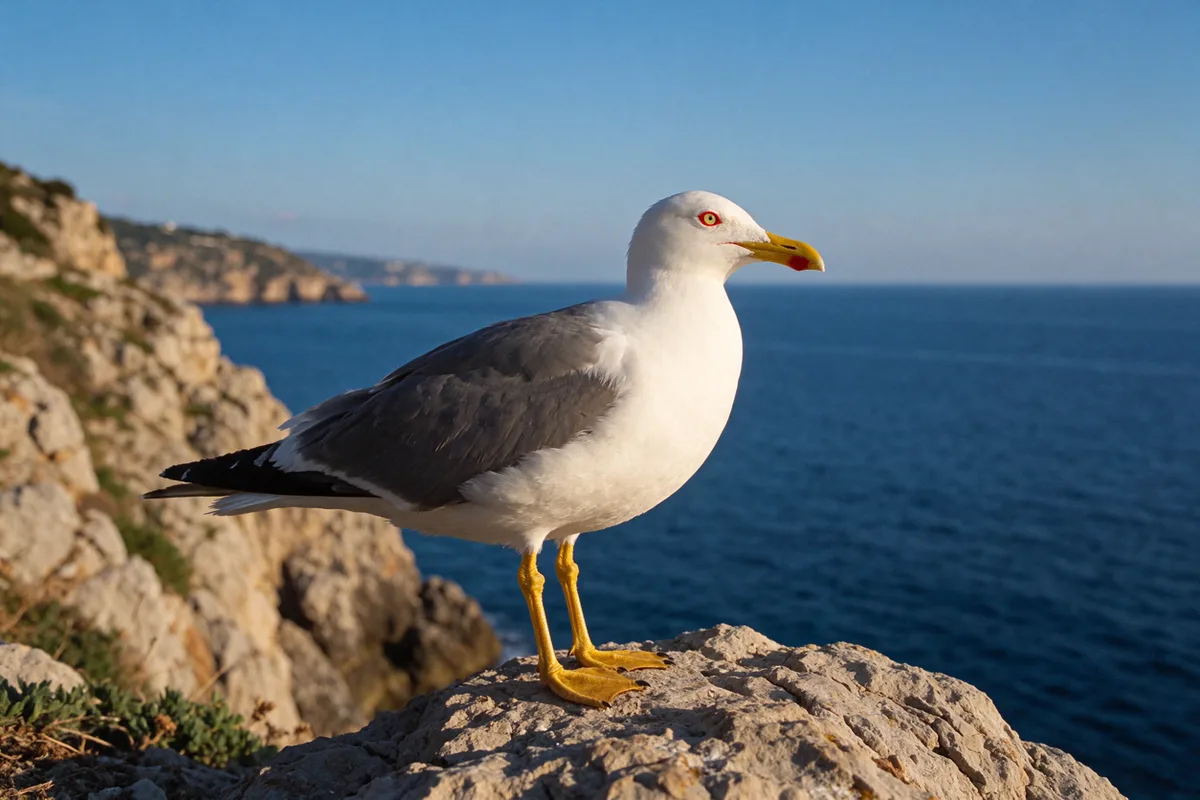
Yellow Legged Gull Identification
The yellow legged gull is a large, stocky bird with a wingspan of 120 to 158 cm (47 to 62 inches) and a body length of 52 to 68 cm (20 to 27 inches). It sits in the same size category as the Herring Gull but has several features that set it apart clearly once you know what to look for.
Adult Plumage
An adult yellow legged gull in breeding condition is a striking bird. Here are the key features to look for:
- Legs: Bright lemon yellow, the clearest single field mark at any distance.
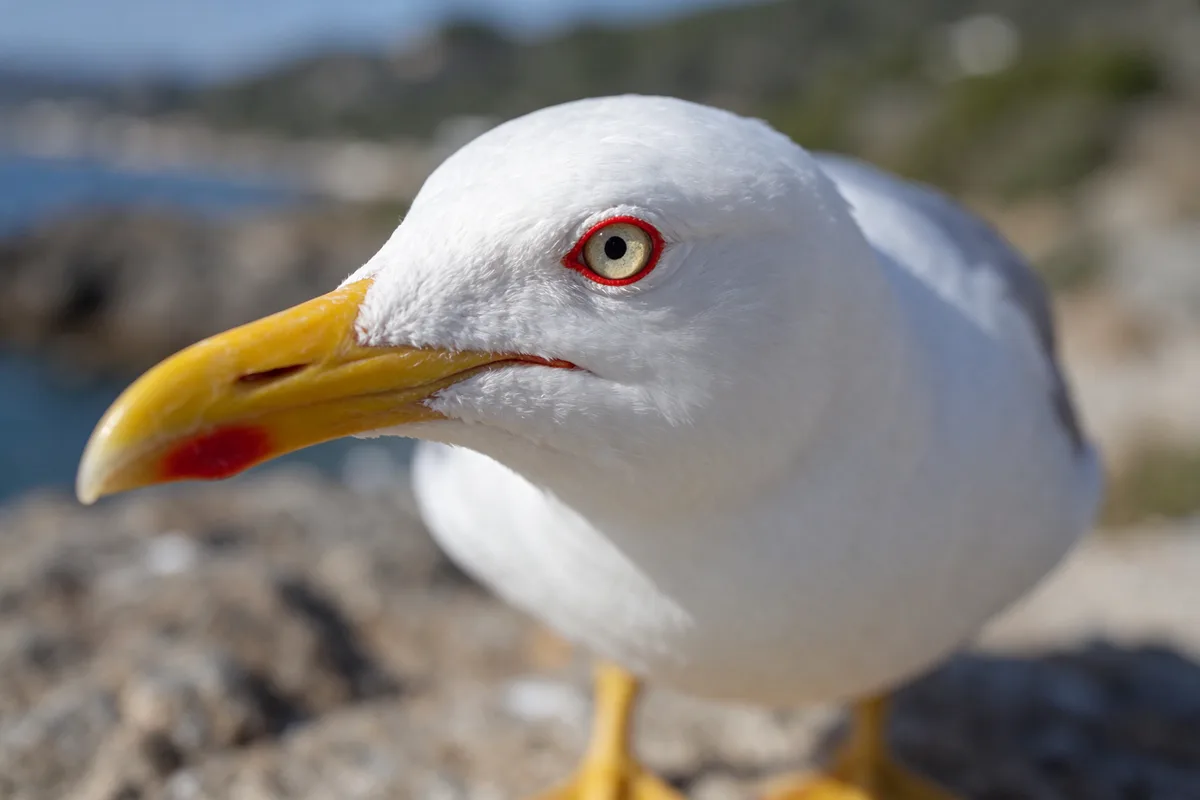
- Bill: Yellow with a bold red spot on the lower mandible.
- Eyes: Pale yellow iris with a vivid red or orange-red orbital ring.
- Back and wings: Medium-dark grey, darker than a Herring Gull but lighter than a Lesser Black-backed Gull.
- Wingtips: Black with small white mirrors (spots) at the tips.
- Head in winter: Remains clean white with very little streaking, unlike the heavily streaked winter head of the Herring Gull.
Juvenile and Immature Plumage
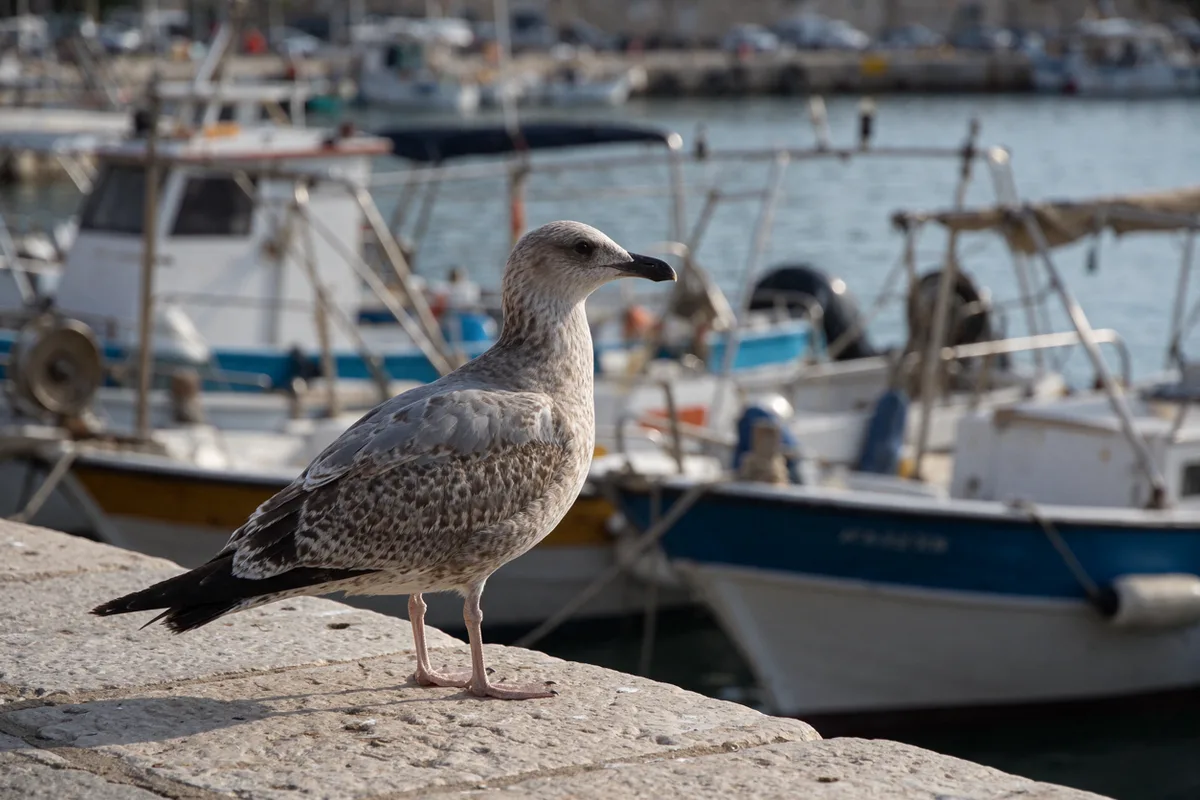
Young yellow legged gulls go through four years of plumage changes before reaching full adult appearance. Juveniles start with mottled brown and black feathers, similar to other large gull species at the same age.
One useful feature for first-winter birds is that they develop a pale grey saddle on the back quite quickly, faster than most other large gulls of the same age. By their second year they show more grey across the back, and by their third year they begin to resemble adults closely, though the bill and eye colours take time to fully develop.
Habitat and Range
The yellow legged gull is centered on the Mediterranean Sea and Black Sea basins. Its core breeding range covers Portugal, Spain, France, Italy, Greece, and the coasts of North Africa. Over the last few decades the species has pushed its range northward, and it now breeds in parts of Germany, Switzerland, and the Netherlands, with regular non-breeding visitors appearing in the UK and Scandinavia.
It uses a wide range of habitats:
- Rocky coastal cliffs and offshore islands
- Sandy and shingle beaches
- Estuaries and coastal lagoons
- Inland lakes, reservoirs, and rivers
- Urban rooftops in coastal cities
- Landfill sites and fishing harbors
Diet and Feeding Behavior
The yellow legged gull is an opportunistic omnivore. It eats almost anything it can find or steal, which is a big part of why it has expanded its range so successfully alongside human settlement.
Its diet includes:
- Fish caught at the surface or in shallow water
- Marine invertebrates: crabs, mussels, sea urchins, starfish
- Small mammals, lizards, and young birds
- Bird eggs raided from other nesting colonies
- Food waste from landfills, fishing boats, and harbors
- Earthworms and insects found on ploughed farmland
It is an aggressive feeder and will rob other seabirds of their catches, a behavior called kleptoparasites. At landfill sites, yellow legged gulls often dominate feeding flocks and displace smaller gull species from the best food sources.
Breeding and Nesting
Yellow legged gulls breed in colonies, though some pairs nest alone on suitable ledges. The breeding season begins in March and runs through June. Both parents share incubation duties over a period of 26 to 30 days.
Clutch size is typically two to three eggs. The eggs are pale greenish or brownish with dark brown spots and are well camouflaged against rock or dry vegetation. The chicks are covered in grey-brown down and are mobile within a day or two of hatching, though they stay close to the nest for protection.
Traditional nesting sites are cliff ledges, rock stacks, and island slopes near the sea. In recent decades, urban rooftop nesting has become increasingly common, particularly in Spanish and Italian coastal cities.
Yellow Legged Gull vs Similar Species
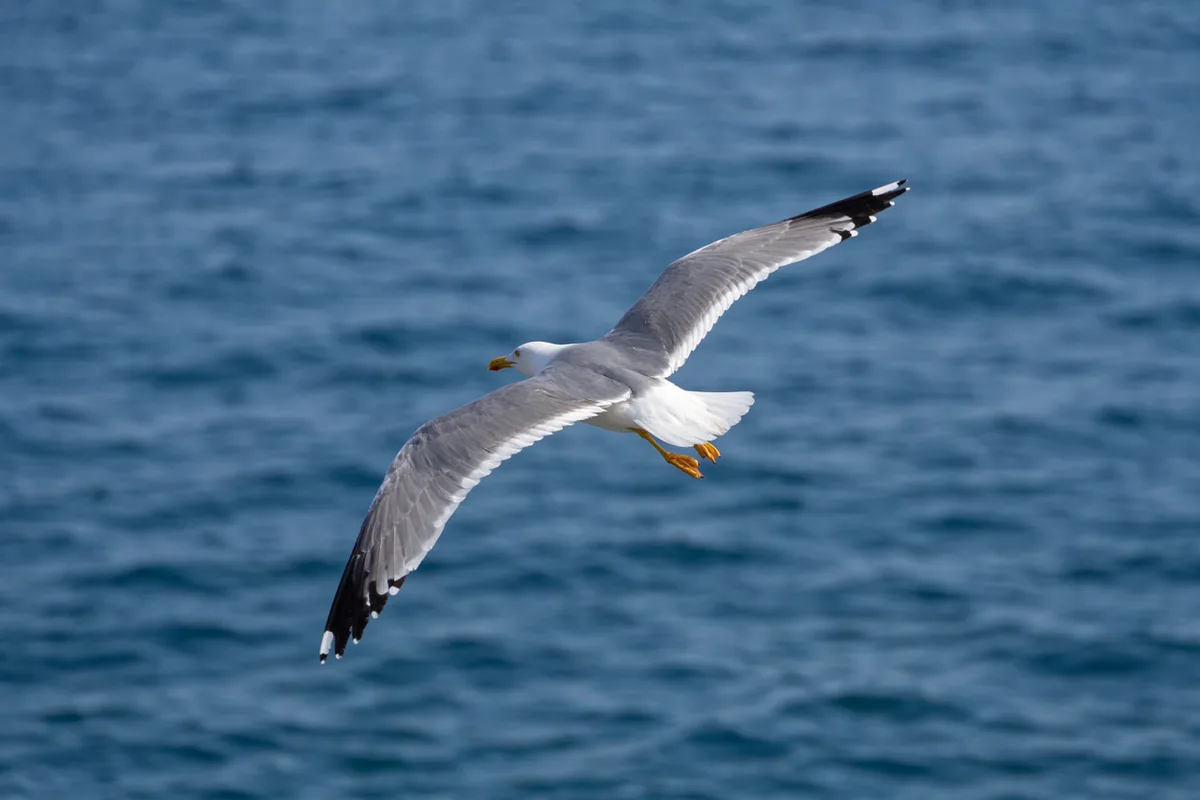
The yellow legged gull was treated as a subspecies of the Herring Gull for many decades. Getting to grips with the differences is one of the more rewarding identification challenges for birders in Europe.
| Feature | Yellow-legged Gull | Herring Gull | Lesser Black-backed Gull |
|---|---|---|---|
| Leg color | Bright yellow | Pale pink | Yellow |
| Back color | Medium-dark grey | Pale grey | Dark slate grey |
| Orbital ring | Red or orange-red | Yellow or orange | Red or orange |
| Winter head | Mostly clean white | Heavily streaked | Lightly streaked |
| Range | Mediterranean, expanding north | Northern and western Europe | Northern Europe, winters south |
The clearest separation from the Herring Gull is leg color combined with the winter head. A clean white head in December on a large gull with yellow legs strongly suggests yellow-legged gull. The Lesser Black-backed Gull also has yellow legs, but its back is much darker, almost charcoal, which makes separation straightforward in good light.
Conservation Status
The yellow legged gull is listed as Least Concern by the IUCN Red List. Its population is large, its range is growing, and it has adapted well to human-modified environments. For detailed species information and range maps, the Cornell Lab of Ornithology’s All About Birds and the RSPB species guide are excellent references.
If you enjoy identifying large seabirds and waterbirds, our guide on the African jacana covers another fascinating waterbird with striking field marks. You can also browse our birds of Southeast Asia guide for more species profiles.
Yellow Legged Gull Quick Facts
| Feature | Detail |
|---|---|
| Scientific name | Larus michahellis |
| Length | 52 to 68 cm (20 to 27 inches) |
| Wingspan | 120 to 158 cm (47 to 62 inches) |
| Key field mark | Bright yellow legs and red orbital eye ring |
| Range | Mediterranean, Black Sea, expanding into northern Europe |
| Habitat | Coasts, cliffs, urban rooftops, landfills, reservoirs |
| Diet | Fish, invertebrates, small animals, food waste |
| Breeding | March to June, 2 to 3 eggs, 26 to 30 days incubation |
| Conservation status | Least Concern (IUCN) |
Frequently Asked Questions
What is the yellow legged gull?
The yellow-legged gull is a large European seagull found mainly around the Mediterranean Sea. It is identified by its bright lemon-yellow legs, yellow bill with a red spot, and vivid red orbital ring around a pale yellow eye. It is now recognized as its own distinct species separate from the Herring Gull.
How do I identify a yellow legged gull?
Look for bright yellow legs, a medium-dark grey back, a yellow bill with a red spot, and a vivid red or orange-red ring around the eye. In winter the head stays clean white with very little streaking, separating it from the Herring Gull.
Where does the yellow-legged gull live?
The yellow-legged gull lives mainly around the Mediterranean Sea and Black Sea, including Spain, France, Italy, Greece, and North Africa. It has expanded into western and central Europe and is now seen regularly in the UK, Germany, and the Netherlands.
What does the yellow legged gull eat?
The yellow-legged gull eats fish, crabs, mussels, small mammals, bird eggs, and food waste from landfills and fishing ports. It is an opportunistic feeder and will rob other seabirds of food.
Is the yellow-legged gull the same as the Herring Gull?
No. The yellow legged gull was once treated as a subspecies of the Herring Gull but is now a separate species. The clearest differences are yellow legs versus the Herring Gull’s pink legs, and a cleaner white head in winter.
Is the yellow legged gull endangered?
No. The yellow legged gull is listed as Least Concern by the IUCN. Its population is large and growing, and it has adapted well to urban and human-modified environments across southern and western Europe.