Thailand is home to more than 1,050 documented bird species, earning its reputation as one of Southeast Asia’s greatest wildlife hotspots. From the misty limestone karsts of Chiang Mai to the coastal mangroves of the south and the busy urban green spaces of Bangkok, birdlife is vibrant and omnipresent. Yet, whether you are sipping an iced coffee at an open-air cafe, walking through a temple courtyard, or gazing out across the vast central rice plains, you do not need to embark on a deep jungle expedition to see incredible avian life.
This identification guide covers the most common birds in Thailand that travelers, nature enthusiasts, and residents encounter daily. Each profile provides precise field identification marks, vocal clues, habitat preferences, and fascinating natural history behaviors so you can identify what you are seeing with total confidence.
Identification Table of Common Birds in Thailand at a Glance
Use this reference table to quickly cross-check the most common species encountered across parks, towns, and agricultural fields:
| Common Name | Scientific Name | Primary Habitat | Distinctive Field Mark | Voice / Call |
|---|---|---|---|---|
| Common Myna | Acridotheres tristis | Urban parks, lawns, markets | Bright yellow eye patch, yellow bill & legs | Noisy squawks, whistles, mimicry |
| White-vented Myna | Acridotheres grandis | Roadsides, farmland, city verges | All-black head crest, pure white undertail | Harsh chatter and rapid chirps |
| Oriental Magpie-Robin | Copsychus saularis | Backyards, gardens, temple grounds | Stark black & white plumage, cocked tail | Rich, musical whistling song at dawn |
| Eurasian Tree Sparrow | Passer montanus | Cities, cafes, food courts | Solid chestnut crown + black cheek dot | Cheerful communal “tsip-tsip” chirping |
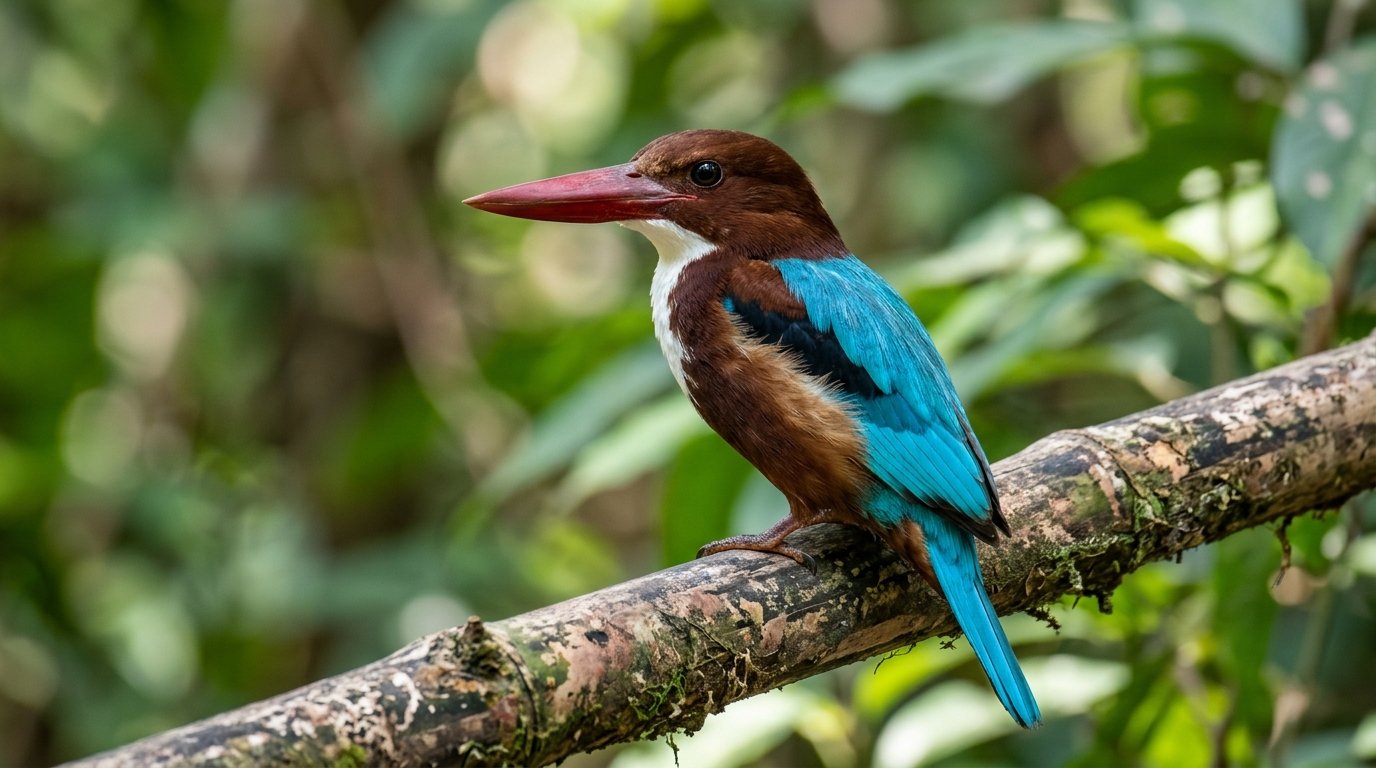
| White-throated Kingfisher | Halcyon smyrnensis | Telephone wires, wetlands, dry scrub | Electric turquoise wings, huge coral-red beak | Loud, ringing cackling laugh |
| Asian Openbill | Anastomus oscitans | Flooded rice paddies, wetlands | Large grey-white stork with arched bill gap | Mostly silent; bill-clattering at nest |
| Coppersmith Barbet | Psilopogon haemacephalus | Tree canopies, fruiting banyans | Vivid crimson forehead, yellow throat | Repetitive metallic “tuk… tuk… tuk” |
| Spotted Dove | Spilopelia chinensis | Gardens, quiet streets, countryside | Wide black-and-white checkered neck collar | Soft, rhythmic “coo-coo-kroo” |
| Olive-backed Sunbird | Cinnyris jugularis | Flower gardens, balconies, park shrubs | Bright yellow belly, dark iridescent throat | High-pitched metallic “zit-zit” notes |
| Asian Koel | Eudynamys scolopaceus | Dense urban tree tops, leafy suburbs | Male: glossy blue-black with ruby red eyes | Piercing, ascending “ko-OOO-el!” dawn call |
1. Urban & Backyard Birds: Bangkok Parks and Garden Companions
Thailand’s major urban centers, including Bangkok, Chiang Mai, and Phuket, support remarkably thriving bird populations thanks to extensive parklands, temple courtyards, and tree-lined canals (khlongs).
Common Myna (Acridotheres tristis) & White-vented Myna (Acridotheres grandis)
Belonging to the starling family (Sturnidae), mynas are the undisputed avian rulers of Thailand’s city pavements, lawns, and open-air food courts. If you’ve ever explored what makes starlings so uniquely adaptable, you will recognize their bold, swaggering gait immediately.
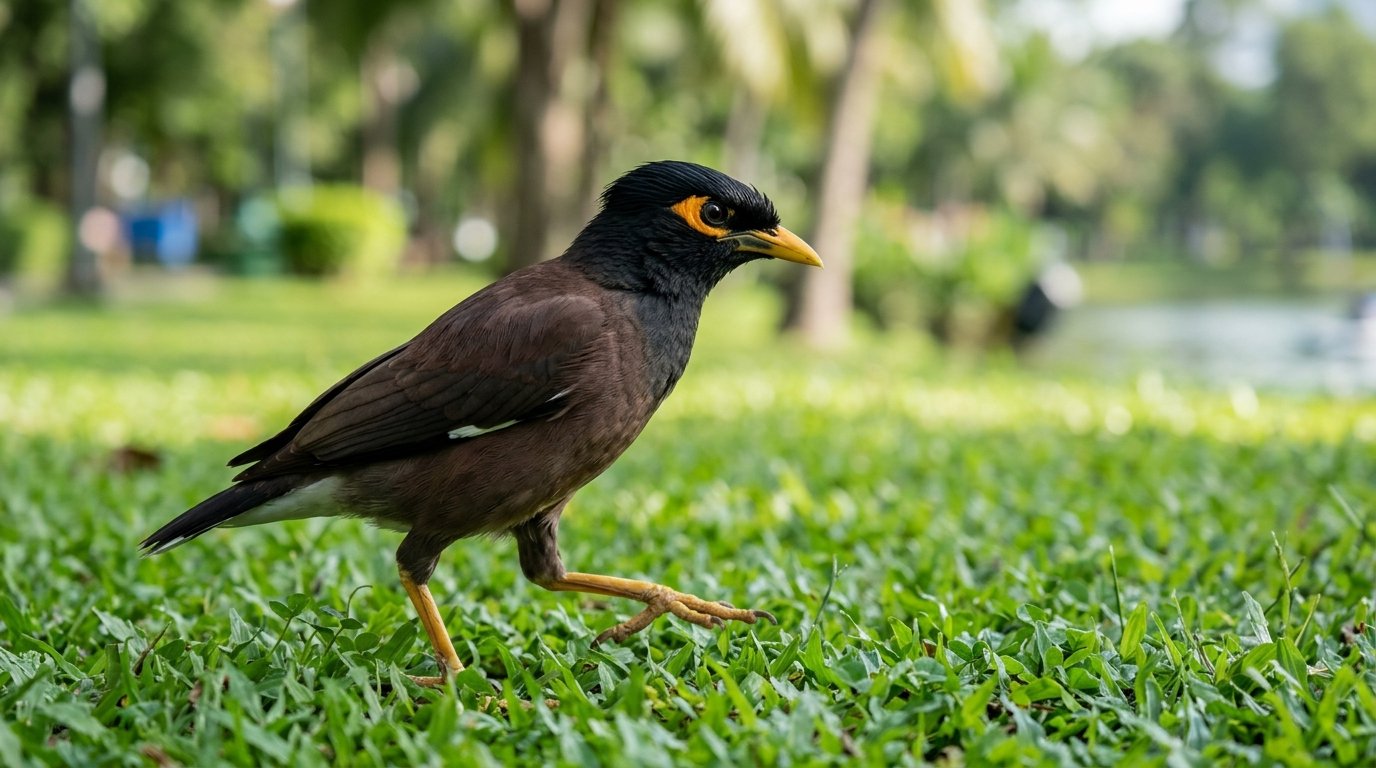
- How to identify: The Common Myna has a rich chocolate-brown body, a jet-black hooded head, and an unmistakable bare patch of bright yellow skin framing each eye. In flight, it reveals brilliant white wing patches. The equally widespread White-vented Myna (often called the Great Myna) is almost entirely dark charcoal-slate with an upright tuft or crest above the bill and a snow-white undertail.
- Behavior & Habits: Mynas are highly social, omnivorous, and fearless. They walk upright rather than hop, strutting across grassy lawns in parks like Lumphini or Benchakitti looking for insects, dropped fruit, and food crumbs. They possess a dizzying repertoire of clicks, whistles, shrieks, and human mimicry.
Oriental Magpie-Robin (Copsychus saularis)
Often considered the unofficial garden mascot of Thailand, the Oriental Magpie-Robin is an energetic songbird that treats every ornamental garden and temple sanctuary as its personal performance stage. Bird lovers who wonder why birds sing so passionately at dawn will find the answer in this bird’s glorious morning serenades across Southeast Asia.
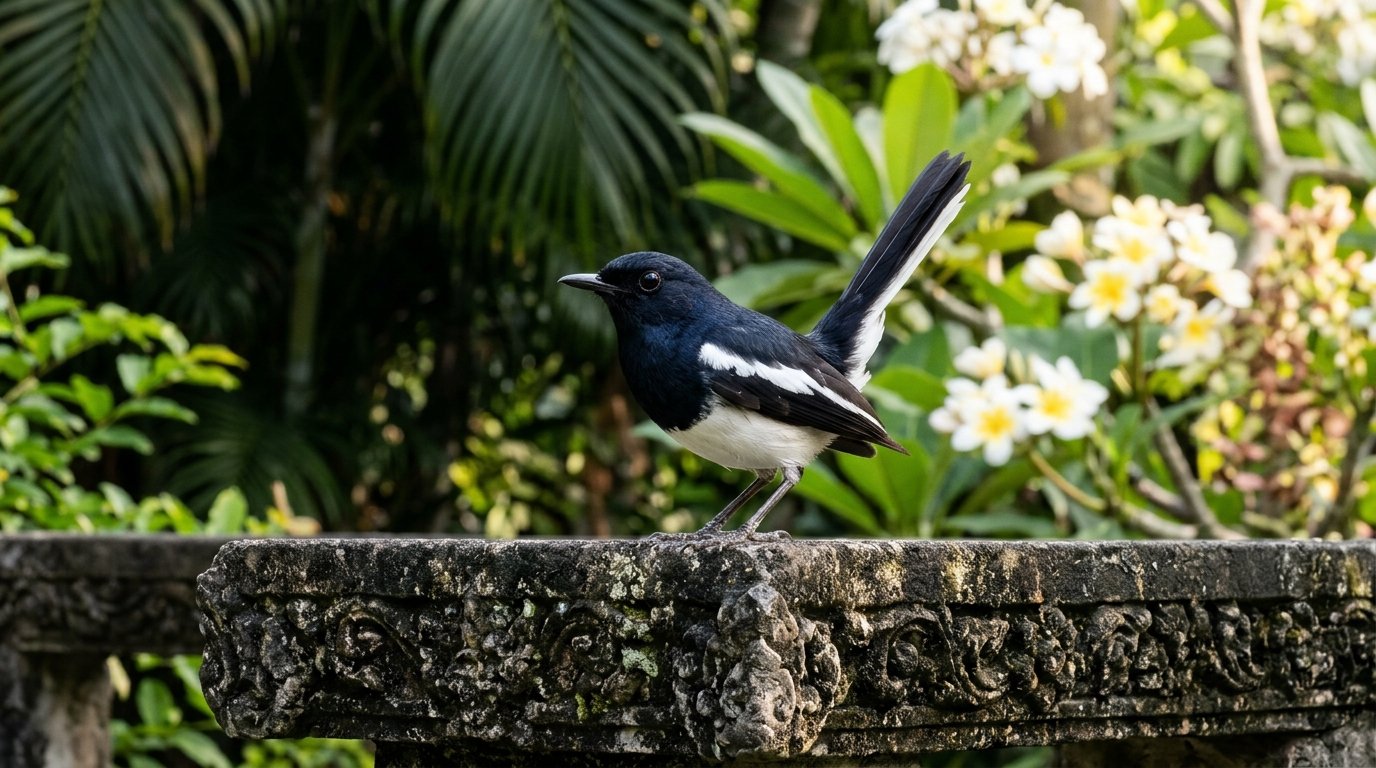
- How to identify: Males showcase crisp, tuxedo-like plumage with a glossy blue-black upper body, hood, and breast, contrasting against a pristine white belly and bold white wing bars. Females share the identical pattern but substitute slate-grey for the glossy black.
- Key Field Clue: Look for its long black-and-white tail, which it habitually flicks upright into a proud 90-degree cocked position while pausing between hops.
- Where to spot: Flower beds, patio walls, school grounds, and quiet park walkways throughout Thailand.
Eurasian Tree Sparrow (Passer montanus)
While the House Sparrow (Passer domesticus) dominates cities in Europe and North America, Thailand’s urban landscapes belong almost exclusively to the Eurasian Tree Sparrow. These industrious little seed-eaters nest in the eaves of traditional Thai teak houses, temple rafters, and modern apartment air conditioning units.
- How to distinguish from House Sparrows: Both males and females share the exact same plumage: a rich, solid chestnut-brown crown (unlike the grey cap of male House Sparrows) and a distinct, clean black circular spot on each white cheek.
- Behavior: They forage in cheerful, bustling flocks around market stalls, sidewalk street-food vendors, and park picnic benches.
Olive-backed Sunbird (Cinnyris jugularis)
Often affectionately mistaken by tourists for hummingbirds, sunbirds belong to the Old World family Nectariniidae and fill the identical ecological niche in tropical Asia. If you cultivate or enjoy flowering garden plants that attract nectar-loving birds, you will see them hovering around hibiscus and bougainvillea across Thailand.
- How to identify: Tiny and hyperactive (measuring only 10–11 cm), the male features an olive-green back, a luminous bright yellow belly, and a stunning iridescent dark blue-purple metallic throat shield that glints in sunlight. Females have entirely bright yellow underparts with olive upperparts.
- Where to spot: Balcony flowerboxes, flowering trees, and ornamental shrubbery, where they hover briefly to extract nectar with their long, slender, decurved beaks.
2. Waterways, Paddies & Open Country: Central Plain Icons
Beyond the cities, Thailand’s central basin is dominated by extensive flooded rice paddies, rivers, and coastal wetlands. These agricultural landscapes offer abundant food for specialized wading birds and insect hunters.
White-throated Kingfisher (Halcyon smyrnensis)
One of the most striking common birds in Thailand, the White-throated Kingfisher is famous for being seen far away from water. It perches stoically on utility wires, telephone poles, and fence posts along rural highways, scanning dry fields for lizards, grasshoppers, and small frogs.
- How to identify: A large, robust bird with electric turquoise-blue back and wings that seem to glow against tropical green foliage. It features a rich chocolate-brown head and underparts, a stark white throat patch, and a massive, dagger-like coral-red bill.
- In Flight: When taking wing, it flashes large white circular wing patches against the turquoise primaries, accompanied by a loud, ringing chattering call.
Asian Openbill (Anastomus oscitans)
Traveling by train or car north from Bangkok toward Ayutthaya or Nakhon Sawan, you will inevitably see hundreds of large, pale storks stalking purposefully through flooded paddies. These are Asian Openbills, one of the most successful large wading birds in Southeast Asia.
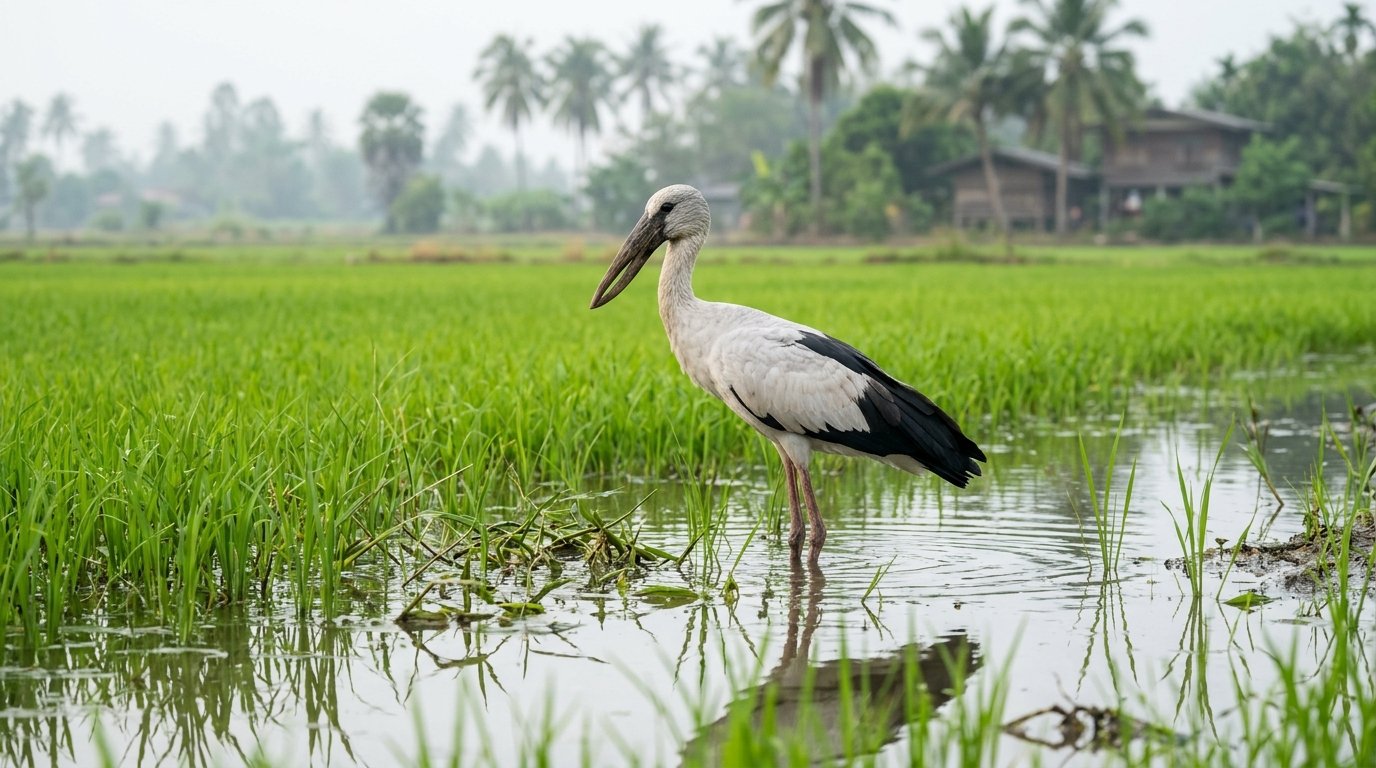
- The Famous Gap: The defining feature of this species is an arched gap between the upper and lower mandibles of adult birds. Contrary to old myths, this gap is not used to crush shells; it acts like a nutcracker’s hinge, allowing the sharp tip of the lower bill to penetrate the operculum (trapdoor) of golden apple snails and extract the meat without breaking the shell.
- Identification: Standing over 80 cm tall, with silvery greyish-white body plumage and contrasting glossy black flight feathers and tail. In breeding season, their plumage turns crisp white.
Javan Pond-Heron (Ardeola speciosa) & Eastern Cattle Egret (Bubulcus coromandus)
Two ever-present wetland companions seen across agricultural plains:
- Javan Pond-Heron: When crouched in muddy water or grass, it looks like an unassuming brown-streaked, camouflaged bird. But the moment it takes flight, it bursts into a brilliant, dazzling flash of pure snow-white wings, surprising anyone who hadn’t noticed it standing still.
- Eastern Cattle Egret: Compact, stocky white egrets with yellow-orange bills that follow water buffalo, tractors, and livestock across pastures, snapping up grasshoppers disturbed by grazing hooves. During breeding season, adults develop warm golden-buff plumes on the head, chest, and back.
3. Canopy, Gardens & Tree-Tops: Vocal Masters and Fruit Seekers
Coppersmith Barbet (Psilopogon haemacephalus)
If you spend any morning in Thailand near trees, you will hear a rhythmic, steady metallic tapping echoing through the air: tuk… tuk… tuk… tuk… at roughly one to two beats per second. This sound, which resembles a metalworker shaping copper vessels with a tiny hammer, is the voice of the Coppersmith Barbet.
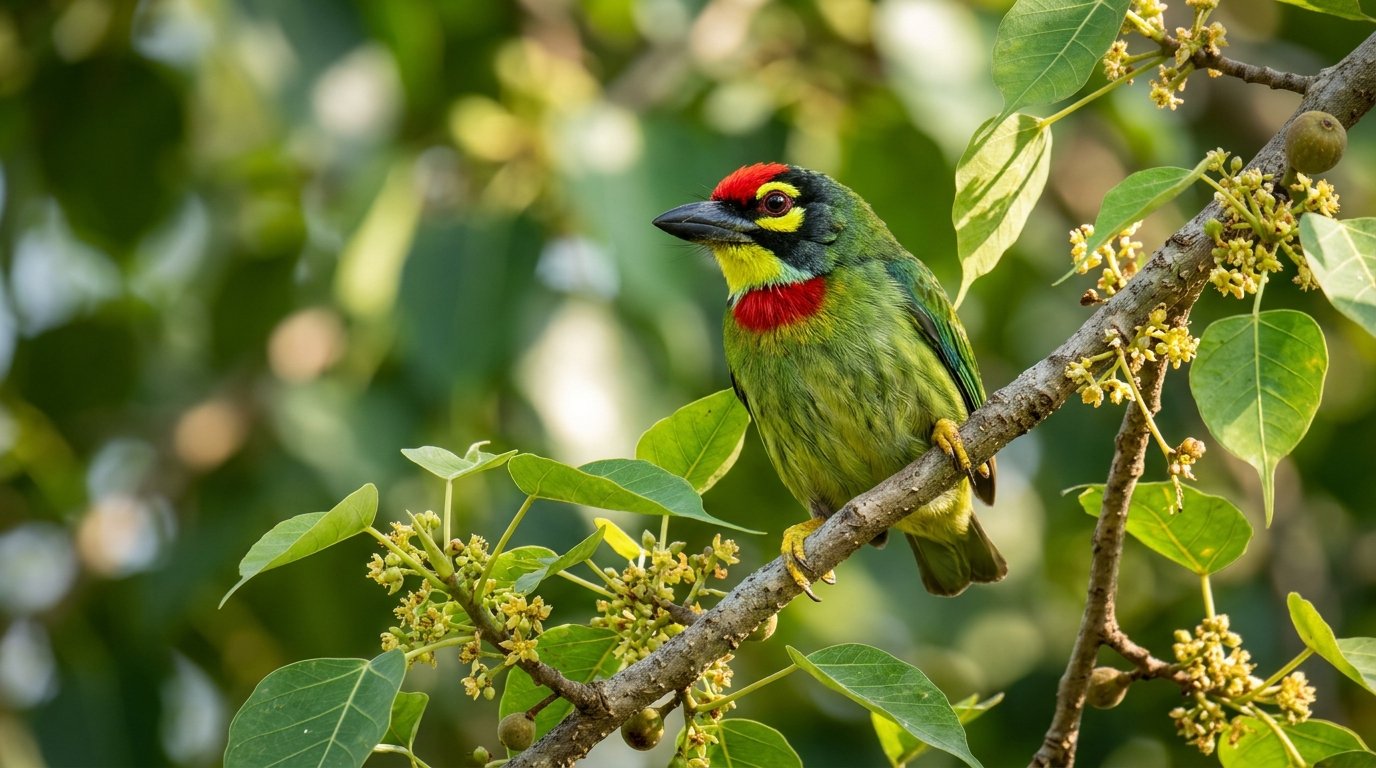
- How to spot them: Despite their vibrant coloration—a grass-green body, scarlet-red forehead and breast band, canary-yellow throat, and bright crimson feet—they are surprisingly difficult to spot because they sit motionless in the upper canopy of fruiting fig (Ficus) trees.
- Nesting behavior: Barbets are related to toucans and woodpeckers and use their heavy, chisel-like bills to excavate clean round nest cavities directly inside rotting tree branches.
Asian Koel (Eudynamys scolopaceus)
No account of common birds in Thailand is complete without the Asian Koel, the famous early-morning wake-up alarm of the kingdom. A large member of the cuckoo family, the Koel’s ringing call begins in the pre-dawn darkness and intensifies through the breeding season (February through August).
- Vocalization: The male produces an unmistakable, booming call that starts low and accelerates upward in pitch and volume: “ko-OOO… ko-OOO… ko-OOO!”, carrying across city blocks.
- Appearance: Males are sleek and glossy blue-black with a pale greenish bill and piercing ruby-red eyes. Females look entirely different: handsomely barred and spotted in brown and white to camouflage in dense leafy crowns.
- Brood Parasite: Like many cuckoos, Koels build no nests of their own. They lay their eggs in the nests of Common Mynas and House Crows, which unwittingly raise the larger Koel chicks.
Spotted Dove (Spilopelia chinensis) & Zebra Dove (Geopelia striata)
Two gentle, widespread doves that bring peaceful rhythm to Thai mornings:
- Spotted Dove: A medium-sized dove with a warm rosy-grey breast, delicate buff-brown wings, and a prominent broad black neck patch peppered with stark white spots (“pearl-necked dove”). Their gentle, syncopated cooing is a staple of suburban mornings.
- Zebra Dove: Small, dainty doves with fine zebra-like black-and-white barring over the neck and breast, and a soft blue face. Known locally as Nok Khao Chawa, they are deeply cherished in southern Thailand for their soft, melodious staccato cooing and are celebrated in traditional singing bird festivals.
Black Drongo (Dicrurus macrocercus)
Perched on electrical wires across open farmland, the Black Drongo resembles a vigilant sentinel. Glossy all-black with a deeply forked tail, this agile aerialist darts out to snatch flying beetles and moths mid-air before returning to its favorite wire perch. Drongos are famously aggressive defenders of their territory, fearlessly dive-bombing crows, hawks, and even monkeys that wander too close to their nests.
Best Locations for Birdwatching in Thailand
If you want to observe these common species alongside rarer tropical migrants and wintering visitors, Thailand offers accessible, world-class birdwatching locations:
- Bangkok City Parks:
- Lumphini Park & Benchakitti Forest Park: Superb for Oriental Magpie-Robins, Coppersmith Barbets, Olive-backed Sunbirds, pond-herons, and wintering flycatchers.
- Suan Rot Fai (Wachirabenchathat Park): A sprawling former golf course adjacent to Chatuchak Market featuring mature trees, ponds, and open grasslands with over 150 recorded species.
- Central Paddies & Wetlands (Central Thailand):
- Bang Pu Recreation Centre (Samut Prakan): Just 45 minutes south of Bangkok on the Gulf of Thailand, famed for thousands of Brown-headed Gulls and wintering waders from November through April.
- Bueng Boraphet (Nakhon Sawan): Thailand’s largest freshwater swamp, supporting huge populations of Asian Openbills, whistling ducks, jacanas, and bitterns.
- National Parks:
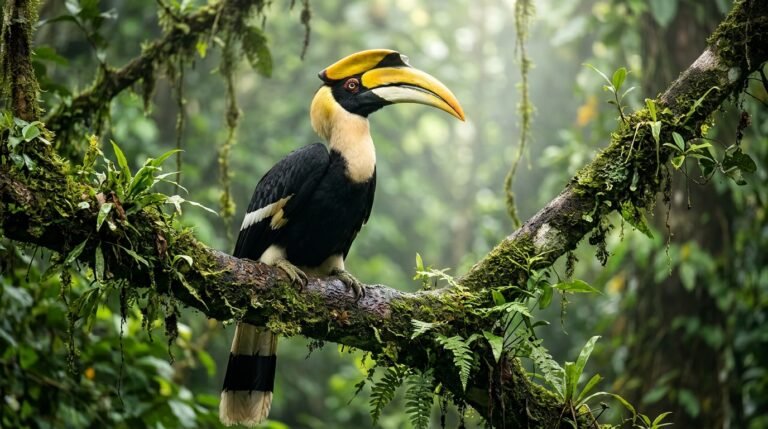
- Khao Yai National Park: Just 2.5 hours northeast of Bangkok, home to Great Hornbills, Asian Fairy Bluebirds, barbets, and trogons.
- Doi Inthanon National Park (Chiang Mai): Thailand’s highest peak, boasting high-elevation Himalayan montane specialties found nowhere else in the country.
Practical Tips for Identifying Birds in Thailand
Field Etiquette & Observation Strategy:
- Get Out Early: Tropical bird activity peaks from sunrise (around 6:00 AM) to 9:30 AM before high temperatures drive birds into dense shaded cover.
- Listen to the Calls: In dense canopies, you will hear species like the Coppersmith Barbet and Asian Koel long before you spot them. Learn their distinctive calls with field audio apps.
- Carry Quality 8×42 Binoculars: 8x magnification provides a wide field of view ideal for tracking quick movements among dense tropical foliage.
- Respect Temple Grounds: Wats (Buddhist temples) frequently feature mature sacred bodhi trees and verdant gardens that serve as quiet wildlife sanctuaries in bustling cities.
Frequently Asked Questions About Thailand Birds
What is the most common bird in Bangkok?
The most frequently seen birds in Bangkok are the Eurasian Tree Sparrow, the Common Myna, and the Oriental Magpie-Robin. In gardens and parks, you will also constantly encounter Zebra Doves, Spotted Doves, and Olive-backed Sunbirds.
What is Thailand’s national bird?
Thailand’s official national bird is the Siamese Fireback (Lophura diardi), a magnificent forest pheasant featuring glossy metallic blue-grey plumage, a bright crimson facial mask, and an arched tail. Unlike the common urban and agricultural species, it is shy and inhabits dense evergreen rainforests such as Khao Yai National Park.
What is the loud bird that calls early in the morning in Thailand?
That booming, repetitive call that begins at sunrise is produced by the Asian Koel (Eudynamys scolopaceus). The male calls with an escalating, two-note whistle: “ko-OOO-el… ko-OOO-el!” that carries across neighborhoods during the spring and summer breeding seasons.
Are there kingfishers in Thailand?
Yes! Thailand boasts 16 distinct kingfisher species. The most widespread is the White-throated Kingfisher, which thrives even far from water in agricultural fields and open country. Other species frequently seen include the Common Kingfisher (a winter migrant), the Black-capped Kingfisher, and the Collared Kingfisher along coastal mangroves.
When is the best time of year for birdwatching in Thailand?
The premier birding season spans from November through March. During these cooler, drier winter months, resident tropical species are joined by hundreds of thousands of migratory birds traveling south along the East Asian–Australasian Flyway from Siberia and Northern China.