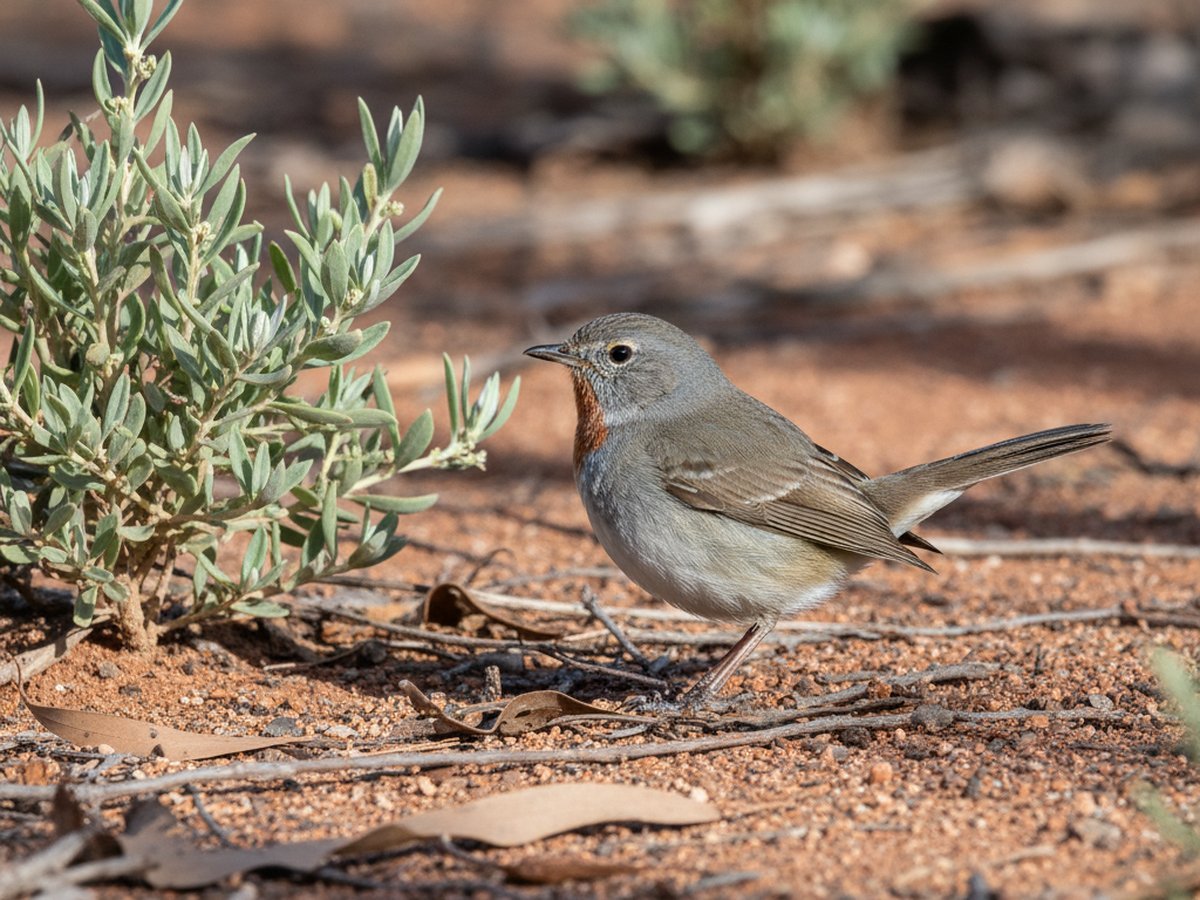
The redthroat (Pyrrholaemus brunneus) is a small songbird of Australia’s dry interior. Most of it is plain gray-brown, and it spends much of its time hopping through low shrubs. Males have a rusty throat patch, which gives the bird its name, and it is known for copying other birds’ calls.
The Basics
- The bird is 11 to 12 cm (4.3 to 4.7 in) long.
- It lives across mainland Australia, except the Australian Capital Territory and Tasmania.
- It favors acacia and chenopod shrublands in arid and semi-arid country.
- It breeds from June to December, depending on the region.
- The IUCN rates it Least Concern, but numbers are falling in parts of its range.
What Is a Redthroat?
The species was described by the English naturalist John Gould in 1841 and given the scientific name Pyrrholaemus brunneus. It belongs to the Acanthizidae, a family of small Australian songbirds that includes thornbills and fieldwrens. The genus Pyrrholaemus has only two species. The other is the speckled warbler (Pyrrholaemus sagittatus).
The two species are closely related, and they share some traits. One is the solid chocolate-brown egg, which is covered in the breeding section below. If you need to tell them apart in the field, check plumage and range details in a regional field guide rather than relying on the genus name.
How to Identify a Redthroat
The bird is about 11 to 12 cm (4.3 to 4.7 in) long. Its plumage is gray-brown overall, with a whitish-gray underbody and pale buff flanks. The back and tail are darker than the rest of the body. Both sexes have thin off-white eye rings and fine scalloping on the forehead. The muted tones blend with dry soil and stems, which helps the bird stay hidden in scrub.
When you are trying to identify one, look for these features:
- Throat patch: adult males have a small rusty-brown patch on the throat. Females and juveniles lack it.
- Tail tips: white patches on the tail tips show in flight and when the tail is folded.
- Body shape: the tail is longer, and the body less compact, than a thornbill’s.
- Tail carriage: the tail is held less upturned than a fieldwren’s or a heathwren’s.
Because females and juveniles have no throat patch, a bird seen from behind or in shade may stay unsexed. Confirm the patch before you call a bird a male.
Many identification guides on this site compare a bird’s shape, color, and markings with similar species. Our Kentish Plover guide shows how identification, habitat, and breeding details can be organized in one article.
Where Redthroats Live
Redthroats are endemic to mainland Australia, which means they are found nowhere else in the world. They occur in every state and territory except the Australian Capital Territory and Tasmania. The species is most common in Western Australia and South Australia. Smaller populations live in the southern Northern Territory, inland southwestern Queensland, and the mallee country of northwestern Victoria.
Within that range, the species favors arid and semi-arid country with acacia and chenopod shrublands. Chenopod shrublands are dominated by salt-tolerant plants such as saltbush. The plants most often linked to the species are mulga, saltbush, and bluebush. Their dense low cover gives the bird shelter and places to forage.
The bird is mostly sedentary. One seen in a patch of suitable habitat is therefore likely to be a local resident. That makes the condition of local habitat especially important for the species.
Other dry regions have their own ground-foraging songbirds. Our guide to backyard birds in New Mexico covers common species in another dry part of the world, which can help you compare how birds use arid landscapes.
Behavior
The bird spends much of its time on the ground. It hops over bare soil and leaf litter, and it darts through low branches and shrubs when it needs cover. Its small size and low posture help it stay hidden in scrub.
The bird is also a mimic. It can copy the calls of several other birds, including the pied butcherbird, rufous fieldwren, grey fantail, fairywrens, and thornbills. A bird calling nearby can therefore sound like a different species from the one actually singing.
Males sing more often during the breeding season. Song is one of the most useful clues for finding this species, but because of mimicry, you should confirm a sighting before you trust a song alone.
What Redthroats Eat
The bird is an omnivore. Its diet includes:
- Seeds from grasses and shrubs
- Spiders
- Insects
- Small snails and other gastropods
Most foraging happens on the ground or in vegetation under about 1 meter (3 feet) high. That keeps the bird close to the cover it uses for protection.
How to Look for One
If you want to find one, the habitat and behavior above suggest a practical approach. These tips are general advice based on the species’ habits, not a guarantee of a sighting:
- Scan low shrubs and open ground in mulga, saltbush, and bluebush country, where the species is most common.
- Search during the breeding season, from about June to December, when males sing more often.
- Watch for birds that hop on the ground and then dart into cover.
- Treat any song as a lead, and check whether the bird you see matches the call.
Breeding
The species breeds from about June to December. The timing varies by region, and breeding has been linked to periods of higher rainfall.
The nest is a large, domed or spherical structure with a round entrance near the top. It is built from bark strips and plant fiber and is often lined with feathers or fur. Nests are placed on or near the ground, in shrubs, in grass tussocks, at the base of trees, among fallen logs, or in small depressions.
A typical clutch has two to four eggs. The eggs are solid chocolate-brown. Among the Acanthizidae, only the redthroat and the speckled warbler are known to lay solid chocolate-brown eggs. The female alone incubates the eggs.
Conservation Status
The IUCN lists the redthroat as Least Concern. That rating reflects its wide range, but the species is declining in many areas. BirdLife International links the declines to habitat loss and degradation, and population density has dropped along the wetter fringes of the range.
Regional status is more serious. The redthroat is listed as Vulnerable in New South Wales. In Victoria, it was placed on the state’s advisory list as endangered in 2007, and BirdLife describes the Victorian population as nearly extinct, with only a few fragmented populations left.
Because the bird depends on dense low shrubland, protecting it mainly means keeping that cover intact. Clearing mulga, saltbush, and bluebush removes both shelter and foraging ground, so habitat protection is the most direct way to help the species.
Frequently Asked Questions
Where do redthroats live?
Redthroats live on mainland Australia, in arid and semi-arid shrublands. They do not occur in the Australian Capital Territory or Tasmania.
Why is it called a redthroat?
The name refers to the rusty-brown throat patch that adult males show. Females and juveniles have no patch.
Is this species endangered?
Globally, the IUCN rates it as Least Concern. The species is declining in parts of its range and is listed as Vulnerable in New South Wales, so local conditions matter.
Can you see redthroats in the wild?
Yes, within its range. The best places to look are mulga, saltbush, and bluebush country in Western Australia and South Australia, where the species is most common. Sightings are easier in the breeding season, when males sing more often.