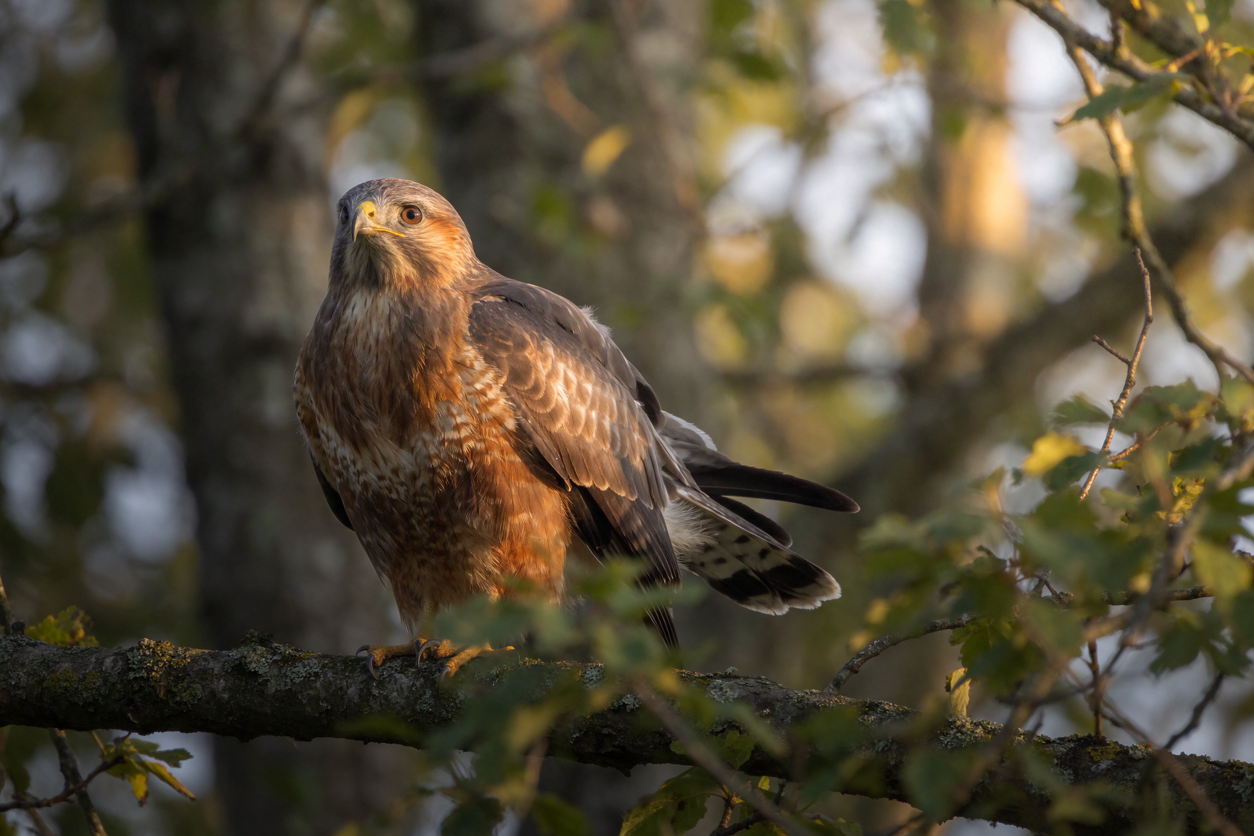
The Broad winged Hawk (Buteo platypterus) is a small, stocky raptor that breeds in eastern North American forests and travels thousands of miles to South America each winter. It is best known for its spectacular autumn migrations, when thousands of birds spiral together in swirling flocks called kettles. For many birders, spotting a Broad-winged Hawk kettle is one of the most exciting wildlife events of the year.
Broad winged Hawk: Quick Facts
| Feature | Details |
|---|---|
| Scientific Name | Buteo platypterus |
| Family | Accipitridae |
| Length | 13 to 19 inches (34 to 48 cm) |
| Wingspan | 32 to 39 inches (81 to 100 cm) |
| Weight | 9 to 20 oz (255 to 560 g) |
| Lifespan | Up to 14 years in the wild |
| Range | Breeds in eastern North America; winters in Central and South America |
| Habitat | Deciduous and mixed forests near water |
| Diet | Mammals, amphibians, reptiles, large insects |
| Conservation Status | Least Concern (IUCN) |
What Does a Broad winged Hawk Look Like?
The Broad winged Hawk is small for a buteo. Adults have a brown back and a reddish-brown, horizontally barred chest. Their tail is their most striking feature, with bold, equal-width black and white bands. In flight, their underwings appear mostly white with a sharp dark border along the trailing edge and wingtips.
Juveniles look different. They have streaked, light brown underparts rather than barred ones. Their tails show thinner, less bold bands. First-year birds can be tricky to identify, but the pointed wingtips and overall small, compact shape are helpful clues.
ℹ️ Did You Know?The Broad winged Hawk is the smallest buteo in North America, roughly the size of an American Crow. Its compact shape and banded tail make it one of the easier hawks to identify when it’s perched.
How Big Is a Broad winged Hawk?
These hawks measure 13 to 19 inches long. Their wingspan reaches 32 to 39 inches. Despite their small size, they are powerful hunters capable of catching snakes longer than themselves.
| Measurement | Broad-winged Hawk | Red-tailed Hawk |
|---|---|---|
| Length | 13-19 in | 18-26 in |
| Wingspan | 32-39 in | 45-52 in |
| Weight | 9-20 oz | 24-52 oz |
Broad winged Hawk Range and Habitat
During the breeding season, Broad winged Hawks live in large, unbroken tracts of deciduous and mixed deciduous-coniferous forest. They are found across eastern North America, from Nova Scotia and Ontario south through the Appalachians and west to Texas and the Great Plains edge. They prefer forests near streams, ponds, or wet areas, which offer a steady supply of frogs and salamanders.
They are secretive birds during the summer. Even in areas where they are common, you may hear their thin, piercing whistle more often than you see them. They tend to stay under the forest canopy and avoid open areas while nesting.
In winter, Broad winged Hawks move to tropical forests in Central and South America, from southern Mexico south through Colombia, Venezuela, and Brazil.
💡 Expert TipIf you want to find a Broad winged Hawk during breeding season, listen for its call near forest streams and edges. Their whistle is surprisingly thin and high-pitched for a hawk, almost like a songbird.
Broad winged Hawk Migration: The Kettle Spectacle
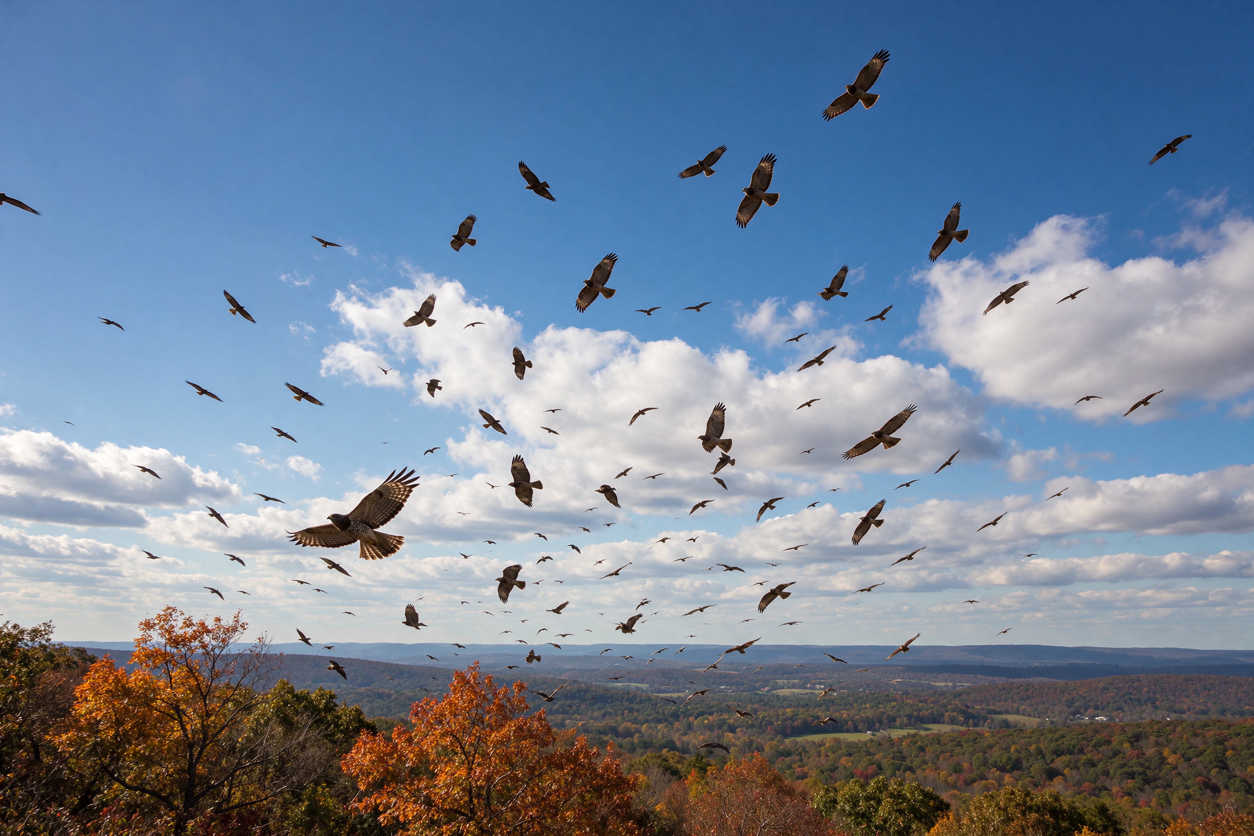
Few wildlife events in North America compare to the Broad-winged Hawk migration. Every September, tens of thousands of these birds travel south in one of the continent’s most dramatic raptor movements. Because they are reluctant to fly over large bodies of open water, they concentrate along mountain ridges, peninsulas, and coastlines, where they can ride thermals and updrafts.
When conditions are right, hundreds or thousands of Broad-winged Hawks circle together on a thermal column, rising high into the sky before gliding south in streams. These swirling groups are called kettles, and peak numbers usually occur around the third week of September.
Best Places to See Broad winged Hawk Migration
- Hawk Mountain Sanctuary, Pennsylvania: One of the most famous hawk-watching sites in the world. Single-day counts of tens of thousands of Broad-winged Hawks are possible.
- Hawk Ridge, Duluth, Minnesota: A legendary site along Lake Superior where birds funnel before heading south.
- Cape May, New Jersey: A coastal concentration point for migrating hawks, including Broad-wingeds.
- Veracruz, Mexico: Millions of raptors pass through this corridor each autumn, with Broad-winged Hawks forming the bulk of the movement.
⚠️ Important NoteBroad-winged Hawk migration is highly weather-dependent. The best days come after cold fronts push through from the northwest, often clearing skies and providing strong thermals. Poor conditions can mean almost no birds are visible, while ideal days can produce spectacular counts.
How Far Do They Travel?
The full journey from Canadian breeding grounds to South American wintering sites can exceed 4,000 miles each way. Some birds banded in the northeastern United States have been recovered in Brazil and Peru. They make this journey twice a year, every year of their lives.
Learn more about how birds communicate during migration with calls and signals.
What Do Broad winged Hawks Eat?
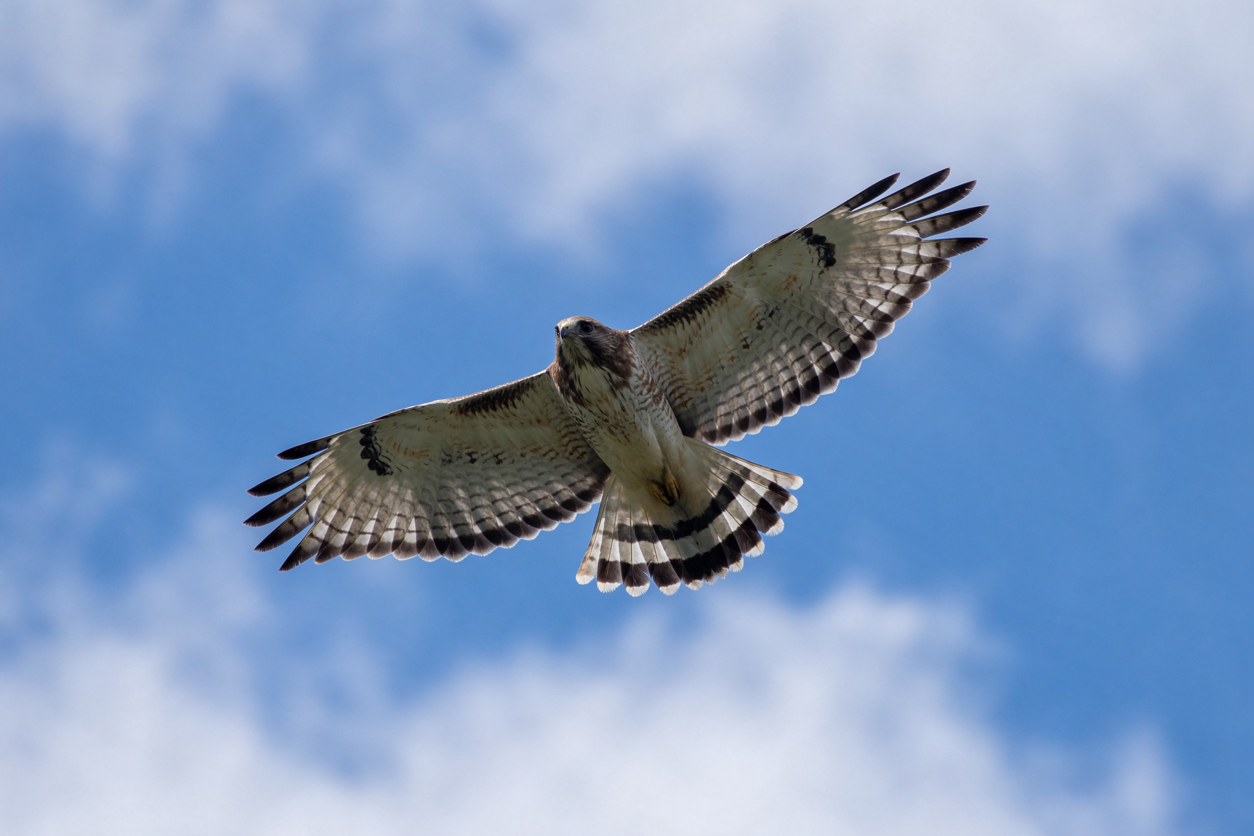
Broad winged Hawks are opportunistic hunters. They eat a wide range of prey depending on what is available. During the breeding season in North America, their diet includes:
- Small mammals: chipmunks, voles, mice, shrews
- Amphibians: frogs, toads, salamanders
- Reptiles: snakes, lizards
- Large insects: caterpillars, beetles, grasshoppers
- Occasionally, small birds and their nestlings
These hawks are skilled at catching snakes. They will perch quietly on a branch near a forest opening or the edge of a pond, then drop onto prey below. This sit-and-wait strategy is very effective in dense forest, where long chases would be difficult.
On their wintering grounds in South America, their diet shifts toward more insects, spiders, crabs, and small lizards. This flexibility is one reason Broad-winged Hawks are so successful across such a wide range of habitats.
If you are interested in what other hawks eat, see our guide to what hawks eat for a broader look at raptor diets.
⭐ Expert InsightBroad-winged Hawks are considered one of the most effective snake hunters among North American raptors. Their relatively long legs help them grip and subdue slippery prey without getting bitten. Snakes can make up a surprisingly large portion of their summer diet in areas where both are common.
Broad winged Hawk Nesting and Breeding
Broad winged Hawks nest in mature deciduous or mixed forests. They typically build their nest in the fork of a large tree, 25 to 40 feet above the ground. Both the male and female help construct a bulky platform of sticks. They often decorate the nest rim with fresh green sprigs of leaves, a behavior common among buteos.
The female lays 1 to 4 eggs, usually 2 or 3. Eggs are whitish or pale blue and speckled with brown markings. Incubation lasts about 28 to 31 days. The female does most of the incubating while the male hunts and brings food to her.
After hatching, both parents feed the chicks. Young birds begin climbing onto nearby branches at around 4 to 5 weeks and take their first flights at around 5 to 6 weeks. Families often stay together for a few weeks after the young hawks learn to fly before they scatter ahead of the autumn migration.
Breeding Season Timeline
- April to May: Adults return to North American breeding grounds
- May: Nest construction or refurbishment begins
- May to June: Eggs laid and incubated
- June to July: Chicks hatch and are fed by both parents
- July to August: Young hawks fledge and learn to hunt
- September: Adults and juveniles migrate south
Broad winged Hawk Call and Sounds
The Broad-winged Hawk’s call is surprisingly delicate for a raptor. It is a high-pitched, thin, two-part whistle: pee-wheeeee or kih-keeeee. Many people compare it to the sound of a tea kettle or a Eastern Wood-Pewee. First-time listeners are sometimes surprised by how soft and high the call sounds compared to the larger, louder Red-tailed Hawk.
The call is most often heard during the breeding season, especially when territorial disputes occur near the nest. During migration, Broad-winged Hawks are generally quiet.
You can hear verified recordings of the Broad-winged Hawk’s call at the Cornell Lab of Ornithology’s All About Birds website.
How to Identify a Broad-winged Hawk
Identifying a Broad-winged Hawk becomes much easier once you know what to look for. Here are the key field marks:
Adult Identification
- Size: Small and compact, roughly crow-sized
- Tail: Bold, equal-width black and white bands (usually 1 to 3 bold bands)
- Underparts: Reddish-brown horizontal barring on chest and belly
- Underwings: Clean white with a distinct dark trailing border and dark wingtips
- Shape in flight: Stocky body, pointed wingtips, short tail
Juvenile Identification
- Brown and buff streaking on underparts instead of horizontal bars
- Thinner, less bold tail bands
- Dark streak through the eye (malar stripe)
- Similar shape and underwing pattern to adults
Broad winged Hawk vs. Red-tailed Hawk
| Feature | Broad-winged Hawk | Red tailed Hawk |
|---|---|---|
| Size | Crow-sized, compact | Large, bulky |
| Tail | Bold black and white bands | Rusty red (adult) |
| Underparts | Reddish-brown bars | Pale with dark belly band |
| Habitat | Deep forest | Open areas, field edges |
| Call | Thin, high whistle | Loud, raspy scream |
For more help identifying North American birds of prey, check our guide to what eats a hawk, which covers the predators and threats that raptors face in the wild.
💡 Expert TipDuring September migration, look for Broad-winged Hawks between 10 AM and 3 PM on days following a cold front. Watch the sky for swirling dots that keep rising rather than drifting. Those are your kettle. Binoculars are helpful, but kettles are often visible with the naked eye when numbers are high.
Broad-winged Hawk Conservation Status
The Broad winged Hawk is listed as Least Concern by the International Union for Conservation of Nature (IUCN). Its global population is estimated in the millions, and breeding numbers across North America are considered stable or slightly increasing.
However, the Puerto Rican Broad-winged Hawk (Buteo platypterus brunnescens), a non-migratory island subspecies, is endangered. It faces serious threats from habitat loss and has a very small population confined to a few forested areas in Puerto Rico.
Like all migratory birds, the continental Broad-winged Hawk faces long-term threats including deforestation on both its breeding and wintering grounds, climate change shifting prey availability, and collisions with structures during migration. The National Audubon Society provides ongoing research and conservation work for this and other migratory raptors.
If you are concerned about hawks around your property, see our guide on how to keep hawks away from chickens for humane and effective methods.
Frequently Asked Questions About the Broad-winged Hawk
What does a Broad-winged Hawk look like?
Adult Broad-winged Hawks have a brown back, a reddish-brown barred chest, and a tail with bold black and white bands. In flight, their underwings look white with a dark border. They are small and stocky, roughly the size of a crow.
Where do Broad-winged Hawks live?
Broad-winged Hawks breed in deciduous and mixed forests across eastern North America, from southern Canada to Texas. They spend winters in Central and South America, primarily in tropical forests.
What do Broad-winged Hawks eat?
They eat small mammals such as chipmunks, voles, and mice, plus frogs, toads, snakes, lizards, and large insects. They hunt by watching from a perch and swooping down onto prey below.
What is a kettle of Broad winged Hawks?
A kettle is a large group of Broad-winged Hawks that circle together on rising columns of warm air called thermals during migration. Kettles can contain thousands of birds swirling upward before gliding south together.
When do Broad winged Hawks migrate?
They migrate south in September, with peak movement in mid-September. They return north in April and May. They travel from North America to Central and South America, a journey of over 4,000 miles.
How can I tell a Broad winged Hawk from a Red-tailed Hawk?
Broad-winged Hawks are much smaller than Red-tailed Hawks, about the size of a crow. Their tail has clear black and white bands, while adult Red-tailed Hawks have a plain rusty-red tail. Broad-winged Hawks also have a dark border around the entire trailing edge of the wing.
Are Broad winged Hawks endangered?
No. The Broad winged Hawk is listed as Least Concern by the IUCN, with stable population numbers across North America. The Puerto Rican subspecies is an exception and is considered endangered due to habitat loss.
Conclusion
The Broad winged Hawk is a remarkable bird. It spends its summers hidden deep in eastern forests, then reappears each September in one of nature’s most breathtaking spectacles. Whether you catch your first kettle swirling over a ridge or spot one perched quietly along a forest trail, this small hawk leaves a lasting impression.
If you enjoy watching birds of prey, explore our related guides on what hawks eat and what eats a hawk to learn more about raptor behavior and ecology in North America.