Several prominent birds that lay green eggs include the American robin, European starling, green heron, mallard duck, and emu, with shell colors ranging from pale turquoise-green and glossy blue-green to deep forest emerald. The unique green coloration is caused by biliverdin, a natural bile pigment deposited onto the calcium carbonate shell as it travels through the female’s oviduct. In the wild, green eggs provide essential survival advantages, serving as natural foliage camouflage against nest predators, signaling maternal health to mates, and aiding in parasite egg discrimination.
This guide covers five bird species that reliably lay green eggs, from a common North American backyard bird to a prehistoric-looking flightless giant from Australia. For each one, you’ll find the exact egg description, clutch size, incubation details, and what the nest and setting typically look like, so you can confidently identify any green egg you spot in the field.
All bird egg color comes from just two pigments. Biliverdin produces blue and green tones; protoporphyrin adds browns, reds, and speckles. When biliverdin penetrates the shell deeply, the result is a vivid turquoise or emerald. When it’s applied lightly or blended with brown, you get pale olive or greenish-buff. The pattern and intensity are genetically determined, and within some species, egg color can even signal female quality to potential mates.
5 Birds That Lay Green Eggs
| # | Bird | Egg Color | Egg Size | Clutch Size |
|---|---|---|---|---|
| 1 | American Robin | Bright turquoise-green, unspotted | ~2.8 cm (1.1 in) | 3–5 eggs |
| 2 | European Starling | Pale blue-green, glossy, unmarked | ~3.1 cm (1.2 in) | 4–6 eggs |
| 3 | Green Heron | Pale blue-green or greenish-gray, unmarked | ~3.8 cm (1.5 in) | 3–5 eggs |
| 4 | Mallard Duck | Creamy olive-green or pale greenish-buff | ~5.8 cm (2.3 in) | 8–13 eggs |
| 5 | Emu | Deep emerald to dark forest green, pebbled surface | ~13 cm (5 in) | 5–15 eggs |
1. American Robin (Turdus migratorius)
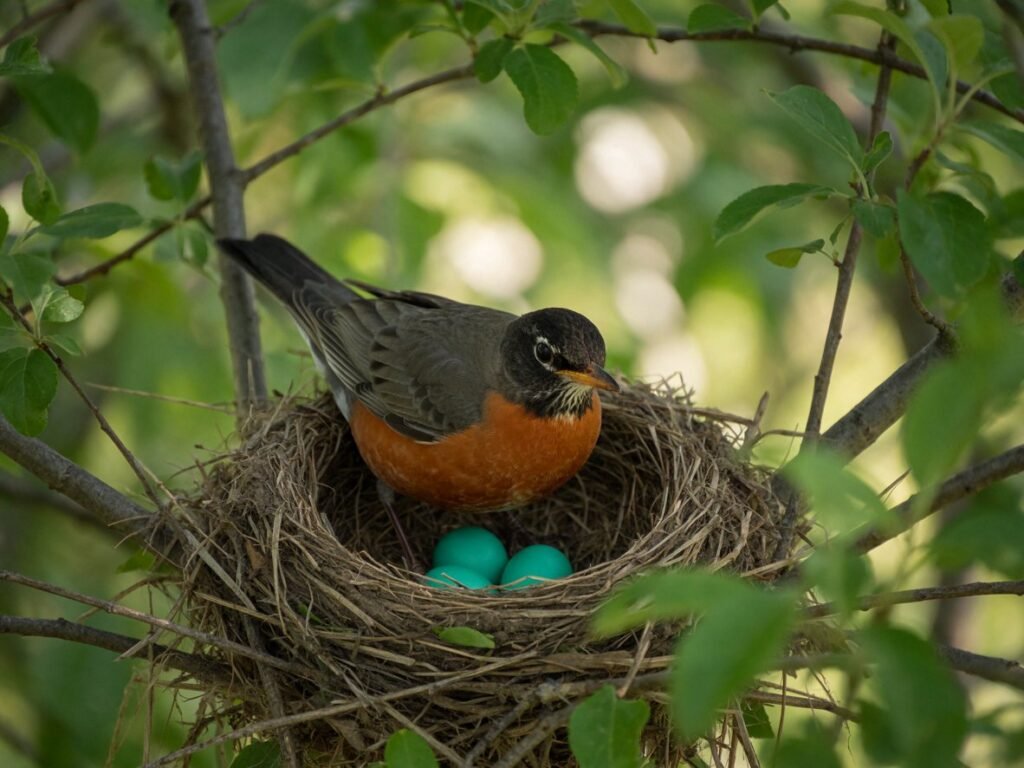
The American robin’s eggs are so distinctive that “robin’s-egg blue” has its own named color — but look closely and many of them lean visibly into green. The shells are an unspotted, vivid turquoise-green, deposited all at once as the egg moves through the female’s oviduct. No other common North American backyard bird produces eggs in quite this shade.
Robins typically lay three to five eggs per clutch and may raise two or three broods in a single season. The female incubates alone for 12 to 14 days while the male defends the territory. Nests are sturdy, bowl-shaped cups constructed from grass and mud, tucked into the fork of a tree branch, on a building ledge, or even on a porch light fixture. After hatching, chicks fledge in about two weeks.
If you find a smooth, unspotted egg roughly the size of a large grape in a neat mud-lined cup nest, it’s almost certainly a robin egg. The bright, clean turquoise-green color and absence of any spots or streaks is diagnostic. For a full side-by-side comparison with other common eggs, see our guide on blue jay eggs vs. robin eggs.
- Egg color: Bright turquoise-green, completely unmarked
- Size: About 2.8 cm (1.1 inches) long
- Clutch size: 3–5 eggs; 2–3 broods per year
- Incubation: 12–14 days, female only
- Nest type: Open cup of mud and grass in a tree, shrub, or on a ledge
2. European Starling (Sturnus vulgaris)
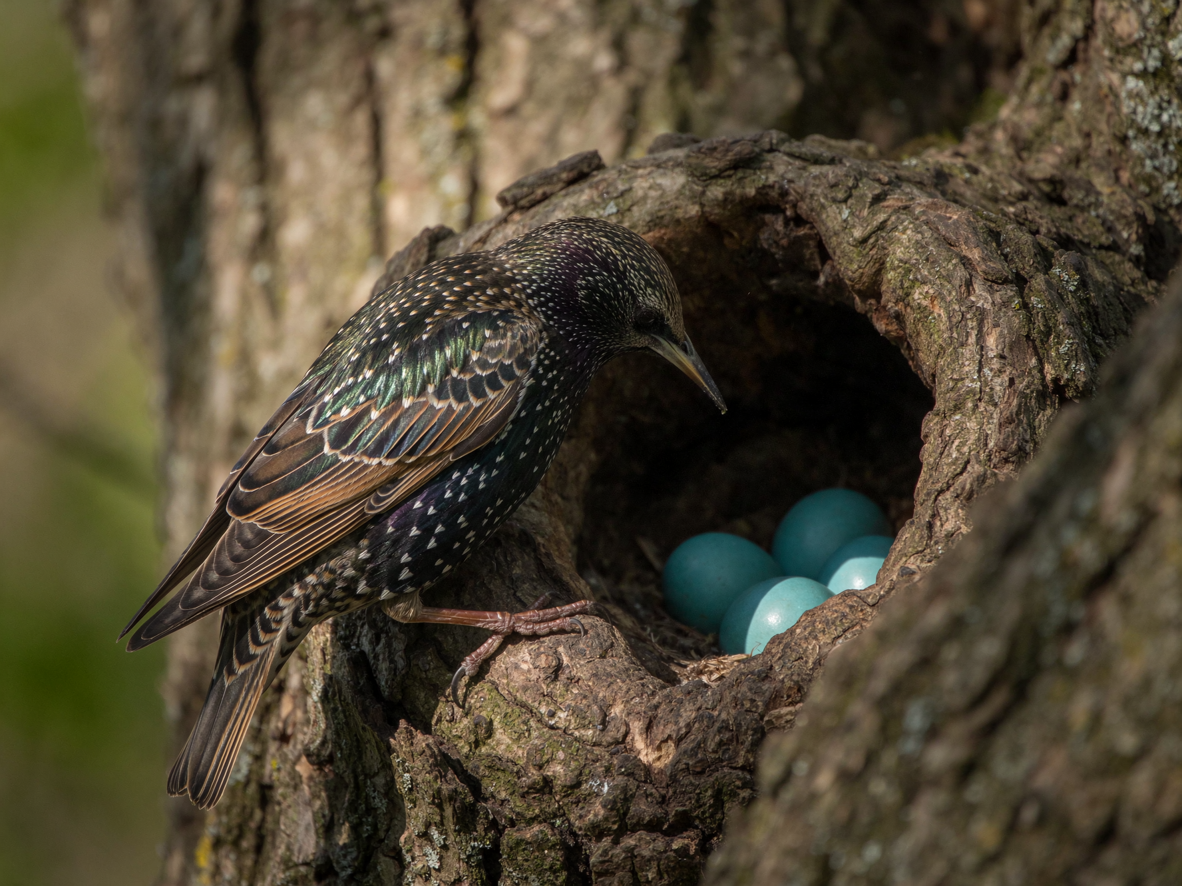
Starlings lay pale blue-green eggs with a smooth, slightly glossy surface and no markings at all. The color sits somewhere between sky blue and mint green and tends to fade slightly as incubation progresses. Up close, the eggs have a clean, almost polished appearance quite unlike the matte shells of many ground-nesting species.
A typical starling clutch holds four to six eggs, and pairs often raise two broods between April and July. Both parents share incubation duties over 12 to 13 days. Because starlings are cavity nesters, their eggs are hidden inside tree hollows, birdhouse openings, cracks in building walls, or any enclosed space they can squeeze into. The nest inside is a loose, often messy collection of dry grass, feathers, and debris.
European starlings are an invasive species in North America. They aggressively compete with native cavity-nesting birds — including bluebirds and woodpeckers — often evicting them from nest boxes and destroying their eggs. If you discover pale blue-green eggs inside a nest box you put up for native species, starlings are almost certainly the culprit. Learn more about how long it takes starling eggs to hatch if you’re monitoring nest activity.
- Egg color: Pale blue-green, glossy, completely unmarked
- Size: About 3.1 cm (1.2 inches) long
- Clutch size: 4–6 eggs; up to 2 broods per year
- Incubation: 12–13 days, shared by both parents
- Nest type: Cavity nest in tree holes, nest boxes, or building gaps
3. Green Heron (Butorides virescens)
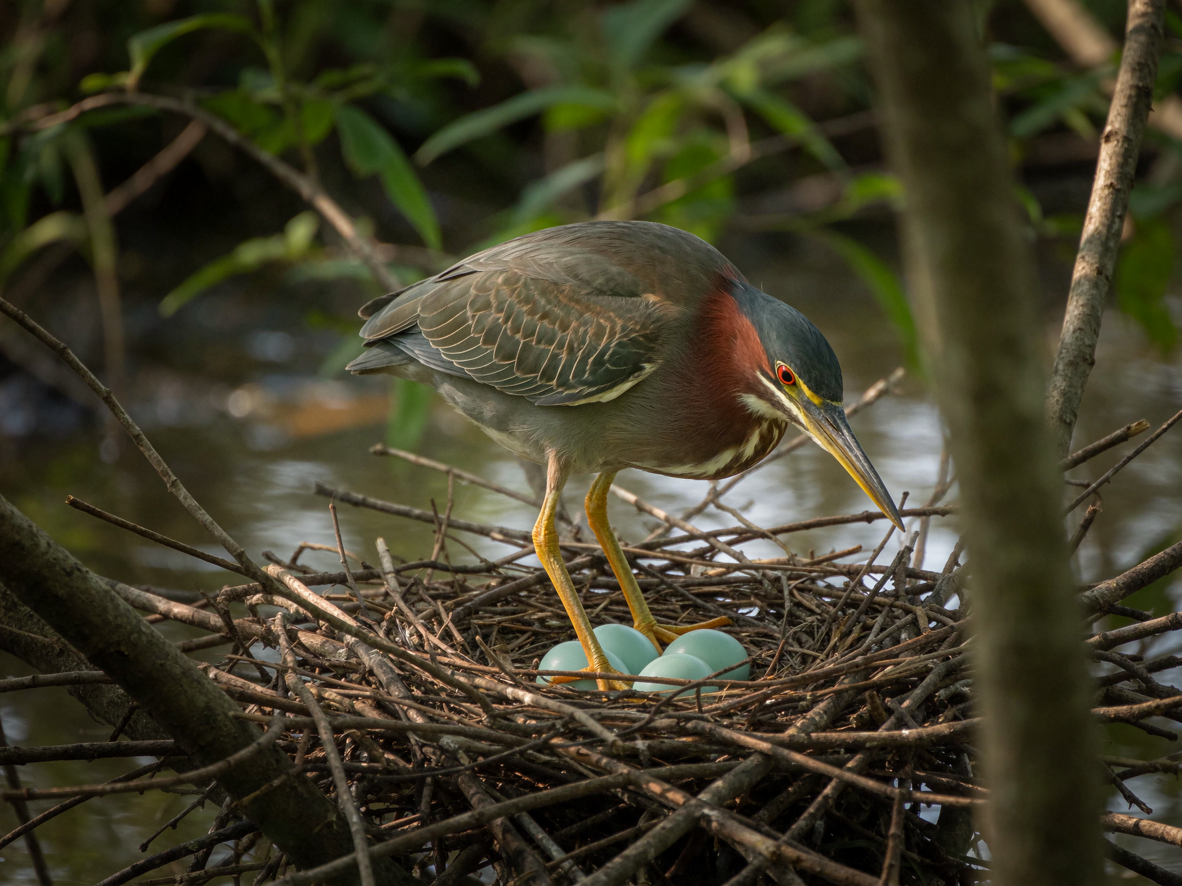
The green heron is a small, secretive wading bird found near ponds, streams, marshes, and wooded swamps across much of North and Central America. Its eggs are pale blue-green or greenish-gray, smooth, and completely unmarked — subtly colored compared to the robin’s vivid turquoise but unmistakably green when held in natural light.
Green herons build flat, loose platform nests from sticks, usually in a tree or dense shrub overhanging water. Clutch size is three to five eggs, and both parents share the incubation, which runs 19 to 21 days. Chicks are semi-altricial — they hatch with some down and can move around the nest after a week or two, but they depend on parents for food for several weeks longer.
Green herons are well known for their intelligence. They’re one of the few wild bird species documented using tools: individuals have been observed dropping small objects — a feather, a berry, a piece of bread — onto the water surface to lure fish close enough to strike.
Documented tool use in birds is rare enough that it draws significant scientific attention. Green herons have been recorded dropping fish food pellets, insects, earthworms, and even small twigs onto calm water to attract fish — then seizing the approaching prey with a rapid, stabbing strike. This behavior appears to be learned individually rather than instinctive, since not all green herons do it.
- Egg color: Pale blue-green or greenish-gray, smooth and unmarked
- Size: About 3.8 cm (1.5 inches) long
- Clutch size: 3–5 eggs; occasionally 2 broods per year
- Incubation: 19–21 days, shared by both parents
- Nest type: Loose stick platform in a tree or shrub above or near water
4. Mallard Duck (Anas platyrhynchos)
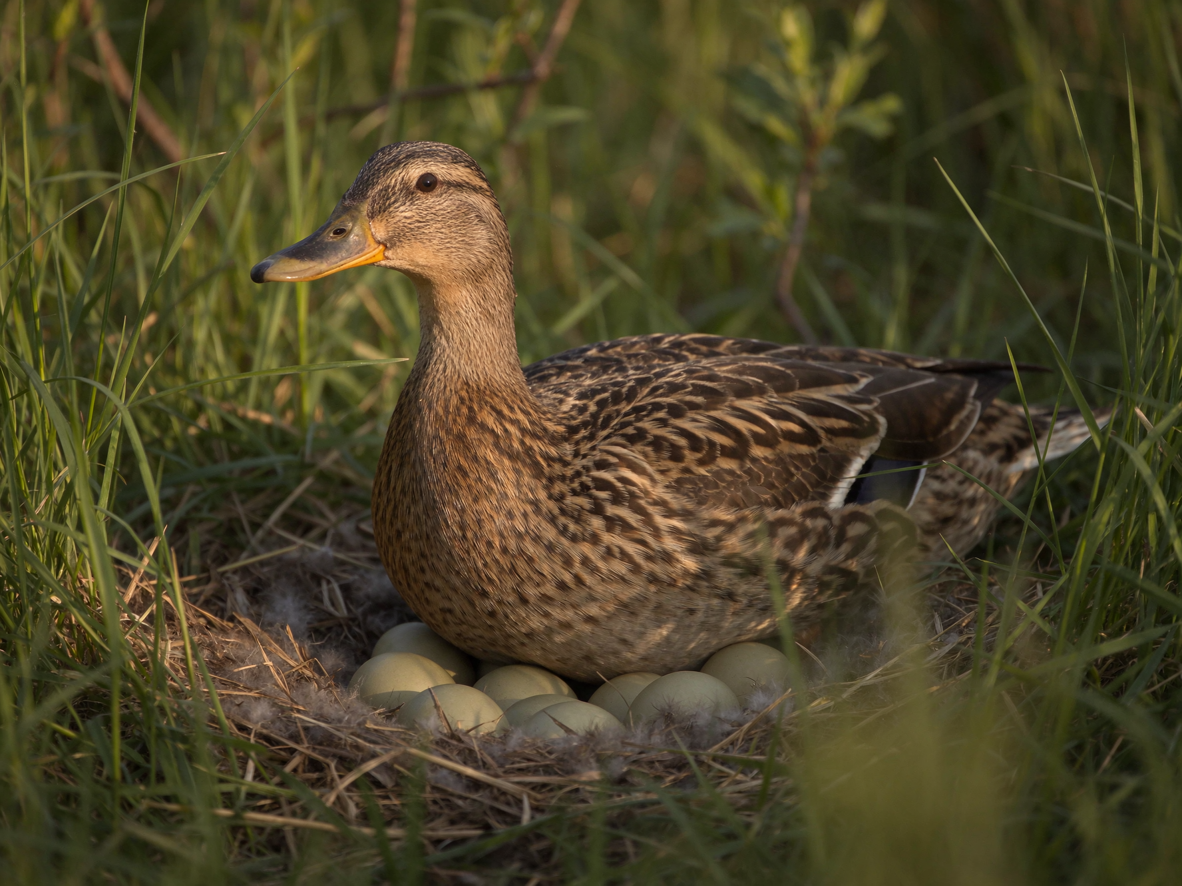
Mallard eggs range from plain off-white or buff to a soft, distinctly greenish shade that varies from bird to bird and even from clutch to clutch. The greenish ones are a muted olive-green or creamy pale green — not vivid like a robin’s egg, but noticeably colored when you find them in the field. Shells are smooth and completely unspotted.
Mallards are ground nesters. The female scrapes a shallow hollow in vegetation near water, lines it with plant material and her own breast down, and lays between 8 and 13 eggs over the course of roughly two weeks. She incubates alone for 26 to 28 days. When she leaves to feed, she pulls the down over the eggs to insulate them and hide them from predators. The male plays no role in incubation or chick-rearing.
Mallard chicks hatch precocial — covered in down, eyes open, and capable of walking and swimming within hours. The female leads them to water almost immediately after the last egg hatches. Mallards are among the most familiar ducks in the world and are the wild ancestor of most domestic duck breeds, which helps explain why domestic ducks sometimes also lay greenish eggs. For a broader look at duck behavior and survival, see our guide on whether ducks can drown and the adaptations that keep them safe in water.
- Egg color: Creamy olive-green to pale greenish-buff, unmarked
- Size: About 5.8 cm (2.3 inches) long
- Clutch size: 8–13 eggs; typically 1 brood per year (may re-nest if first clutch is lost)
- Incubation: 26–28 days, female only
- Nest type: Ground scrape lined with vegetation and breast down, hidden in tall grass or shrubs near water
Not every mallard lays green eggs — some females consistently produce plain buff or grayish-white eggs throughout their lives. If you find a large, smooth, unmarked egg on the ground in a down-lined nest near water, it’s likely a mallard regardless of the precise color. Never handle or disturb wild duck nests, as this can cause the female to abandon the clutch.
5. Emu (Dromaius novaehollandiae)
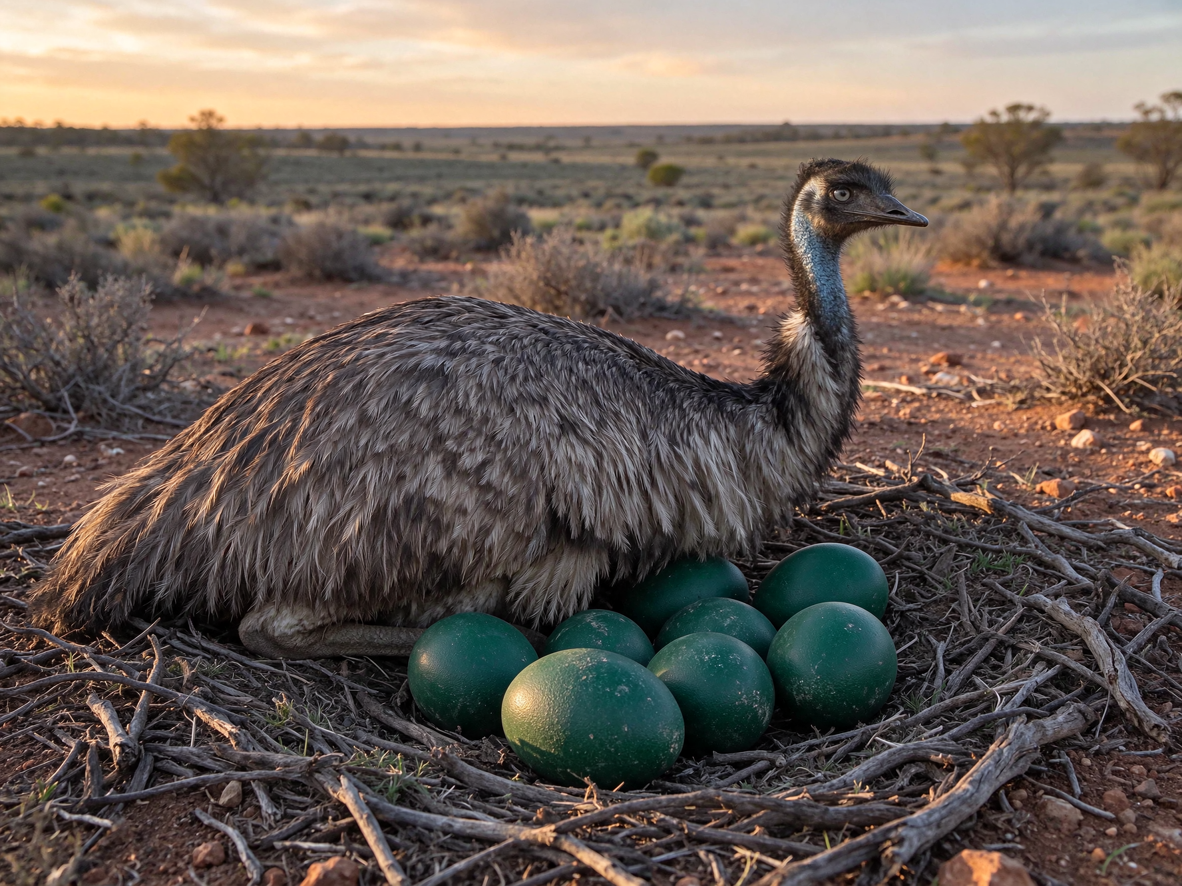
Emu eggs are unlike anything else on the list. They’re large — roughly the size of a small melon — with a deeply textured, granular surface that feels more like rough stone than a typical eggshell. Freshly laid eggs are a deep, rich forest green or dark emerald color. As incubation continues over eight weeks, the shell gradually darkens further, eventually turning nearly black by the time the chick is ready to hatch.
Emus are native to mainland Australia and are the second-largest living birds by height, behind only ostriches. The female lays between 5 and 15 eggs over several weeks, then — in a striking role reversal — leaves entirely. The male takes sole responsibility for incubation, sitting on the clutch for 56 days with barely any food or water. During this period, he may lose up to a third of his body weight. He also raises the striped chicks alone for up to 18 months after hatching.
A single emu egg weighs roughly 500 to 650 grams (about 1.1 to 1.4 pounds) and contains the equivalent of roughly 10 to 12 chicken eggs in volume. For anyone interested in the broader family of large, flightless birds and how they compare, our overview of the world’s largest flying birds gives useful context on the range of avian body sizes.
Freshly laid emu eggs are a vivid dark green. Over the 56-day incubation period, the green shell gradually deepens and dulls, turning from forest green to dark olive to near-black by hatch day. This progressive color change reflects oxidation and abrasion as the male turns the eggs daily throughout the long incubation. The granular surface texture also becomes slightly smoother as hatching approaches.
- Egg color: Deep forest green to dark emerald, darkening toward black during incubation
- Size: About 13 cm (5 inches) long; weighs 500–650 g (1.1–1.4 lbs)
- Clutch size: 5–15 eggs per season
- Incubation: 56 days, male only
- Nest type: Shallow ground scrape lined with bark, grass, and leaves; often in open scrubland or grassland
How to Identify a Green Bird Egg: 4 Questions to Ask
If you’ve come across an egg in the field or the garden and you’re not sure which species laid it, work through these four questions before drawing a conclusion:
- How large is it? Grape-sized (around 3 cm) suggests a robin or starling. Chicken-egg-sized (around 6 cm) points to a duck. Melon-sized (13 cm or more) is an emu or ostrich.
- Is it spotted or plain? The five species above all lay plain, unspotted green eggs. Spotted or heavily blotched green eggs belong to other species — common examples include the northern mockingbird (reddish-brown blotching) and the song thrush (dark spots on a blue-green shell).
- Where was it found? A cup nest of mud and grass in a tree suggests a robin. A cavity nest in a birdhouse or tree hollow suggests a starling. A loose stick platform over water is likely a heron. A ground nest lined with down near water points to a mallard. A large scrape in open ground in Australia is an emu.
- Is it legal to investigate? In the United States, almost all native wild bird nests, eggs, and chicks are protected under the Migratory Bird Treaty Act. Touching, moving, or collecting them without a federal permit is illegal. Observe from a distance and leave nests undisturbed.
Frequently Asked Questions
What bird lays small bright green eggs?
The American robin lays the most recognizable small bright green eggs. The eggs are an vivid, unspotted turquoise-green, roughly 2.8 cm (1.1 inches) long, and held in a neat cup nest of mud and grass. European starlings also lay small pale blue-green eggs, though the color is more muted and the nest is hidden inside a cavity.
What bird lays large green eggs?
Emus lay the largest green eggs of any bird species commonly encountered. The eggs are deep forest green, heavily textured, and around 13 cm (5 inches) long — roughly the volume of 10 chicken eggs. Cassowaries also lay large pale green eggs, though they’re found only in New Guinea and northeastern Australia.
Do mallard ducks always lay green eggs?
No. Mallard egg color varies considerably between individuals. Some females consistently lay plain buff or off-white eggs; others lay pale olive-green or creamy greenish shells. The color depends on how much biliverdin pigment the individual female produces during egg formation.
Are robin eggs blue or green?
American robin eggs are typically described as “robin’s-egg blue,” but many lean clearly into blue-green or bright turquoise-green, particularly in direct sunlight. The specific shade varies slightly between clutches and individuals. The eggs are always completely smooth and unmarked, whichever way the color reads.
Can you touch a green egg you find outside?
In the United States, it’s illegal to handle, move, or collect wild bird eggs under the Migratory Bird Treaty Act. The same protections apply in Canada and the United Kingdom. Leave any wild nest you find undisturbed. The best action is to observe from a respectful distance and avoid disturbing the area, particularly during active incubation.
Sources
- National Audubon Society: American Robin
- Cornell Lab of Ornithology (All About Birds): American Robin Life History
- Cornell Lab of Ornithology (All About Birds): Green Heron Life History
- Australian Government: Emu Species Profile and Conservation Notes
- American Museum of Natural History: Colorful Eggs and Their Dinosaur Origins