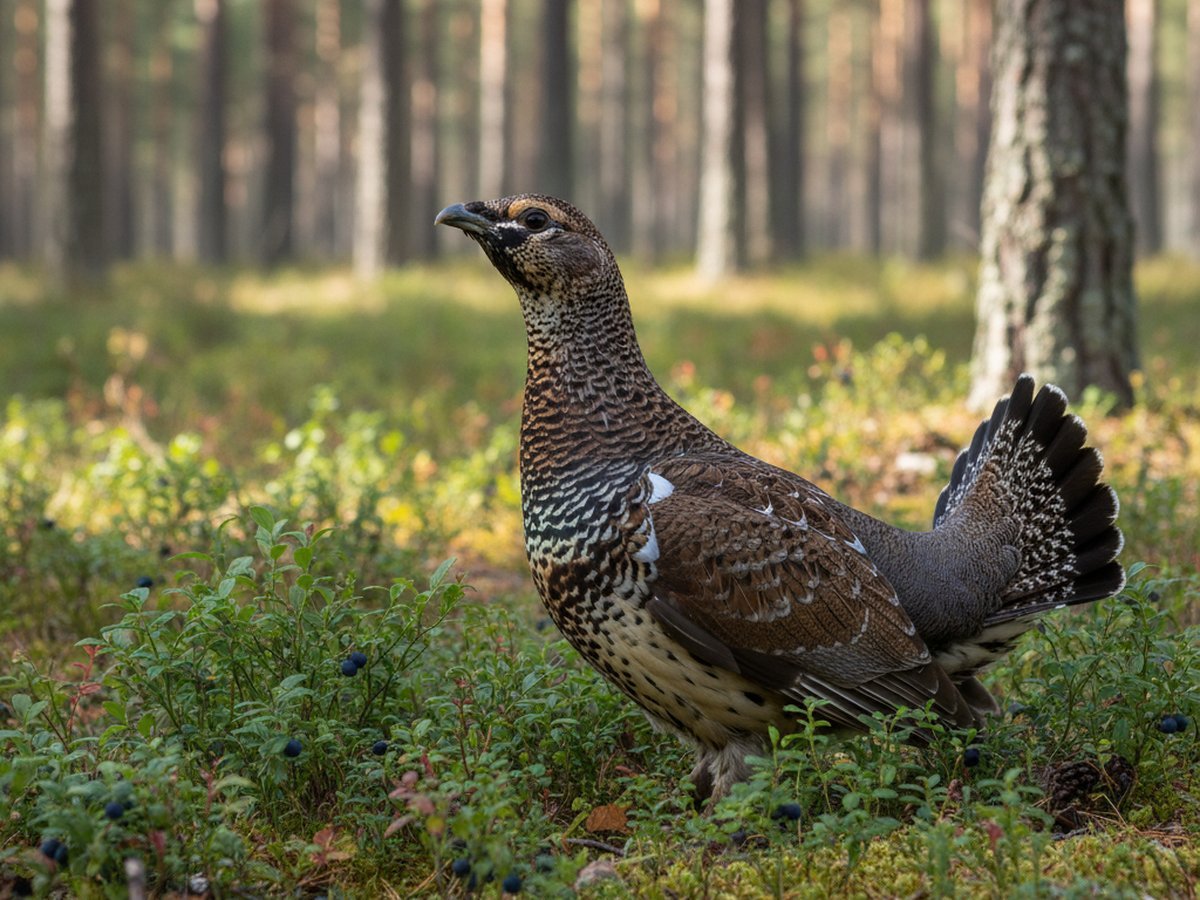
The western capercaillie (Tetrao urogallus) is the biggest grouse in the world. Males are dark and glossy, females are barred brown, and both sexes live on the forest floor across Europe and into Siberia. The male’s courtship display is among the best known of any European bird. Numbers are falling in parts of its range, especially Scotland and central Europe.
The Basics
- Males are 74 to 85 cm long and average 4.1 kg. Females are 54 to 64 cm and average 1.8 kg.
- The species lives across Europe and the Palearctic, from Scandinavia to Siberia.
- It needs mature conifer forest with an open canopy and thick ground cover.
- The IUCN rates it Least Concern worldwide, but numbers are falling in central Europe and Scotland.
What Is the Western Capercaillie?
The western capercaillie was formally described by the Swedish naturalist Carl Linnaeus in 1758, in the tenth edition of his Systema Naturae. It is one of two living species in the genus Tetrao. Its closest relative is the black-billed capercaillie, which breeds in the larch taiga forests of eastern Russia and parts of northern Mongolia and China.
The common name is a corruption of the Scottish Gaelic capall coille, meaning “horse of the woodland.” The bird is also known as the wood grouse, heather cock, and Eurasian capercaillie. Eight subspecies are recognized. The amount of white on the underparts of males increases from west to east, from almost entirely black in western and central Europe to nearly pure white in Siberia. Females vary much less between subspecies than males do.
The genus name is a Latin word that was once used for both the black grouse and the western capercaillie.
How to Identify a Western Capercaillie
Male and female western capercaillies look very different. The male is one of the most size-dimorphic living birds, and males are nearly twice the size of females. The RSPB describes the large black males as unmistakable in the field.
- Male: dark grey to dark brown body feathers, a dark metallic green breast, and a bright red patch of bare skin above each eye. German hunters call these red patches “roses.” Both sexes have a white spot on the wing bow.
- Female: brown upperparts with black and silver barring, and paler, buffish-yellow underparts. Her camouflage helps her stay hidden on the nest.
- Feet: the legs are feathered, especially in cold weather. The toes have comb-like horn tacks that spread the bird’s weight on snow, which gave the German family name Rauhfußhühner, meaning “rough-footed hens.”
- Tracks: the footprints in snow show the sex of the bird, because the male’s track is much larger than the female’s.
Young chicks look like the hen, with cryptic colouring and black crown feathers. They gradually moult toward adult plumage at about three months old, in late summer. If you are new to comparing plumage across sexes and ages, our Kentish Plover guide shows one way to organize identification, habitat, and breeding details in a single article.
Where Western Capercaillies Live
The western capercaillie is non-migratory and sedentary. It breeds across northern Europe and the Palearctic, and its populations are large in Norway, Sweden, Finland, Russia, and Romania. In Central Finland it appears on the regional coat of arms.
Populations in western and central Europe are much more fragmented. In Germany the species is on the Red List as threatened with extinction, and it is no longer found in the lower mountains of Bavaria. In Switzerland it lives in the Alps and the Jura. In France the largest population is in the Pyrenees, while small groups survive in the Jura and the Vosges. The French Alps no longer hold the species, though it is present in the Austrian and Italian Alps.
In the British Isles, the species was common in Ireland until the 17th century, and it disappeared from Ireland in the 18th century. The native Scottish population became extinct between 1770 and 1785, and the birds in Scotland today descend from an introduced population of the nominate subspecies. RSPB reports that UK capercaillies breed in Scottish native pinewood and in commercial conifer plantations.

Habitat Needs of the Western Capercaillie
Western capercaillies are adapted to old coniferous forests with a rich interior structure and dense ground vegetation made of Vaccinium species, under a light canopy. They rarely use any other forest type. The best habitat is old, mixed forest with spruce, pine, fir, and some beech, where the ground is covered in blueberry-type shrubs.
Dense young forests are avoided, because they provide neither cover nor food, and they make flight difficult for such a heavy bird. Abundance depends on habitat quality. It is highest in sun-flooded, open, old mixed forests with spruce, pine, fir, and some beech, where the ground is rich in Vaccinium shrubs. Even so, the species never had particularly high densities. Spring territories are about 25 hectares (62 acres) per bird on average. Adult males are strongly territorial and hold 50 to 60 hectares (120 to 150 acres) of good habitat, while hens use about 40 hectares (100 acres). Their annual range can extend over several square kilometres when storms and heavy snow force them to winter at lower altitudes.
Scottish native pinewood is a rare and vulnerable habitat, and the RSPB describes it as such. Because the capercaillie depends on this woodland, protecting the pinewood is central to the bird’s future in Scotland.
The most serious threat to the species is habitat degradation, especially the conversion of diverse native forest into single-species timber plantations.
Behavior and Movement
The western capercaillie is primarily a ground-living bird, although it spends time in trees. It is diurnal, which means it is active only during daylight hours. At night it roosts in old trees with horizontal branches. These sleeping trees can be found by the droppings that collect beneath them, and birds often use the same tree for several nights in a row.
Ground-living birds are easy to miss in cover. Our redthroat guide covers another ground-foraging species, from Australia, and shows how to tell one from its look-alikes.
The bird is not an elegant flier. Its body is heavy and its wings are short and rounded. It produces a sudden, thundering noise when it takes off, which can deter predators. In flight it alternates short glides with beats of its wings, and its feathers produce a whistling sound. In winter, hens rarely come down to the ground, and many of the tracks in the snow belong to males. Both sexes may form loose foraging groups over the winter.
What Western Capercaillies Eat
The western capercaillie is a highly specialized herbivore. Its diet includes buds, leaves, berries, insects, grasses, and, in winter, mostly conifer needles. Droppings show what the birds have eaten: when blueberries ripen, they dominate the diet and the droppings become soft and bluish black. The main food is Vaccinium species, especially bilberry. The RSPB notes that capercaillies also feed on shoots and buds, sometimes taken directly from trees. Chicks depend on small insects in their first weeks, so the forest must hold both food plants for adults and insects for the young.
- Bilberry and other Vaccinium plants: the staple food of adults.
- Shoots and buds: often taken from trees, especially in winter.
- Small insects: a key food for growing chicks.
The Courtship Display
The breeding season begins between March and April, depending on spring weather, vegetation growth, and altitude. It lasts until May or June. About three-quarters of this long season is territorial competition between males on the same courting ground.
The display begins at dawn, when a male takes up a position on a thick branch of a lookout tree. He raises and fans his tail, holds his neck upright and his beak pointed toward the sky, and drops his wings. His song is a series of double clicks, like a ping-pong ball bouncing, that speeds up into a popping sound like a champagne cork, followed by scraping sounds.
Later in the season, hens gather at the courting grounds, which are called leks, a Swedish word meaning “play.” Males then display on the ground. The hens crouch and make a begging sound when they are ready to mate. When several males share a lek, the dominant male usually does most of the mating.
Breeding and Nesting
Hens are ground breeders, and the nest is on the forest floor. The hen starts laying about three days after mating and completes the clutch in about 10 days. The average clutch is eight eggs, but it can reach 12, and it is occasionally only four or five. The eggs are about the same size and shape as chicken eggs, but they are more heavily speckled with brown spots.
Brooding lasts about 26 to 28 days, depending on weather and altitude. Chicks are precocial, which means they are covered in down at hatching and can leave the nest soon after. They cannot yet control their body temperature, so they rely on the hen for warmth. Hens with young chicks spend the night with them in dense cover on the ground.
Chicks grow quickly. They find their own food, mainly insects such as butterfly caterpillars, ants, and ground beetles. They make their first short flights at three to four weeks old and begin sleeping in trees on warm nights. By about six weeks they can maintain their own body temperature, and at about three months they moult into subadult plumage, when the sexes can be told apart. From early September, families begin to break up. The young cocks disperse first, followed by the young hens.
Disturbance is a serious risk during breeding. The RSPB describes the species as highly sensitive to disturbance, which is one reason why the advice is not to go looking for capercaillies.
Predators
Mammals that prey on capercaillies include the Eurasian lynx and the grey wolf, although these larger predators prefer larger prey. Pine martens, beech martens, brown bears, wild boars, and red foxes mostly take eggs and chicks, but they can attack adults when they catch them off guard. In Sweden the golden eagle is the main predator of the western capercaillie. Goshawks take large numbers of the birds, usually young ones, and eagle-owls occasionally take birds of any age.
Conservation Status
Globally, the species is listed as Least Concern by the IUCN. Its estimated range is between 1,000,000 and 10,000,000 square kilometres, and its population in Europe alone is estimated at 1.5 to 2 million individuals. The IUCN threshold for a threatened listing is a decline of more than 30 percent over ten years or three generations, and the overall species does not reach that threshold. Some populations, however, are in serious trouble.
In central Europe, populations are declining and fragmented, and some may have disappeared. Germany lists the species as threatened on its Red List. In Scotland, the population has declined greatly since the 1960s because of deer fencing, predation, and loss of suitable habitat, and the birds survive mainly in the Caledonian Pine Forest. In 2015 the species was named the bird most likely to become extinct in the UK. The RSPB reports that the UK population has fallen so rapidly that it is again at real risk of extinction, and it is listed as a Red List species.
Other pressures are local. A Spanish researcher reported in the 1960s that the northwestern Spanish subspecies, a remnant of the Ice Age, was threatened by the commercial gathering of holly branches for Christmas decorations. A 2022 study by the NatureScot scientific advisory committee recommended renewed intensive measures, especially steps to help eggs and chicks survive. Mowing heather to allow blaeberry to grow is one measure that has been used.
Wikipedia reports that the Scottish population fell from about 10,000 pairs in the 1960s to 532 birds in the wild by 2025. The main threats include conversion of diverse forest into plantations, collisions with deer fences, and collisions with poorly marked ski-lift cables in mountain areas. Predators such as crows, foxes, and pine martens are also blamed for losses, and increased human recreation can injure adult birds. Ski-lift cables can be made safer with proper colouring, sighting, and height adjustments.
How to Watch Western Capercaillies Responsibly
The RSPB advises people not to go looking for capercaillies. The species is rare in the UK, declining, and highly sensitive to disturbance. That advice matters most in Scotland and in other places where the population is small.
If you visit forests where capercaillies live, keep these habits in mind:
- Stay on marked paths, and do not enter areas the land manager has closed.
- Avoid courting grounds at dawn, when males are displaying.
- Keep your distance if you see a bird, and leave quickly if it becomes alarmed.
- Do not play recorded calls to attract a bird.
Frequently Asked Questions
Is the western capercaillie endangered?
Globally, the IUCN lists it as Least Concern. Some populations, especially in Scotland and central Europe, are declining or at serious risk.
Why is it called a capercaillie?
The name comes from the Scottish Gaelic capall coille, meaning “horse of the woodland.”
Can you see western capercaillies in the UK?
The species breeds in Scottish native pinewood and in commercial conifer plantations. The RSPB advises against going looking for capercaillies because they are rare and highly sensitive to disturbance.
What do western capercaillies eat?
Adults eat mainly bilberry and other Vaccinium plants, and they also take shoots and buds. Chicks depend on small insects.
Are western capercaillies the same as black grouse?
No. They are different species, although the two occasionally hybridise. The hybrids are known by the German name Rackelhahn.