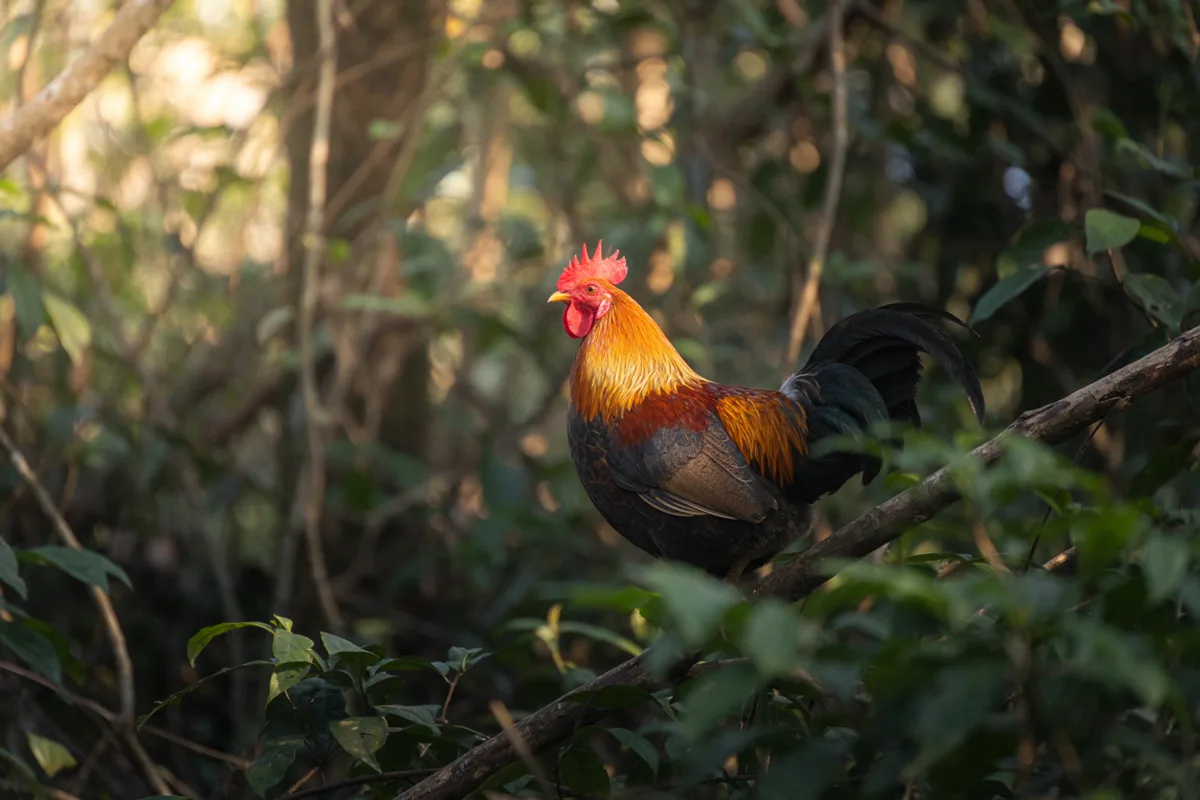
The red junglefowl (Gallus gallus) is the wild ancestor of the domestic chicken and one of the most significant birds in human history. It lives in the dense forests and bamboo thickets of South and Southeast Asia, and was first domesticated about 8,000 years ago. Today, billions of domestic chickens trace their ancestry back to this one wild species. Here is everything you need to know about how to identify it, where it lives, what it eats, and what makes it fascinating.
Red Junglefowl at a Glance
| Trait | Detail |
|---|---|
| Scientific Name | Gallus gallus |
| Family | Phasianidae (pheasants and partridges) |
| Length | 65 to 70 cm (26 to 28 in) including tail |
| Weight (male) | 0.9 to 1.5 kg (2.0 to 3.3 lb) |
| Weight (female) | 0.7 to 1.1 kg (1.5 to 2.4 lb) |
| Lifespan (wild) | 3 to 5 years |
| Conservation Status | Least Concern (IUCN) |
How to Identify the Red Junglefowl
The red junglefowl shows strong differences between the sexes. Males and females look so different that a first-time observer might mistake them for two separate species.
Male
The male is a striking bird. He has brilliant golden-orange hackle feathers flowing down his neck and back, dark maroon body feathers, and a long tail with glossy green-black iridescent plumes. His comb and wattles are bright red, and he has a distinctive white patch near his ear. His legs are slate-grey, which is an important field mark that separates pure wild birds from most feral domestic chickens. During the post-breeding season from June to October, males shed their long tail feathers and go through an eclipse molt, turning temporarily duller and shorter.
Female
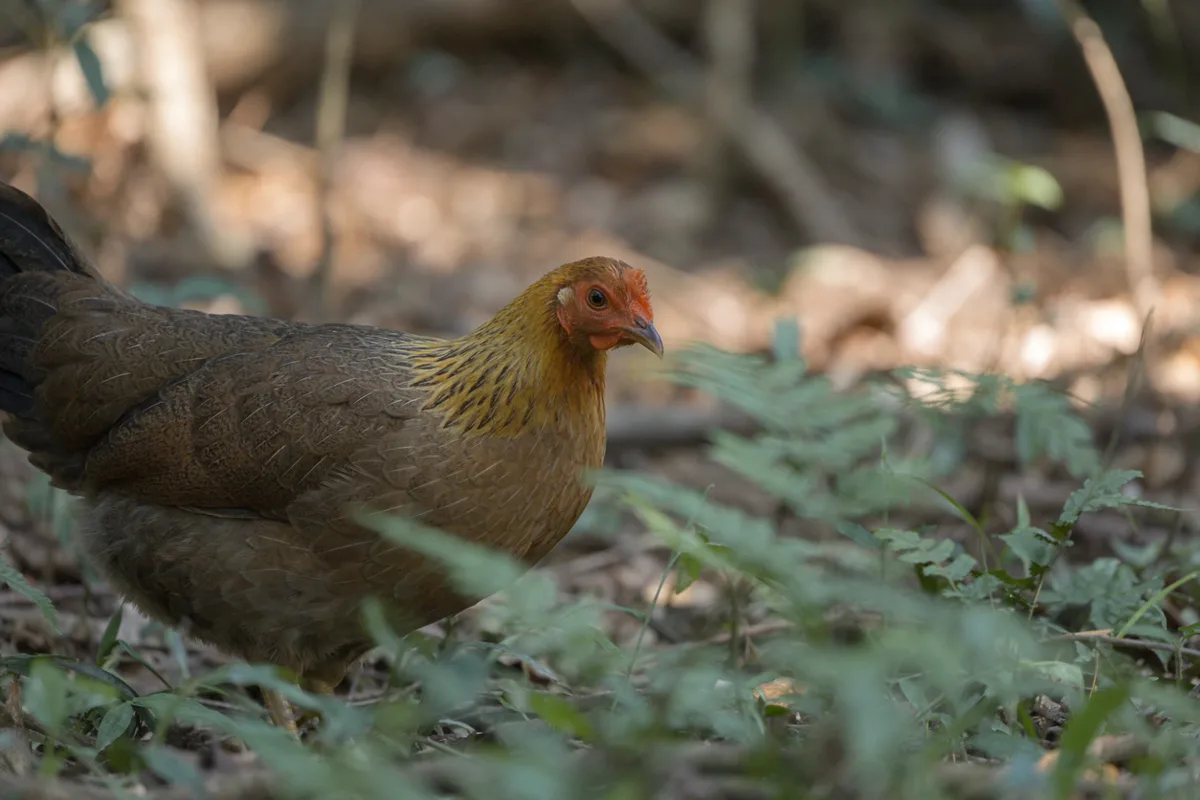
The female is much more subdued. Her plumage is mottled brown, black, and buff, giving her excellent camouflage on the forest floor while nesting. Her comb and wattles are small and pale compared to the male’s. She is leaner and lighter than a typical domestic hen.
Chick
Chicks hatch covered in fluffy downy feathers, speckled brown and buff. They are precocial, meaning they can walk and follow their mother within hours of hatching. A pale cheek patch on each side of the head is a useful identification mark in young birds.
The white ear patch seen on pure wild male red junglefowl is a key identification mark. Feral domestic chickens and hybrids usually lack this feature, making it one of the most reliable ways to identify truly wild birds in the field.
Red Junglefowl vs. Domestic Chicken
Many birders see what looks like a red junglefowl, but it may be a feral domestic chicken or a hybrid. Here is how to tell them apart.
| Feature | Red Junglefowl (wild) | Domestic Chicken |
|---|---|---|
| Body build | Lean, streamlined, horizontal posture | Bulkier, varies by breed |
| Leg color | Slate-grey or grey-brown | Yellow or orange (most breeds) |
| Ear patch | Distinct white patch | Usually absent or reduced |
| Tail feathers | Long, arching, metallic green-black | Shorter, varies by breed |
| Flight ability | Strong, capable flier | Poor, rarely flies |
| Comb in winter | Shrinks and pales (eclipse) | Stays prominent year-round |
| Egg laying | Seasonal, 6 to 12 eggs per year | Year-round, 200 to 300+ eggs |
| Temperament | Alert, skittish, flees from humans | Generally docile |
Habitat and Range
Red junglefowl are native to a wide area of South and Southeast Asia. Their natural range covers northern India, Nepal, Myanmar, Thailand, Vietnam, Laos, Cambodia, Malaysia, southern China, Indonesia, and the Philippines. Feral populations introduced by humans also live on Pacific islands such as Hawaii and on several Caribbean islands.
Within their range, red junglefowl prefer dense tropical forests, bamboo thickets, secondary growth forest, and scrubland. They also move through forest edges near agricultural land, rubber and tea estates, and palm oil plantations where ground vegetation is thick. At night they roost up in trees or dense bamboo clumps to avoid ground predators. According to the Cornell Lab of Ornithology’s All About Birds, red junglefowl in Hawaii tend to live in forested habitats away from areas dominated by feral domestic chicken hybrids.
Diet and Foraging Behavior
Red junglefowl are omnivores. They spend most of the day on the ground, scratching through leaf litter with their feet and sweeping their bills side to side to find food. Their diet changes with the season and what is available locally.
They eat seeds, fallen fruit, berries, tender shoots, insects such as ants, termites, beetles, and grasshoppers, spiders, worms, snails, and occasionally small lizards or frogs. Females actively seek calcium-rich food such as snails and tiny bones during the egg-laying season to support eggshell production.
To spot red junglefowl feeding, look and listen for the scratching sound in dry leaf litter under dense vegetation near forest edges. They tend to forage in the early morning and late afternoon, retreating to shade during the hottest part of the day.
Breeding and Nesting
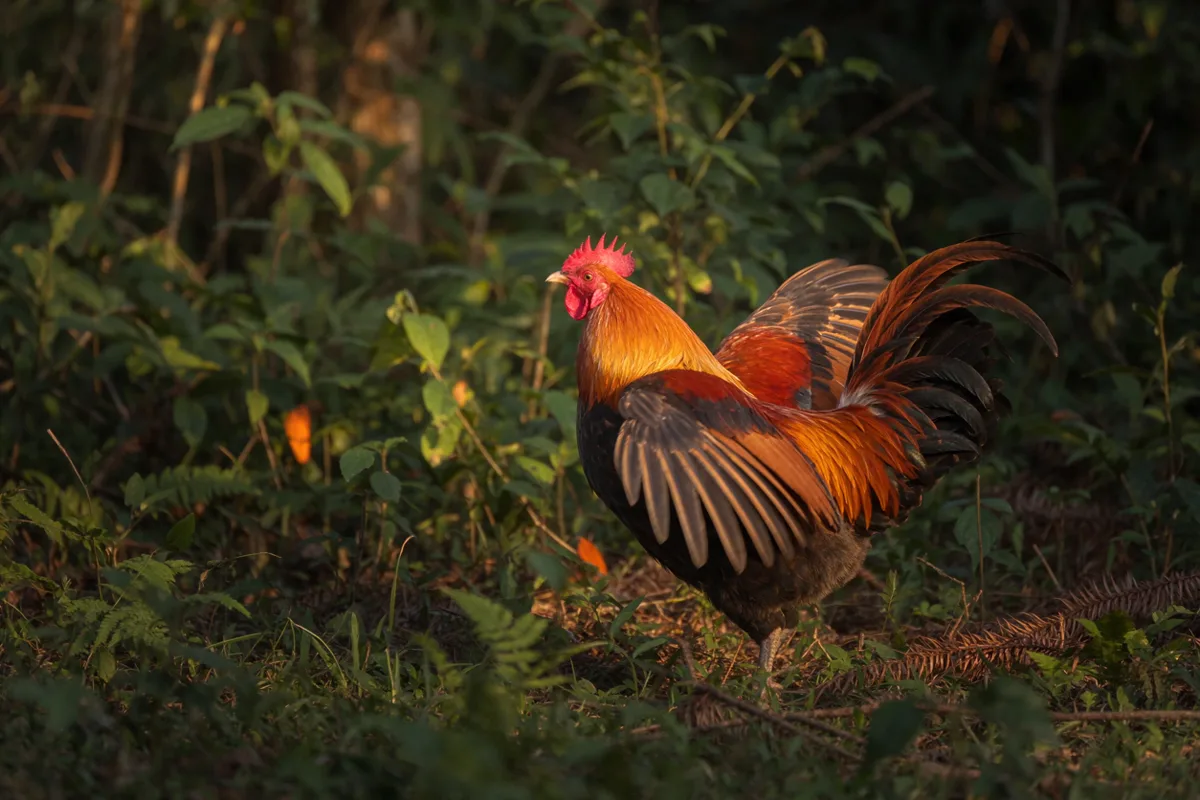
The main breeding season runs from March to May in most of their range, though timing varies by location. Males display by fanning their tails, puffing their chest feathers, circling the female, and picking up and dropping food items in a behavior called tidbitting. The crow of the male red junglefowl, a sharp “cock-a-doo-doo” similar to a domestic rooster but shorter and faster, is used to defend territory and attract females.
The nest is a shallow scrape on the ground, hidden carefully under dense bushes, grass clumps, or bamboo roots and lined with dry leaves and grass. The female lays 5 to 8 pale cream or buff-colored eggs and incubates them alone for about 21 days. The chicks are precocial and can walk and forage with their mother within a few hours of hatching. The male plays no role in incubation or chick-rearing.
Calls and Voice
The male’s crow is similar to a domestic rooster’s call but higher-pitched, sharper, and shorter. It is typically written as “cock-a-doo-doo” and used mainly at dawn to defend territory. Females make soft clucking sounds when calling chicks and low alarm calls when predators approach. Both sexes produce a sharp, loud alarm call when startled that sends the whole group running or flying into cover.
Conservation Status
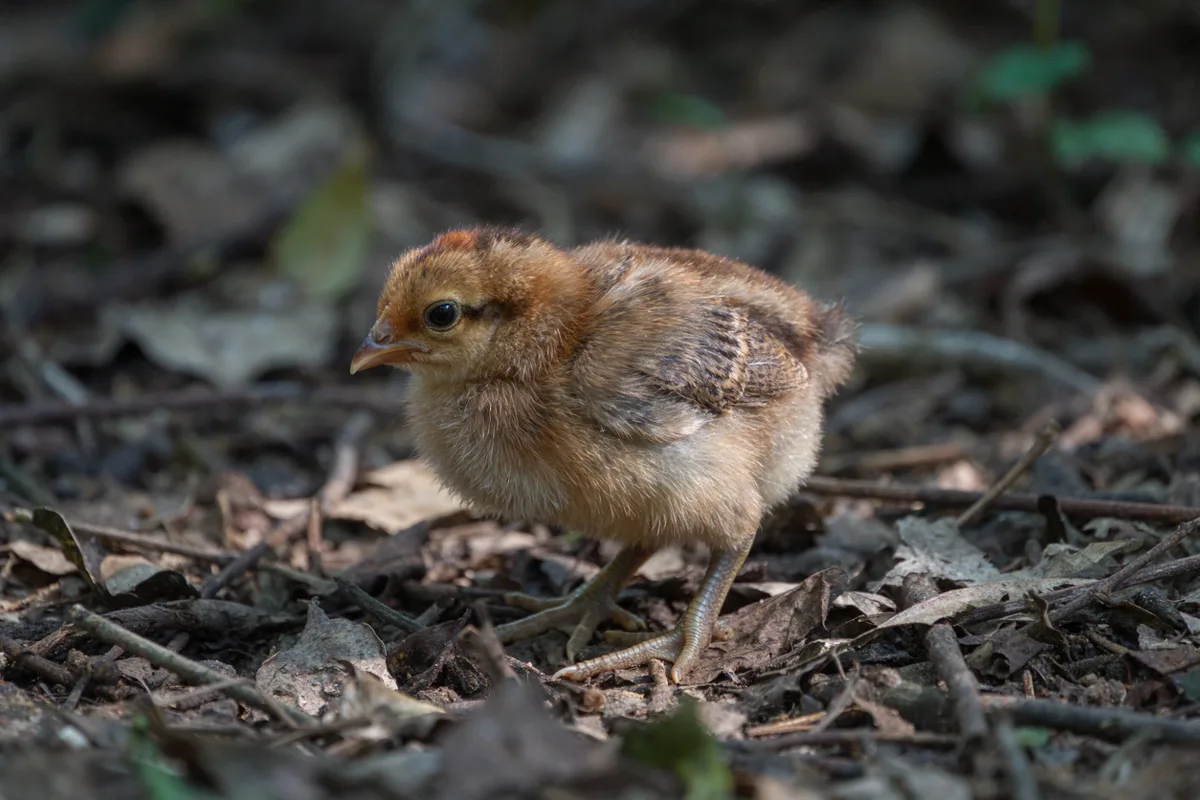
The IUCN Red List classifies the red junglefowl as Least Concern globally. Its large range and adaptability mean overall numbers are stable. However, pure wild populations face a serious long-term threat: hybridization with free-ranging domestic and feral chickens near villages and farmland.
Field studies have found that many wild-caught red junglefowl carry significant domestic chicken DNA. Some individuals show up to 20 to 50 percent chicken genome integration. This genetic pollution is slowly eroding the genetic integrity of the original wild species in parts of Southeast Asia. Conservation efforts in protected reserves focus on maintaining genetically pure populations away from domestic flocks.
Genetic pollution from domestic and feral chickens is a growing concern. Protecting forest reserves and limiting free-ranging domestic chickens in buffer zones around national parks is essential for preserving pure red junglefowl populations.
Where to See Red Junglefowl
Red junglefowl can be seen in protected national parks and forest reserves across South and Southeast Asia. Good locations include Khao Yai National Park in Thailand, Chitwan National Park in Nepal, and Manas National Park in India. They are easiest to find along forest trails early in the morning before the heat of the day drives them into the shade.
If you enjoy finding tropical forest birds like this one, our guide to birds in Southeast Asia covers many species you can find in the same forest habitats. You may also enjoy our profile on common birds in Thailand, where red junglefowl are a familiar sight in forested national parks.
Frequently Asked Questions
Is the red junglefowl the ancestor of the chicken?
Yes. The red junglefowl is the primary wild ancestor of the domestic chicken. Genetic and archaeological evidence shows it was first domesticated roughly 7,000 to 10,000 years ago, most likely in South or Southeast Asia. Modern chickens also carry small amounts of DNA from other wild junglefowl species through historical hybridization.
How do you tell a wild red junglefowl from a feral chicken?
Look for grey legs, a white ear patch, a lean horizontal build, and a shorter, faster crow. Feral domestic chickens usually have yellow or orange legs and lack the distinctive white ear patch. Wild birds are also much more alert and difficult to approach.
What does the red junglefowl eat?
It eats seeds, fruit, insects, worms, snails, and occasionally small lizards or frogs. It forages by scratching through leaf litter on the forest floor, like a domestic chicken scratching in a yard.
Does the red junglefowl migrate?
No. Red junglefowl are resident birds and do not migrate. They make short local movements within their territory depending on food availability, but they do not undertake long-distance seasonal migrations.
Are red junglefowl endangered?
Not globally. The IUCN lists the red junglefowl as Least Concern. However, pure wild populations are increasingly threatened by hybridization with domestic and feral chickens in parts of their range, which is an ongoing conservation concern.